Resonant Interlayer Coupling in NbSe2‐Graphite Epitaxial Moiré Superlattices
Shu Mo, Ksenija Kovalenka, Sebastian Buchberger, Bruno K. Saika, Anugrah Azhar, Akhil Rajan, Andela Zivanovic, Yu‐Chi Yao, Rodion V. Belosludov, Matthew D. Watson, M Saeed Bahramy, Phil D.C. King

TL;DR
This paper shows how moiré superlattices formed by stacking niobium diselenide and graphite can influence electronic properties and collective states in 2D materials.
Contribution
The study reveals moiré replica formation and interlayer coupling in epitaxial NbSe2-graphite heterostructures using experimental and theoretical methods.
Findings
Moiré replicas of graphite π states form interlocking Dirac cones intersecting NbSe2's Fermi surface.
The coupling explains the lack of CDW enhancement in NbSe2 on graphene compared to insulating substrates.
Moiré engineering is proposed as a route to control collective states in 2D materials.
Abstract
Moiré heterostructures, created by stacking 2D materials together with a finite lattice mismatch or rotational twist, represent a new frontier of designer quantum materials. Typically, however, this requires the painstaking manual assembly of heterostructures formed from exfoliated materials. Here, clear spectroscopic signatures of moiré lattice formation in epitaxial heterostructures of monolayer (ML) NbSe2 grown on graphite substrates are observed. Angle‐resolved photoemission measurements and theoretical calculations of the resulting electronic structure reveal moiré replicas of the graphite π states forming pairs of interlocking Dirac cones. Interestingly, these intersect the NbSe2 Fermi surface at the k‐space locations where NbSe2's charge‐density wave (CDW) gap is maximal in the bulk. This provides a natural route to understand the lack of CDW enhancement for ML‐NbSe2/graphene as…
Genes, proteins, chemicals, diseases, species, mutations and cell lines named across the full text — each resolved to its canonical identifier and authoritative record.
Click any figure to enlarge with its caption.
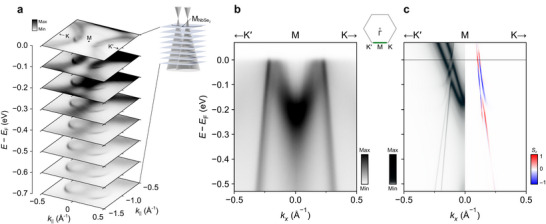 Figure 1
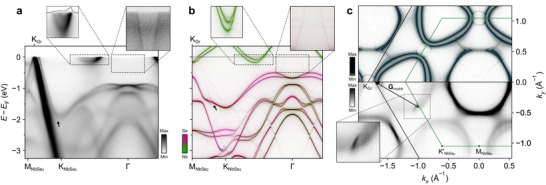 Figure 2
 Figure 3
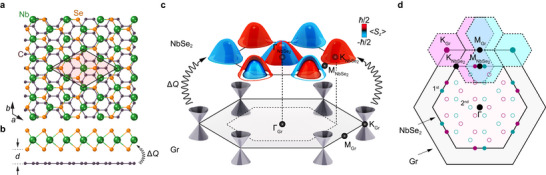 Figure 4
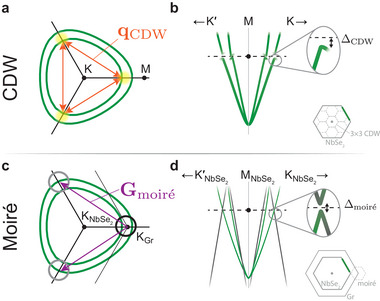 Figure 5
Peer Reviews
No public reviews on file for this paper yet. If you reviewed it on a platform where reviews are public (OpenReview, ICLR, NeurIPS, ICML), you can paste yours below so the community can read it here.
Videos
No videos yet. Explain this paper in a talk, walkthrough, or lecture? Add one.
Taxonomy
Topics2D Materials and Applications · Topological Materials and Phenomena · Graphene research and applications