Circularly Polarized Polariton Lasing from Spin‐Momentum Locking in Deformed Plasmonic Kagome Cavities
Zhaoyun Zheng, Chuchuan Hong, Siamak Khorasani, Shreya K. Patel, Marc R. Bourgeois, David J. Masiello, Teri W. Odom

TL;DR
This paper presents a method to achieve polariton lasing with high circular polarization using deformed plasmonic Kagome cavities at room temperature.
Contribution
The study introduces spin-momentum locking in deformed Kagome lattices to enable controlled circular polarization in polariton lasing.
Findings
Deformed Kagome lattices produce circularly polarized lattice resonances with high polarization degrees.
Six lasing beams from T points show alternating handedness and low lasing thresholds.
The technique opens new avenues for optical analogues of spin and valley physics.
Abstract
This paper describes room‐temperature polariton lasing with high circular polarization from plasmonic Kagome lattice cavities strongly coupled to colloidal semiconducting quantum wells. By shrinking and expanding the trimer unit cells in Al nanoparticle lattices, the inversion symmetry is broken, resulting in the spin‐momentum locking of cavity photons. Circularly polarized lattice resonances emerged from crossings of different diffraction orders, denoted as T points, along the Γ‐K direction in momentum space and whose degree of circular polarization is higher than those of high‐symmetry K‐points. Deformed Kagome lattice cavities combined with CdSe nanoplatelets enabled the formation of exciton‐polaritons. Spin‐selectivity from cavity modes resulted in control over the handedness of circular polarization as well as direction of photoluminescence from lower polaritons. Six lasing beams…
Genes, proteins, chemicals, diseases, species, mutations and cell lines named across the full text — each resolved to its canonical identifier and authoritative record.
Click any figure to enlarge with its caption.
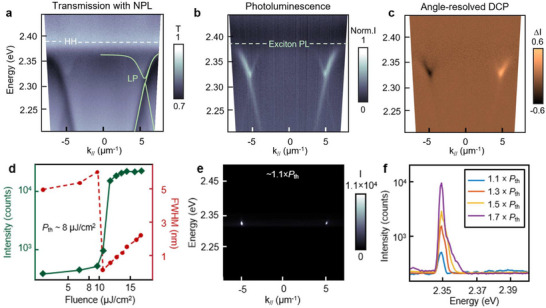 Figure 1
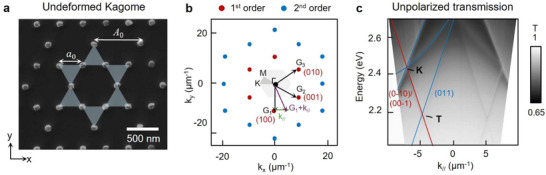 Figure 2
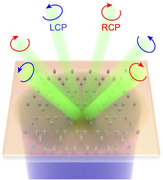 Figure 3
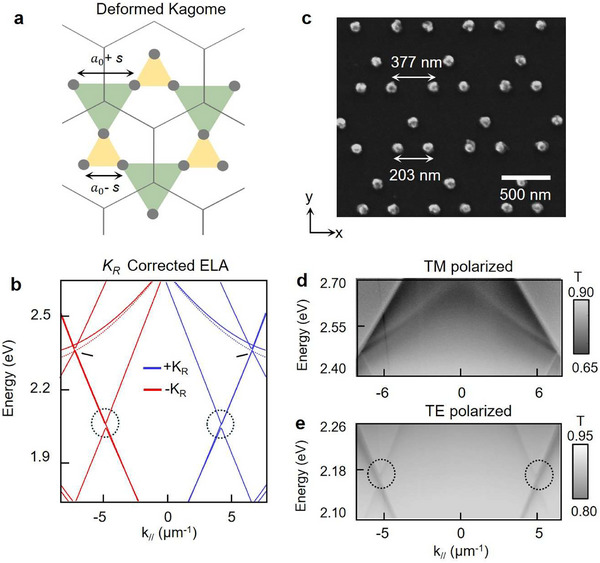 Figure 4
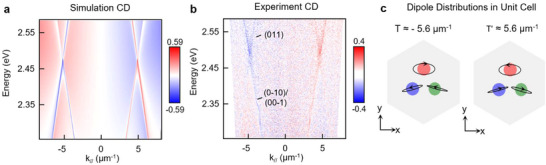 Figure 5
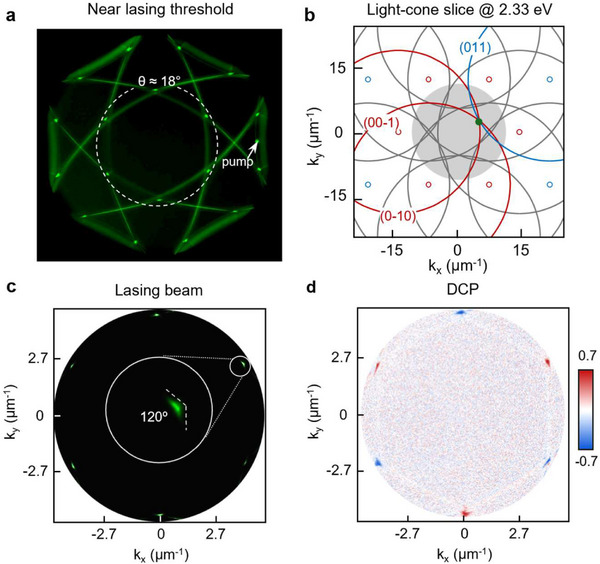 Figure 6
Peer Reviews
No public reviews on file for this paper yet. If you reviewed it on a platform where reviews are public (OpenReview, ICLR, NeurIPS, ICML), you can paste yours below so the community can read it here.
Videos
No videos yet. Explain this paper in a talk, walkthrough, or lecture? Add one.
Taxonomy
TopicsStrong Light-Matter Interactions · Plasmonic and Surface Plasmon Research · Topological Materials and Phenomena