Virtual Reality to Improve Pain Management and Mental Health in Stroke Survivors With Chronic Pain: Study Protocol for a Feasibility Randomized Controlled Trial on Virtual Reality-Acceptance and Commitment Therapy
Sérgio A Carvalho, Paulo Menezes, Catarina Duarte, David Skvarc, Ana Rita Sousa e Silva, Ana Valentim, João Emanuel Diogo, João Sargento-Freitas, Inês A Trindade, Paula Castilho, Teresa Lapa, Gerhard Andersson, Miguel Castelo-Branco

TL;DR
This study explores using virtual reality and acceptance commitment therapy to help stroke survivors manage chronic pain and improve mental health.
Contribution
The study introduces a novel combination of virtual reality and ACT for chronic poststroke pain management.
Findings
The VR-ACT program will be tested for feasibility and preliminary efficacy in a randomized controlled trial.
Quantitative and qualitative outcomes will assess pain, psychological symptoms, and brain network connectivity.
Results may support VR-ACT as a feasible and effective pain self-management tool.
Abstract
Studies suggest that 40% to 65% of stroke survivors develop chronic poststroke pain (CPSP), which severely affects their quality of life and mental health. Empirical evidence suggests that existing treatments often fall short, underscoring the need for innovative, integrative interventions. Virtual reality (VR) seems to provide valuable tools in stroke rehabilitation. Also, contextual-behavioral psychological approaches, such as acceptance and commitment therapy (ACT), offer promising pain management and mental health resources, which seem to be feasible in VR formats. However, their combined application in CPSP remains unexplored. This study protocol describes the VR-ACT study, which will test the feasibility and preliminary efficacy of an 8-week VR-ACT program for CPSP. This pilot randomized controlled trial (N=30) will compare a VR-based ACT intervention with a sham VR control. The…
Genes, proteins, chemicals, diseases, species, mutations and cell lines named across the full text — each resolved to its canonical identifier and authoritative record.
Click any figure to enlarge with its caption.
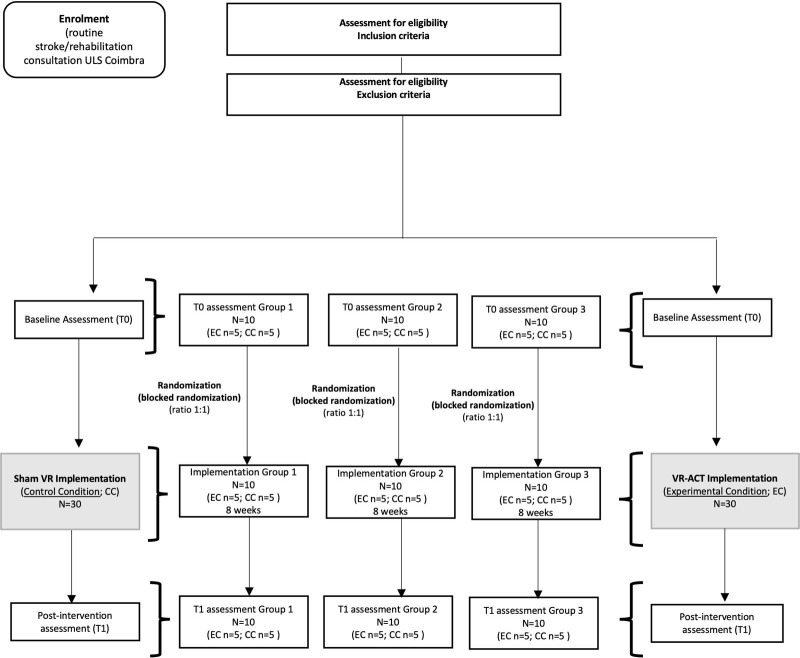 Figure 1
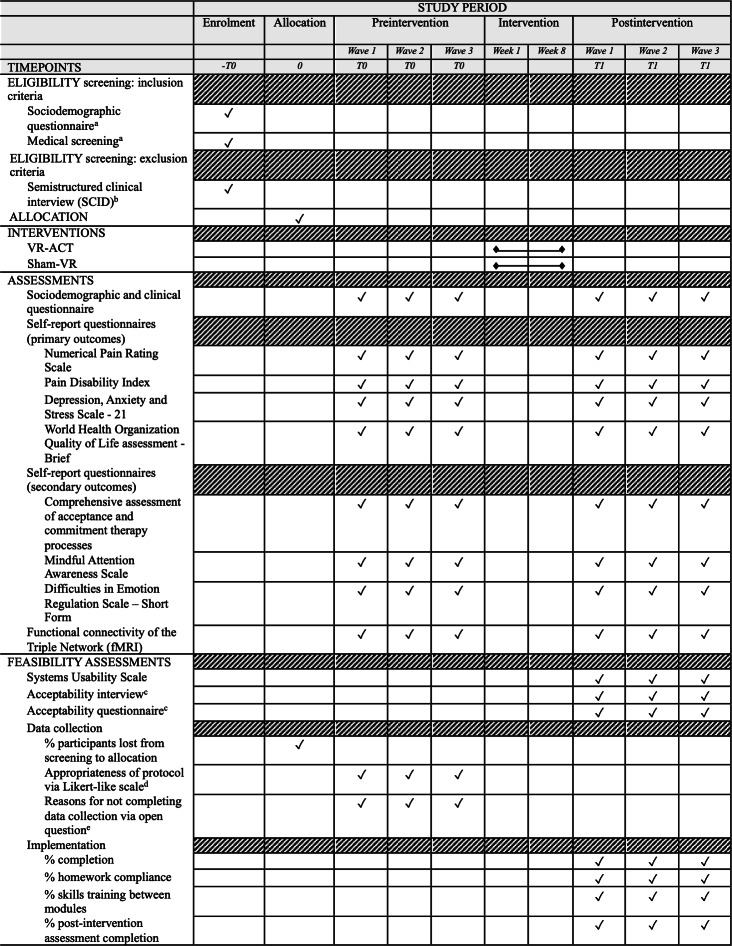 Figure 2
Peer Reviews
No public reviews on file for this paper yet. If you reviewed it on a platform where reviews are public (OpenReview, ICLR, NeurIPS, ICML), you can paste yours below so the community can read it here.
Videos
No videos yet. Explain this paper in a talk, walkthrough, or lecture? Add one.
Taxonomy
TopicsStroke Rehabilitation and Recovery · Musculoskeletal pain and rehabilitation · Pediatric Pain Management Techniques