Bright electron bunches from a plasma-wakefield accelerator with a steep density down-ramp
J. C. Wood, L. Boulton, J. Beinortaitė, J. Björklund Svensson, S. Bohlen, G. Boyle, J. M. Garland, P. Gonzalez Caminal, C. A. Lindstrøm, G. Loisch, S. M. Mewes, T. Parikh, F. Peña, K. Põder, S. Schröder, M. Thévenet, S. Wesch, J. Osterhoff, R. D’Arcy

TL;DR
This paper shows how plasma accelerators can produce high-quality electron bunches with low emittance and high brightness for use in particle physics and photon science.
Contribution
The novel contribution is demonstrating reproducible generation of ultra-bright electron bunches in a plasma accelerator with low emittance and high charge per unit energy.
Findings
Electron bunches with mm-mrad normalized emittance were injected and accelerated in a plasma.
The bunches achieved O(10 pC/MeV) spectral density and per-cent-level energy spread.
The results show excellent reproducibility and potential for future ultra-bright bunch production.
Abstract
High-brightness electron bunches drive fundamental research in particle physics and photon science. Key to achieving a high brightness is to have a low transverse emittance, which ensures that the bunch can be tightly focussed. In radiofrequency accelerators a low initial emittance can be rapidly degraded due to space charge forces, which are greatly diminished once the electron bunch attains a relativistic velocity. A plasma accelerator can maintain orders-of-magnitude higher accelerating fields than radiofrequency accelerators, while multiple techniques exist to create a low emittance electron bunch directly inside the plasma accelerator structure. Plasma accelerators therefore offer a possibility to create high-brightness bunches in wakefields driven even by low-quality drive bunches. Here we demonstrate the injection and gigavolt-per-metre acceleration of electron bunches with…
Genes, proteins, chemicals, diseases, species, mutations and cell lines named across the full text — each resolved to its canonical identifier and authoritative record.
Click any figure to enlarge with its caption.
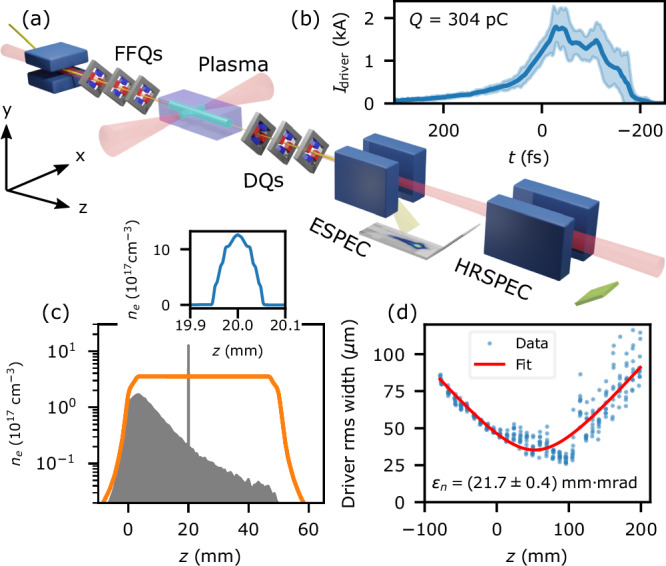 Figure 1
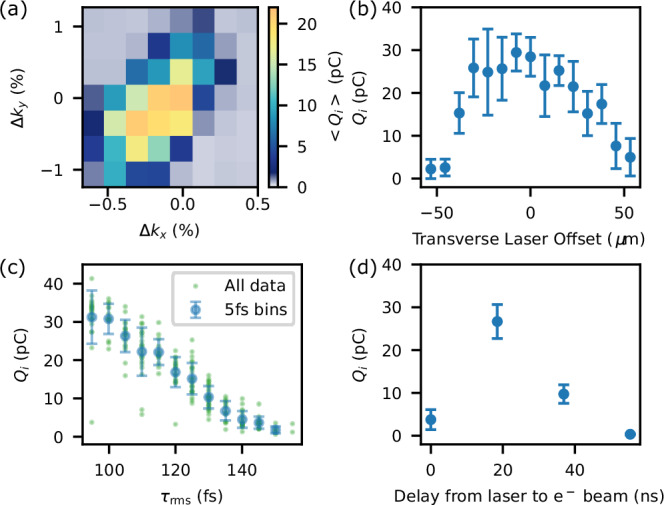 Figure 2
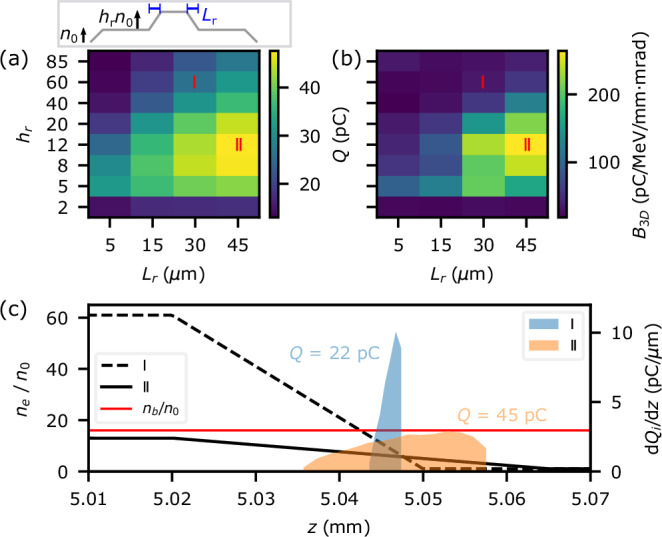 Figure 3
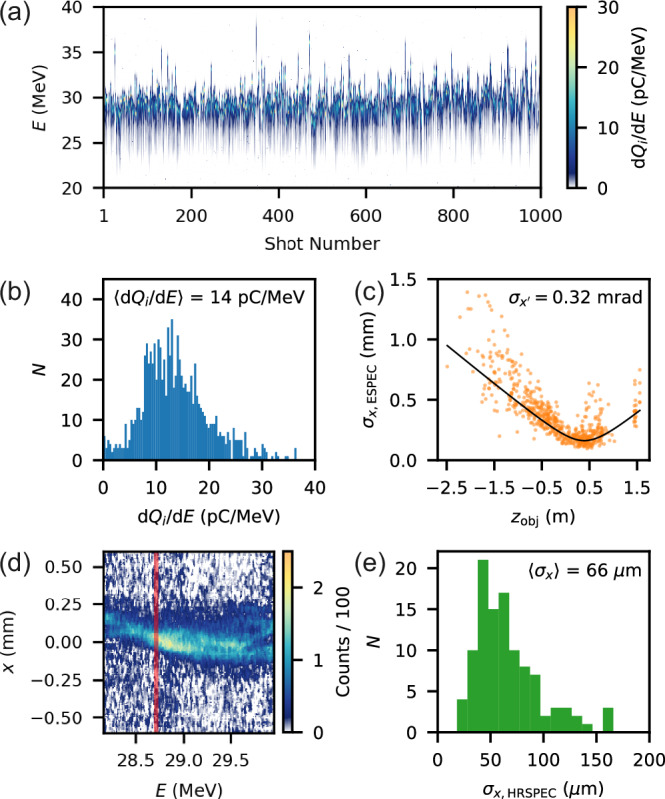 Figure 4
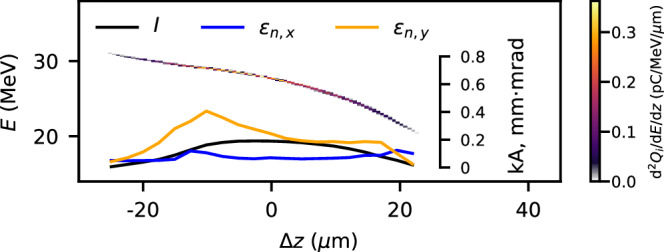 Figure 5
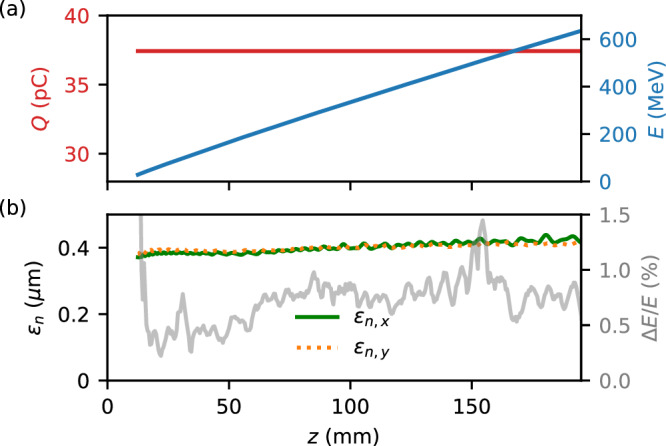 Figure 6
Peer Reviews
No public reviews on file for this paper yet. If you reviewed it on a platform where reviews are public (OpenReview, ICLR, NeurIPS, ICML), you can paste yours below so the community can read it here.
Videos
No videos yet. Explain this paper in a talk, walkthrough, or lecture? Add one.
Taxonomy
TopicsParticle Accelerators and Free-Electron Lasers · Laser-Plasma Interactions and Diagnostics · Astrophysics and Cosmic Phenomena