Visual classification of allergenic pollen in iteratively reconstructed lens-less DIHM images
Blaž Cugmas, Eva Štruc, Mindaugas Tamosiunas, Zbigņevs Marcinkevičs, Miran Bürmen, Peter Naglič

TL;DR
This study shows that lens-less holographic microscopy can accurately identify allergenic pollen when used with iterative reconstruction, matching traditional microscopy in accuracy.
Contribution
The study demonstrates that iteratively reconstructed lens-less DIHM images can be effectively used for visual allergenic pollen classification by experts.
Findings
Lens-less DIHM achieved 95.8% classification accuracy, comparable to conventional optical microscopy (96.9%).
Inter-observer agreement was high (Cohen’s κ = 0.91), indicating consistent pollen identification across experts.
Silver birch pollen was most frequently misclassified due to its morphological variability and similarity to other pollen types.
Abstract
Lens-less digital in-line holographic microscopy (DIHM) is a low-cost, wide-field imaging technique that relies on computational reconstruction to form focused images that should ideally be free of twin-image artifacts. While current DIHM-based pollen classification systems are typically automated and rely on large datasets and deep learning, our study explored whether iteratively reconstructed DIHM images using the Gerchberg–Saxton (GS) algorithm are suitable for visual classification by human experts. Two veterinary cytopathologists evaluated images of six clinically relevant pollen types, namely timothy grass, common ragweed, silver birch, common alder, olive tree, and hazel, using both lens-less DIHM and conventional optical microscopy. Classification accuracy was comparable across modalities, with DIHM achieving 95.8% and optical microscopy 96.9%. Inter-observer agreement was high…
Genes, proteins, chemicals, diseases, species, mutations and cell lines named across the full text — each resolved to its canonical identifier and authoritative record.
Click any figure to enlarge with its caption.
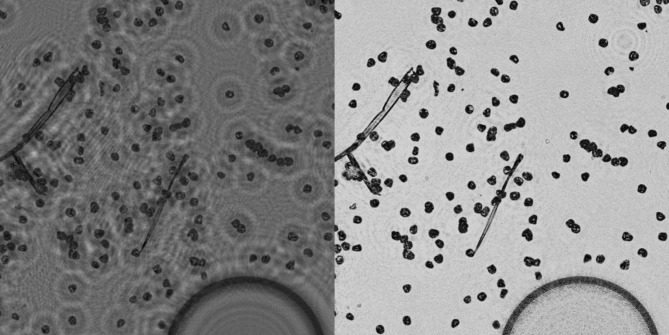 Figure 1
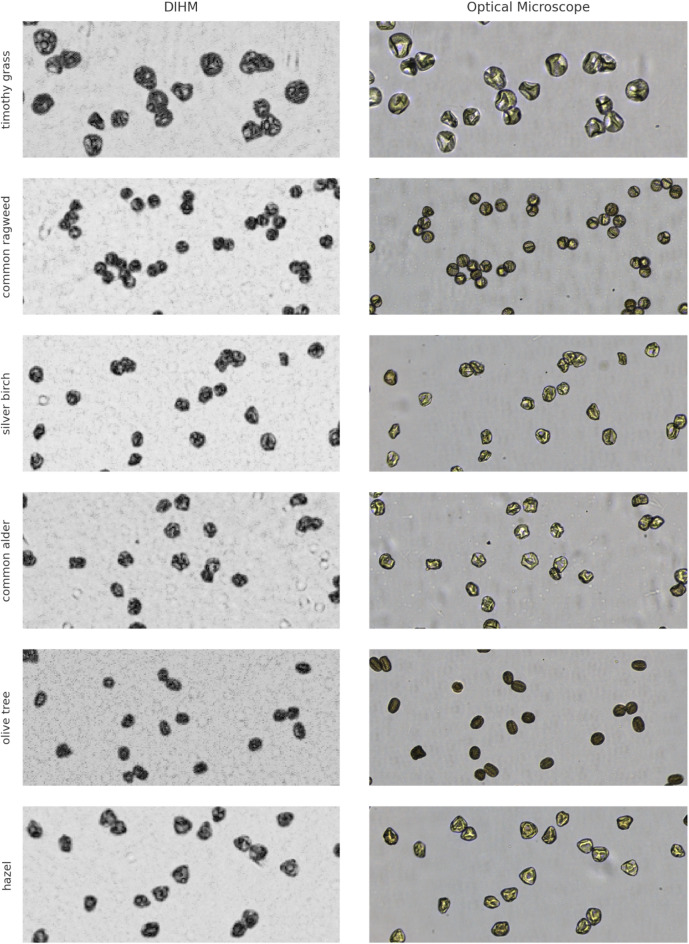 Figure 2
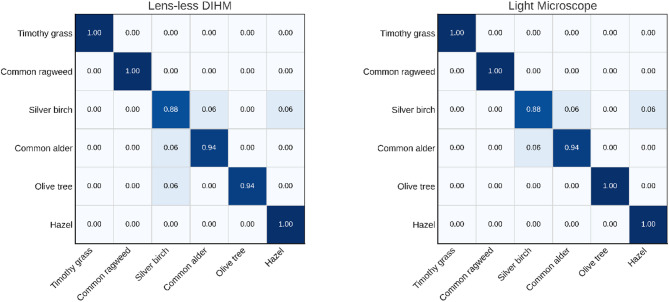 Figure 3
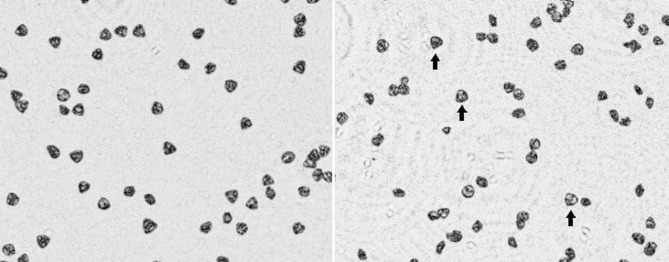 Figure 4
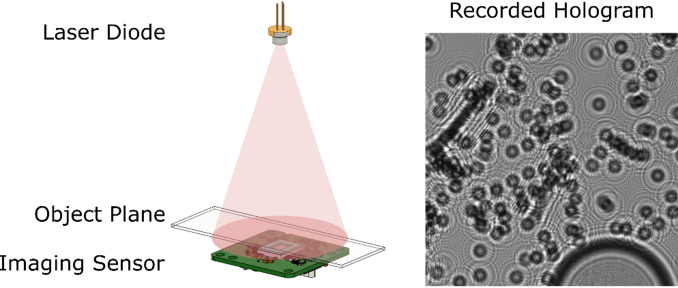 Figure 5
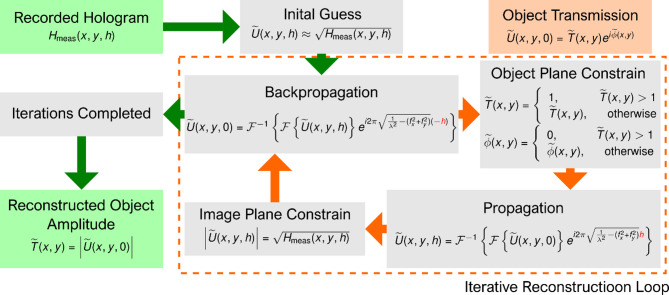 Figure 6
Peer Reviews
No public reviews on file for this paper yet. If you reviewed it on a platform where reviews are public (OpenReview, ICLR, NeurIPS, ICML), you can paste yours below so the community can read it here.
Videos
No videos yet. Explain this paper in a talk, walkthrough, or lecture? Add one.
Taxonomy
TopicsDigital Holography and Microscopy · Ophthalmology and Visual Impairment Studies · Cell Image Analysis Techniques