The spermatozoon neck role in infertility and intracytoplasmic sperm injection outcomes
Derek F. Kluczynski, Isabel Nester, Haley Prine, Kadyn Heising, Ethan Gartee, David Adegoke, Gunnar Eriksen, Conner Liber, Yashwanth Byreddy, Rudraksh Dua, Mira Adkins, Nathan Pan, Brady Artz, Natalie Doumet, Haley Salazar, Jakya Warren, Tomer Avidor-Reiss

TL;DR
This paper explores how the structure of the sperm neck affects infertility and outcomes of ICSI, focusing on proteins that cause headless sperm.
Contribution
The paper introduces a classification of 24 proteins into five types of acephalic spermatozoa based on neck breakpoints.
Findings
Mutations in neck proteins lead to acephalic spermatozoa, categorized into five types based on the breakpoint location.
The location of the neck break influences ICSI outcomes, possibly through effects on the centrosome and DNA functionality.
Future research should examine DNA, PLC zeta, and centriole function alongside breakpoint location for better ICSI understanding.
Abstract
The mammalian spermatozoon neck is a unique structure that functions during spermatid differentiation and spermatozoa swimming, and its contents are critical for post-fertilization embryogenesis. Mutations in proteins localizing to the neck connecting piece (the modified pericentriolar material) result in acephalic spermatozoa. In contrast, mutations in proteins localizing to the centriole often produce abnormal tail morphology. Acephalic spermatozoa can be categorized based on the exact location of the neck breakpoint. Here, we classify 24 proteins known to cause acephaly in human and mice spermatozoa into five different acephalic types, depending on where the breakpoint occurs. We also discuss other proteins found in the spermatozoon neck, which may result in spermatozoa acephaly. The relationship between the exact location of the neck’s break and intracytoplasmic sperm injection…
Genes, proteins, chemicals, diseases, species, mutations and cell lines named across the full text — each resolved to its canonical identifier and authoritative record.
Click any figure to enlarge with its caption.
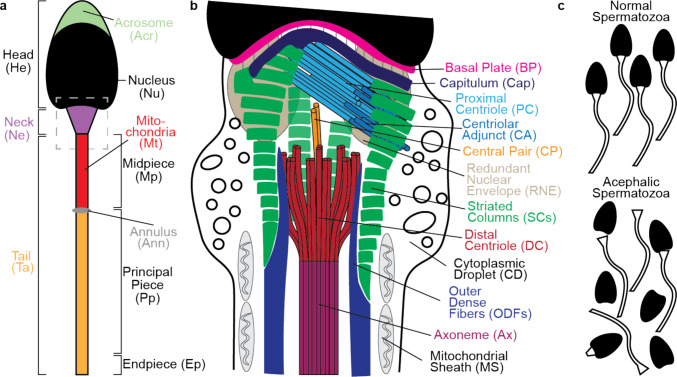 Figure 1
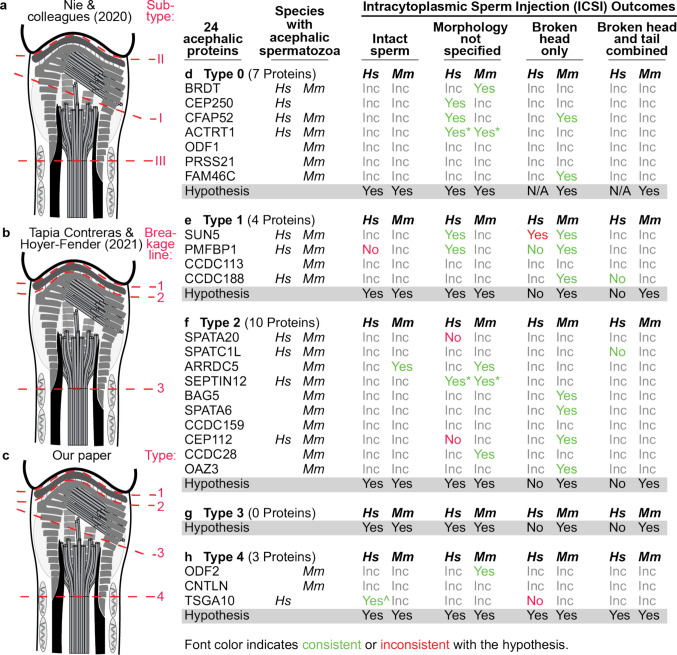 Figure 2
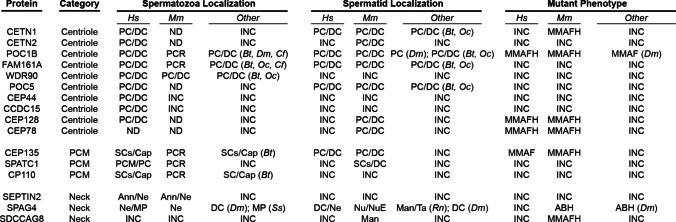 Figure 3
Peer Reviews
No public reviews on file for this paper yet. If you reviewed it on a platform where reviews are public (OpenReview, ICLR, NeurIPS, ICML), you can paste yours below so the community can read it here.
Videos
No videos yet. Explain this paper in a talk, walkthrough, or lecture? Add one.
Taxonomy
TopicsSperm and Testicular Function · Reproductive biology and impacts on aquatic species · Microtubule and mitosis dynamics