Poster Session I - Poster of Distinction I - A20 ODIN: AN UNBIASED BRIGHTFIELD IMAGE-BASED MACHINE LEARNING ALGORITHM FOR INTESTINAL ORGANOID CHARACTERIZATION
H E Teslak, J Lee, S Hirota

TL;DR
ODIN is a machine learning tool that improves the objective analysis of intestinal organoid images, reducing researcher bias and increasing reproducibility in organoid research.
Contribution
ODIN introduces a novel machine learning algorithm for unbiased brightfield image analysis of intestinal organoids, enhancing standardization and reducing manual assessment.
Findings
ODIN detected more organoids than manual counts, suggesting improved sensitivity to smaller or overlooked structures.
Morphology predictions preserved overall distribution patterns but had classification discrepancies for spheroids and crypt-like features.
ODIN outperformed manual methods in speed and sensitivity, though size underestimation and morphology classification require refinement.
Abstract
As intestinal organoids become increasingly central to basic and translational research, standardized quality control tools are urgently needed. Current assessment methods rely heavily on manual visual inspection of brightfield microscopy images, introducing researcher bias. Existing automated image analysis tools are not optimized for the multidimensional and heterogeneous morphology of intestinal organoids. The lack of a robust, objective, and standardized evaluation method hinders the harmonization of culture quality standards and thus limiting reproducibility of organoid research. To develop a machine learning-based algorithm (ODIN) capable of analyzing brightfield organoid microscopy images and quantifying 3D culture characteristics such as quantity, size, and morphology. Generalist image segmentation tools (ilastik and Cellpose) were incorporated and modified into the ODIN…
Click any figure to enlarge with its caption.
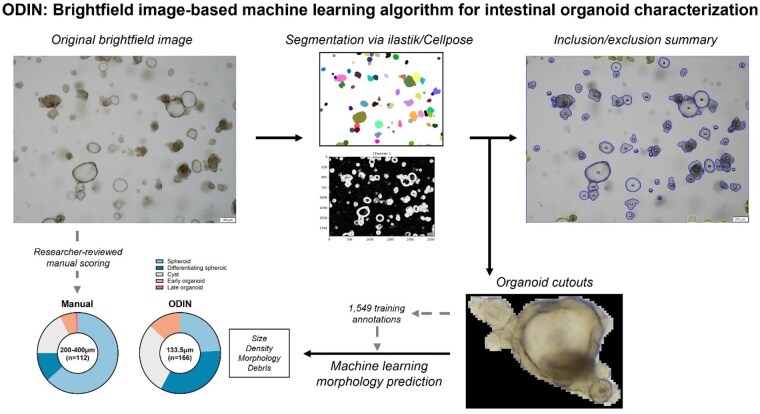 Figure 1
Peer Reviews
No public reviews on file for this paper yet. If you reviewed it on a platform where reviews are public (OpenReview, ICLR, NeurIPS, ICML), you can paste yours below so the community can read it here.
Videos
No videos yet. Explain this paper in a talk, walkthrough, or lecture? Add one.
Taxonomy
TopicsCancer Cells and Metastasis · AI in cancer detection · Cell Image Analysis Techniques