Poster Session II - A227 BRAIN NEAR INFRARED SPECTROSCOPY REVEALS A POTENTIAL LINK BETWEEN PREFRONTAL CORTEX HYPOXIA, MITOCHONDRIAL DYSFUNCTION, AND ALTERED INTEROCEPTION IN CROHN’S DISEASE
A Hansen, A Soroush, C Ma, C Diribe, A Fuhrmann, D Marshall, C Lu, C Seow, R Ingram, K Novak, G G Kaplan, R Panaccione, J F Dunn, M G Swain

TL;DR
This study explores how brain hypoxia and mitochondrial dysfunction in Crohn’s disease patients may be linked to increased awareness of internal body sensations.
Contribution
The study introduces a novel use of FD-NIRS to investigate mitochondrial dysfunction and interoception in Crohn’s disease patients.
Findings
Reduced PFC NIRS-LS correlated with lower PFC oxygenation in Crohn’s disease patients.
Lower NIRS-LS values were associated with higher interoceptive awareness scores in Crohn’s disease patients.
The relationship between PFC oxygenation and NIRS-LS was not observed in healthy controls.
Abstract
Crohn’s disease (CD) patients show heightened interoceptive awareness (perception of internal body sensations), which may worsen psychological distress. The prefrontal cortex (PFC) plays a key role in processing interoceptive signals. PFC hypoxia can be measured as low tissue oxygen saturation (StO2) by frequency-domain near-infrared spectroscopy (FD-NIRS). Mitochondria are key cellular oxygen consumers, and hypoxia can alter their function/structure. NIRS light scattering (NIRS-LS) can detect mitochondrial dysfunction in vivo. Thus, we hypothesized that low PFC oxygenation could lead to mitochondrial dysfunction and altered interoception in CD. To investigate whether PFC NIRS-LS is altered in CD patients compared to healthy controls (HCs) and examine its relationship to PFC hypoxia and interoceptive awareness. HCs (n=15, age 44±15) and CD patients (n=26, age 49±14) were recruited. CD…
Genes, proteins, chemicals, diseases, species, mutations and cell lines named across the full text — each resolved to its canonical identifier and authoritative record.
Click any figure to enlarge with its caption.
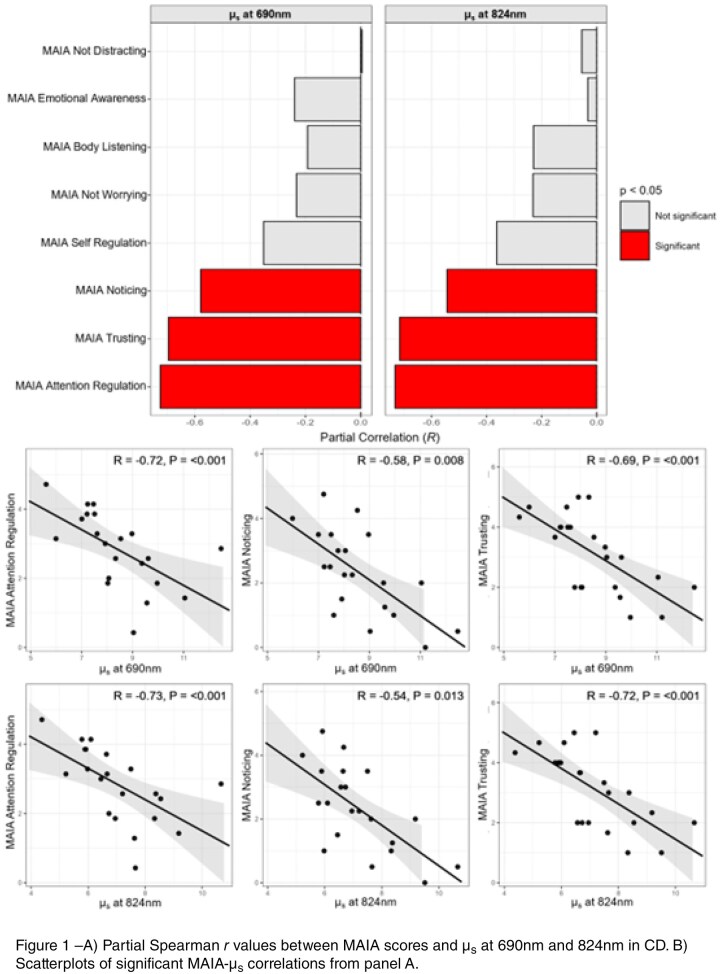 Figure 1
Peer Reviews
No public reviews on file for this paper yet. If you reviewed it on a platform where reviews are public (OpenReview, ICLR, NeurIPS, ICML), you can paste yours below so the community can read it here.
Videos
No videos yet. Explain this paper in a talk, walkthrough, or lecture? Add one.
Taxonomy
TopicsOptical Imaging and Spectroscopy Techniques · Inflammatory Bowel Disease · Functional Brain Connectivity Studies