Poster Session II – Poster of Distinction II - A213 PREDICTING SUSTAINED REMISSION AND MAXIMAL DISEASE SEVERITY IN PEDIATRIC CROHN’S DISEASE USING MACHINE LEARNING
I Ng, H Sham, K Jacobson, K Korthauer, B Vallance

TL;DR
This study uses machine learning to predict disease outcomes in children with Crohn’s disease, helping identify those who need early aggressive treatment.
Contribution
The study introduces integrated machine learning models combining clinical and microbiome data to predict pediatric Crohn’s disease severity and remission.
Findings
Integrated models outperformed single-modality models in predicting sustained remission, with logistic regression achieving a mean AUC of 0.763.
Microbiome models best predicted maximal disease severity, with Gaussian naïve Bayes reaching a mean AUC of 0.801.
Key predictive features included clinical variables and specific gut microbes like Haemophilus, Clostridium, and Coprococcus.
Abstract
Pediatric Crohn’s disease (CD) is a chronic inflammatory condition affecting the gastrointestinal tract. It displays more heterogeneous disease trajectories and treatment responses than adult-onset cases, posing significant management challenges. While patients following more severe trajectories may benefit from early aggressive treatments, no reliable objective method exists to identify which children will follow a severe trajectory at diagnosis. This prognostic gap leaves risk stratification dependent on subjective clinical judgment, potentially delaying interventions for high-risk patients. Early identification of severe trajectories could transform treatment decisions and improve outcomes through timely aggressive therapy. This study aims to predict one-year sustained remission and maximal disease severity using machine learning models trained on baseline clinical and microbiome…
Genes, proteins, chemicals, diseases, species, mutations and cell lines named across the full text — each resolved to its canonical identifier and authoritative record.
Click any figure to enlarge with its caption.
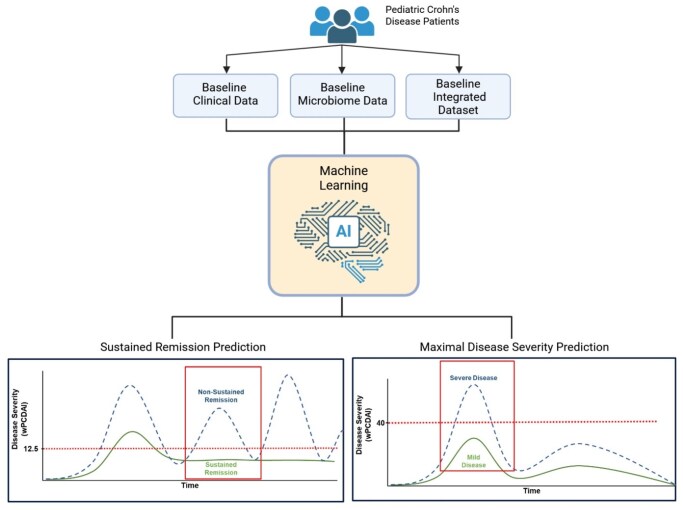 Figure 1
Peer Reviews
No public reviews on file for this paper yet. If you reviewed it on a platform where reviews are public (OpenReview, ICLR, NeurIPS, ICML), you can paste yours below so the community can read it here.
Videos
No videos yet. Explain this paper in a talk, walkthrough, or lecture? Add one.
Taxonomy
TopicsInflammatory Bowel Disease · Gut microbiota and health · Immune responses and vaccinations