Poster Session I - A150 A RARE CASE OF PARTIAL SMALL BOWEL OBSTRUCTION FROM PHYTOBEZOAR MIMICKING CROHN’S DISEASE FLARE
R Ahmed, T Guzowski

TL;DR
A rare case of partial small bowel obstruction caused by a phytobezoar was mistaken for a Crohn’s disease flare, highlighting the importance of diagnostic tools like intestinal ultrasound.
Contribution
This case study demonstrates how intestinal ultrasound can help differentiate between a Crohn’s flare and a phytobezoar-induced obstruction.
Findings
Intestinal ultrasound showed preserved wall stratification and normal vascularity, suggesting fibrosis rather than active inflammation.
A radiopaque linear mass on CT and rapid normalization of inflammatory markers indicated a phytobezoar, not an IBD flare.
Phytobezoars can mimic Crohn’s disease symptoms and trigger non-specific inflammatory responses.
Abstract
Phytobezoars are accumulations of indigestible plant material typically found in the stomach or small intestine. While rare, they occur in approximately 4% of all cases of mechanical bowel obstruction. However, this may be an underestimation. Usually described as ovoid or mottled appearing on CT scan. Rarely, they have been described as linear opaque material. Patients with Crohn’s disease develop an environment for phytobezoars to form. There have been observations of a transient increase in inflammatory markers. The diagnostic challenge arises when patients with CD present acutely with symptoms mimicking a flare, but are actually experiencing a mechanical obstruction. Intestinal Ultrasound (IUS) in assisting with diagnostic challenges in CD patients with symptoms mimicking a flare, but are actually experiencing a mechanical obstruction. A 65-year-old male with quiescent Crohn’s…
Genes, proteins, chemicals, diseases, species, mutations and cell lines named across the full text — each resolved to its canonical identifier and authoritative record.
Click any figure to enlarge with its caption.
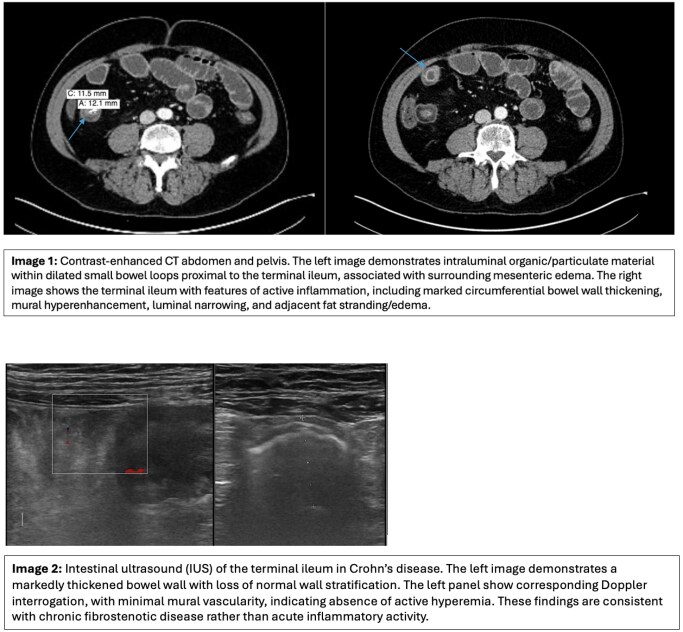 Figure 1
Peer Reviews
No public reviews on file for this paper yet. If you reviewed it on a platform where reviews are public (OpenReview, ICLR, NeurIPS, ICML), you can paste yours below so the community can read it here.
Videos
No videos yet. Explain this paper in a talk, walkthrough, or lecture? Add one.
Taxonomy
TopicsIntestinal and Peritoneal Adhesions · Omental and Epiploic Conditions · Appendicitis Diagnosis and Management