Poster Session II - A217 SECOND-LINE INFLIXIMAB THERAPY FOR CROHN’S DISEASE (SLIT-CD): A RETROSPECTIVE COHORT STUDY
C Galts, S Anvari, D Borovsky, K Grossman, H R Tran, A Wen, A Albassam, N Habib, A Varghese, S Halder, J Marshall, N Narula

TL;DR
This study found that infliximab is less effective as a second-line treatment for Crohn’s disease compared to when it is used first, with lower response rates and higher hospitalization and surgery rates.
Contribution
The study provides new evidence on the reduced efficacy of infliximab when used as a second-line therapy for Crohn’s disease.
Findings
Second-line infliximab users had significantly lower clinical and endoscopic response rates compared to first-line users.
Second-line users experienced higher hospitalization and surgery rates than first-line users.
There was no significant difference in immunomodulator use or dose escalation between the groups.
Abstract
Current North American guidelines position infliximab alongside other first line agents for the management of moderate-to-severe Crohn’s disease (CD). However, data on its efficacy as a second-line agent after advanced therapy remain limited. The purpose of this study is to evaluate infliximab’s efficacy as a second-line agent and compare outcomes to first line use. We conducted a retrospective cohort study of adults with CD treated with infliximab between 2016-2025 at a Canadian tertiary care hospital. Patients were categorized by timing of infliximab use (bio-naïve/first-line vs experienced). Clinical and endoscopic outcomes were compared at one year. Among 160 included patients, 123 received infliximab as first line therapy and 37 as second-line or subsequent; of these, 10 received it as third-line or subsequent. The most common reason to change therapy was secondary loss of…
Genes, proteins, chemicals, diseases, species, mutations and cell lines named across the full text — each resolved to its canonical identifier and authoritative record.
Click any figure to enlarge with its caption.
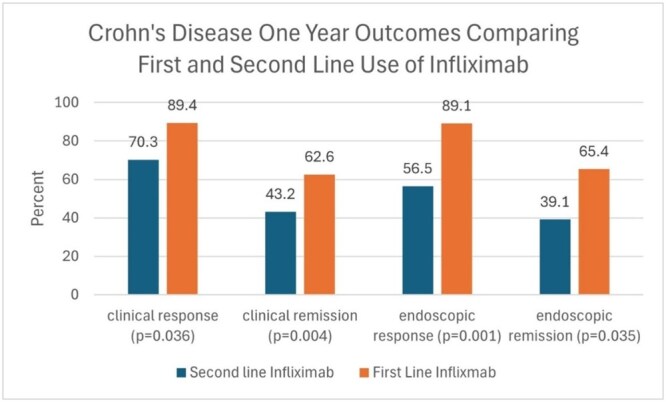 Figure 1
Peer Reviews
No public reviews on file for this paper yet. If you reviewed it on a platform where reviews are public (OpenReview, ICLR, NeurIPS, ICML), you can paste yours below so the community can read it here.
Videos
No videos yet. Explain this paper in a talk, walkthrough, or lecture? Add one.
Taxonomy
TopicsInflammatory Bowel Disease · Biosimilars and Bioanalytical Methods · Biochemical and Structural Characterization