Poster Session II A333 ARTIFICIAL INTELLIGENCE MODELS DEMONSTRATE PROMISING BUT SUBOPTIMAL PERFORMANCE IN DIAGNOSING AND TREATING DISORDERS OF GUT-BRAIN INTERACTION
M Ahn, C Parker

TL;DR
AI models show moderate accuracy in diagnosing gut-brain interaction disorders but have significant limitations in treatment recommendations.
Contribution
This study evaluates the diagnostic and treatment accuracy of five AI models for disorders of gut-brain interaction using Rome IV standards.
Findings
Perplexity and ChatGPT had the highest diagnostic accuracy at 74% and 72%, while Microsoft Copilot and OpenEvidence had the lowest at 65%.
Treatment recommendations were most accurate for neonate/toddler disorders but poorest for gastroduodenal disorders.
No significant differences were found between AI models in diagnostic or treatment accuracy.
Abstract
Diagnosing disorders of gut-brain interaction (DGBIs) remains a persistent challenge in gastroenterology and primary care. Large language artificial intelligence models (LLM) have emerged as a potential tool to support clinical decision-making, yet their clinical applicability remains unclear. To compare the diagnostic accuracy and treatment recommendations generated from five LLMs using clinical scenarios from the Rome IV Multidimensional Clinical Profile (MDCP). 68 case scenarios representing various DGBIs were entered into Chat GPT 4.0, Google Gemini 2.5 Pro, Microsoft Copilot, OpenEvidence, and Perplexity. Each model was provided a standardized prompt to produce a diagnosis and treatment options based on the case scenario. Responses were evaluated against MDCP standards and expert consensus for diagnostic and treatment accuracy. For diagnostic accuracy, a response was correct if…
Click any figure to enlarge with its caption.
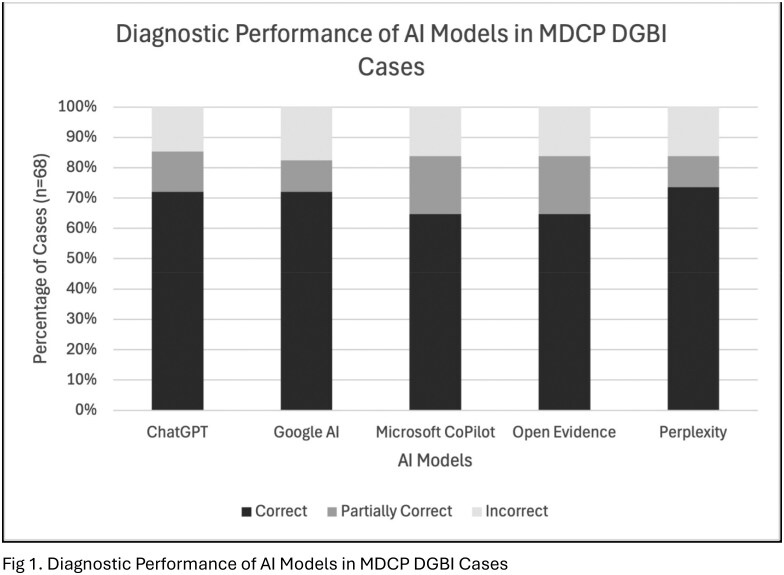 Figure 1
Peer Reviews
No public reviews on file for this paper yet. If you reviewed it on a platform where reviews are public (OpenReview, ICLR, NeurIPS, ICML), you can paste yours below so the community can read it here.
Videos
No videos yet. Explain this paper in a talk, walkthrough, or lecture? Add one.
Taxonomy
TopicsArtificial Intelligence in Healthcare and Education · Gastrointestinal motility and disorders · Genomics and Rare Diseases