Poster Session I - A132 IMPLICATIONS OF ARTIFICIAL INTELLIGENCE FOR THE FORMAL AND HIDDEN CURRICULUM IN GASTROENTEROLOGY TRAINING
C Galts, S Samnani, A Wen

TL;DR
This paper explores how AI impacts gastroenterology training, focusing on both formal and hidden curricula, and highlights gaps in current research.
Contribution
The study identifies the current focus of AI in GI training and emphasizes the need for research on the hidden curriculum and implicit learning.
Findings
Current AI research in GI training focuses on endoscopic skills and knowledge acquisition.
There is limited research on AI's impact on the hidden curriculum and trainee identity formation.
Behaviorist and cognitivist learning theories are prominent in existing AI-related GI education studies.
Abstract
AI research in GI has recently accelerated, though fewer than 1% of studies involve direct patient contact, raising concerns about ‘dehumanization’ in GI research and training. Given its widespread availability and its influence on learning styles, AI may affect both the formal and hidden curricula. We aimed to explore how various AI technologies including Large Language Models (LLMs) and deep learning algorithms, are described in GI training literature, and to identify their implications for both the formal and hidden curricula as well as for relevant learning theories. We performed a scoping review using PRISMA-ScR guidelines. PubMed, Embase, and Google Scholar were searched for English-language articles published between January 2010 and June 2025. Search terms included AI-related and GI education terms (e.g., ‘ChatGPT,’ ‘fellowship,’ ‘curriculum’). We used Covidence for…
Click any figure to enlarge with its caption.
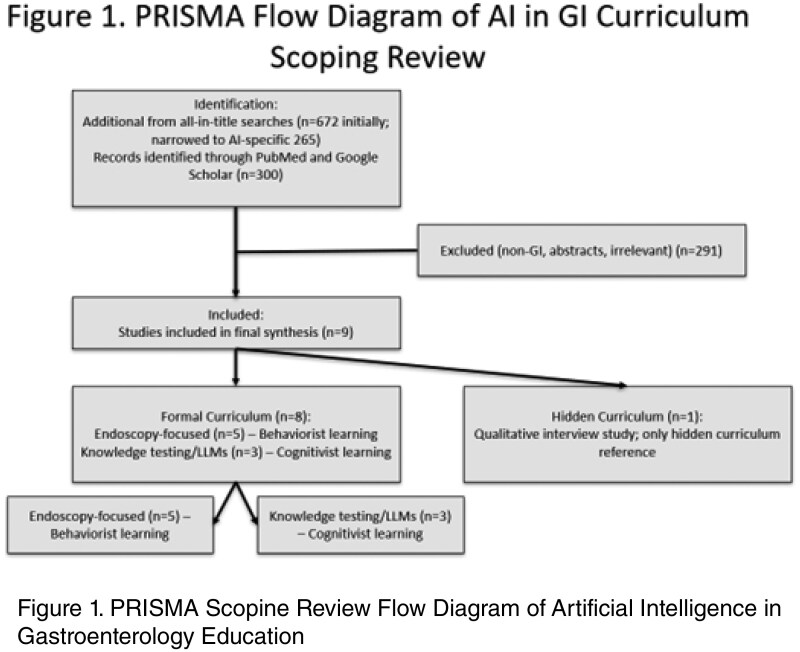 Figure 1
Peer Reviews
No public reviews on file for this paper yet. If you reviewed it on a platform where reviews are public (OpenReview, ICLR, NeurIPS, ICML), you can paste yours below so the community can read it here.
Videos
No videos yet. Explain this paper in a talk, walkthrough, or lecture? Add one.
Taxonomy
TopicsArtificial Intelligence in Healthcare and Education · Surgical Simulation and Training · Clinical Reasoning and Diagnostic Skills