Poster Session II - A259 HUMAN INTESTINAL ORGANOID MODELLING OF CROHN’S DISEASE FISTULA FORMATION: PARTIAL EMT STATE DRIVES COLLECTIVE EPITHELIAL MIGRATION
D Kola-Ilesanmi, M Stephens, C MacKenzie, B McDonald, F Visser, S Hirota

TL;DR
Researchers developed a human intestinal organoid model to study how Crohn’s disease causes fistulas, finding that a partial EMT state leads to collective cell migration.
Contribution
A novel human intestinal organoid model was developed to study Crohn’s disease fistula formation through partial epithelial-to-mesenchymal transition.
Findings
Cytokine treatment induced a partial EMT state in organoids, marked by epithelial identity and mesenchymal features.
Treated organoids showed collective sheet-like migration and cytoskeletal changes, resembling fistula transitional cells.
SNAI2 upregulation and suppression of SNAI1 and αSMA suggest a unique partial EMT pathway distinct from canonical EMT.
Abstract
Fistulas occur in 30-50% of Crohn’s disease (CD) patients and represent a major therapeutic challenge. Fistula tracts are lined with transitional cells exhibiting features of partial epithelial-to-mesenchymal transition (EMT), with retained epithelial cell markers and acquired invasive properties. The chronic inflammatory microenvironment in CD is characterized in part by elevated TGFβ, TNFα, IL13 and IL22, which is likely driving EMT. However, the mechanisms of CD fistula formation remain unclear due to a lack of physiologically relevant models. To establish a human intestinal organoid (HIO) model of CD cytokine-induced partial EMT and characterize the morphological and functional changes driving CD fistula formation. Organoids were derived from ileal biopsies of healthy donors (n = 4) and Crohn’s disease patients (n = 2). Organoids were cultured in reduced Matrigel with 8-day…
Genes, proteins, chemicals, diseases, species, mutations and cell lines named across the full text — each resolved to its canonical identifier and authoritative record.
Click any figure to enlarge with its caption.
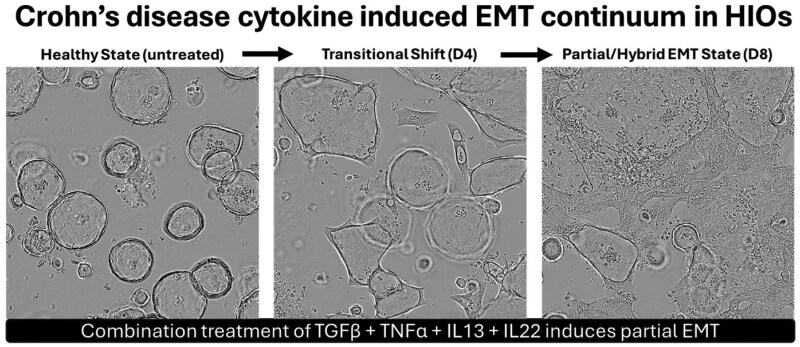 Figure 1
Peer Reviews
No public reviews on file for this paper yet. If you reviewed it on a platform where reviews are public (OpenReview, ICLR, NeurIPS, ICML), you can paste yours below so the community can read it here.
Videos
No videos yet. Explain this paper in a talk, walkthrough, or lecture? Add one.
Taxonomy
TopicsInflammatory Bowel Disease · Diagnosis and treatment of tuberculosis · Autoimmune and Inflammatory Disorders