Poster Session I - A52 THE USE OF LARGE LANGUAGE MODELS IN GASTROENTEROLOGY LITERATURE: A GROWING ARTIFICIAL INTELLIGENCE FOOTPRINT
A Zoughlami, A Arezki, E Medawar, S Arezki, T Bessissow

TL;DR
This study shows a sharp rise in AI-generated language in gastroenterology research abstracts since the introduction of ChatGPT, with higher use in top and lower-impact journals.
Contribution
The study quantifies the adoption of LLMs in gastroenterology literature and reveals a U-shaped pattern across journal impact factors.
Findings
AI-like language in GI abstracts rose from 0.07% in 2016 to 4.68% in 2024.
Adoption was highest in Q1 and Q4 journals and lowest in Q2/Q3 journals.
Lexical diversity remained stable despite the increase in AI-related language.
Abstract
The integration of Large Language Models (LLMs) into academic writing has transformed scientific literature, but the adoption within the gastrointestinal (GI) literature remains to be quantified. In this study, we aim to estimate the proportion of classical LLM-related language in GI abstracts from 2010 to 2024, and to characterize its variation across impact factor (IF) quartiles, and impact on lexical patterns. We conducted a retrospective, bibliometric analysis of 158,473 PubMed-indexed GI abstracts, sourced from all GI-related journals with 2024 IF ≥ 2 as found on Clarivate. A synthetic corpus of 10,000 GPT-3.5 generated abstracts was used to model AI-like linguistic distributions. The annual proportion of AI-like text (α) was estimated using a maximum-likelihood mixture model with Laplace smoothing. Journals were stratified into quartiles by their 2024 IF for sub-analysis.…
Click any figure to enlarge with its caption.
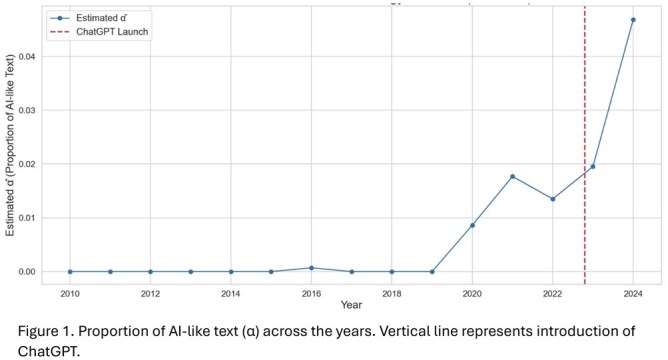 Figure 1
Peer Reviews
No public reviews on file for this paper yet. If you reviewed it on a platform where reviews are public (OpenReview, ICLR, NeurIPS, ICML), you can paste yours below so the community can read it here.
Videos
No videos yet. Explain this paper in a talk, walkthrough, or lecture? Add one.
Taxonomy
TopicsArtificial Intelligence in Healthcare and Education · Topic Modeling · Meta-analysis and systematic reviews