Poster Session II - A189 FIRST PROSPECTIVE CANADIAN DATA OF THE WORLD-WIDE REGISTRY ON HELICOBACTER PYLORI MANAGEMENT (WORLDHPREG)
T Krahn, G Ou, C Rueda-Clausen, M Miles, R Odsen, A Singla, O Farrés, P Parra, L Moreira, O P Nyssen, S Veldhuyzen Van Zanten, J P Gisbert

TL;DR
This study presents the first Canadian data from a global registry on Helicobacter pylori treatment, showing high success rates for two first-line therapies.
Contribution
The paper provides the first prospective Canadian data from the WorldHpReg, offering insights into treatment success and adverse events in real-world clinical practice.
Findings
PAMC and PBMT achieved success rates above 90% as first-line therapies.
Adverse events were common, with diarrhea, nausea, and dysgeusia being the most frequently reported.
Only 50% success rate was observed for rescue therapies like PAL and PAR.
Abstract
It is still unclear what the optimal treatment regimen for Helicobacter. pylori (Hp) infection is. The Maastricht VI (2022) and ACG (2024) guidelines recommend bismuth-based quadruple therapy (proton pump inhibitor [PPI], bismuth-metronidazole-tetracycline [PBMT]) for 14 days as first-line therapy for Hp. PPI-amoxicillin-metronidazole-clarithromycin (PAMC) is also recommended as first-line therapy by the Toronto Consensus (2016) and Maastricht VI guidelines. PPI-amoxicillin-levofloxacin (PAL) and PPI-amoxicillin-rifabutin (PAR) are accepted rescue therapies for treatment failures. To describe the success and adverse event rates of currently prescribed treatments for Hp in Canada. Multicentre, prospective registry evaluating the decisions and outcomes of Hp management by Canadian gastroenterologists (Hp-CanadaReg, WorldHpReg’s partner). Local research ethics board approval was obtained…
Genes, proteins, chemicals, diseases, species, mutations and cell lines named across the full text — each resolved to its canonical identifier and authoritative record.
Click any figure to enlarge with its caption.
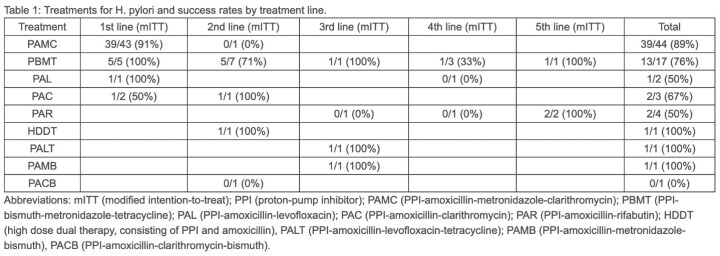 Figure 1
Peer Reviews
No public reviews on file for this paper yet. If you reviewed it on a platform where reviews are public (OpenReview, ICLR, NeurIPS, ICML), you can paste yours below so the community can read it here.
Videos
No videos yet. Explain this paper in a talk, walkthrough, or lecture? Add one.
Taxonomy
TopicsHelicobacter pylori-related gastroenterology studies · Clostridium difficile and Clostridium perfringens research · Gastroesophageal reflux and treatments