Poster Session I - A59 TEMPORAL TRENDS IN ADHERENCE TO QUALITY INDICATORS IN ENDOSCOPIC SURVEILLANCE OF BARRETT’S ESOPHAGUS
Y Yao, C Roda, A Hu, S Sui, Y Mandoub, D M Koerber, A Walia, P Tavakoli, S Pang, E Taylor, D Motomura, E Lam, R A Enns, W Xiong, N C Shahidi

TL;DR
This study examines how well endoscopists followed quality indicators for Barrett’s Esophagus surveillance over time, finding that adherence remains low except for one indicator.
Contribution
The study identifies temporal trends in adherence to specific quality indicators for Barrett’s Esophagus surveillance and highlights the role of interventional endoscopists.
Findings
Adherence to quality indicators for Barrett’s Esophagus surveillance was generally low, with only Prague classification use showing significant improvement over time.
Interventional endoscopists demonstrated higher adherence to selected quality indicators compared to general endoscopists.
The median composite adherence score was low, indicating suboptimal adherence to recommended surveillance practices.
Abstract
Endoscopic surveillance of Barrett’s Esophagus (BE) enables timely endotherapy to prevent progression to esophageal adenocarcinoma (EAC). Guidelines emphasize using quality indicators (QIs) to optimize outcomes, yet adherence remains inconsistent. To evaluate temporal trends in adherence to four QIs: key anatomic landmark documentation, Prague classification (PC) use, Seattle biopsy protocol (SP) use, and guideline surveillance interval recommendations. From 01/2006 - 12/2024, 869 patients with histologically confirmed intestinal metaplasia with goblet cells were identified from a validated pathology registry at a tertiary care center. Patients with BE (>1 cm of columnar epithelium above the gastric folds on index endoscopy) underwent retrospective chart review. Adherence to all QIs was determined from the index endoscopy report, except SP use, which was assessed from the first…
Genes, proteins, chemicals, diseases, species, mutations and cell lines named across the full text — each resolved to its canonical identifier and authoritative record.
Click any figure to enlarge with its caption.
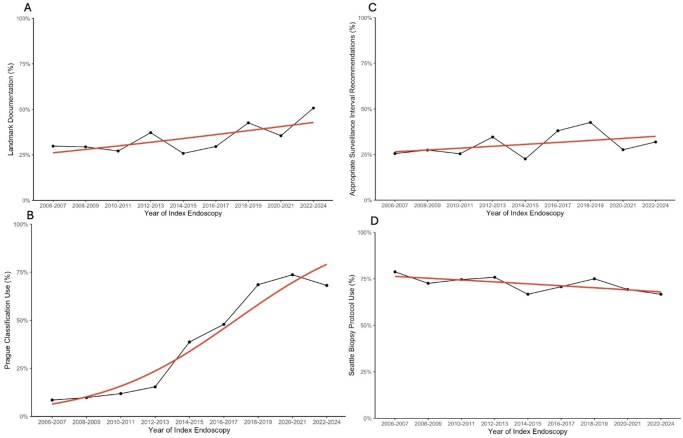 Figure 1
Peer Reviews
No public reviews on file for this paper yet. If you reviewed it on a platform where reviews are public (OpenReview, ICLR, NeurIPS, ICML), you can paste yours below so the community can read it here.
Videos
No videos yet. Explain this paper in a talk, walkthrough, or lecture? Add one.
Taxonomy
TopicsEsophageal Cancer Research and Treatment · Eosinophilic Esophagitis · Gastrointestinal Tumor Research and Treatment