Rising Obesity in Malaysia (1990–2023): A Comprehensive Analysis of Temporal Trends, Sex Inequalities, and Lifestyle Drivers
Vetriselvan Subramaniyan

Abstract
Genes, proteins, chemicals, diseases, species, mutations and cell lines named across the full text — each resolved to its canonical identifier and authoritative record.
Click any figure to enlarge with its caption.
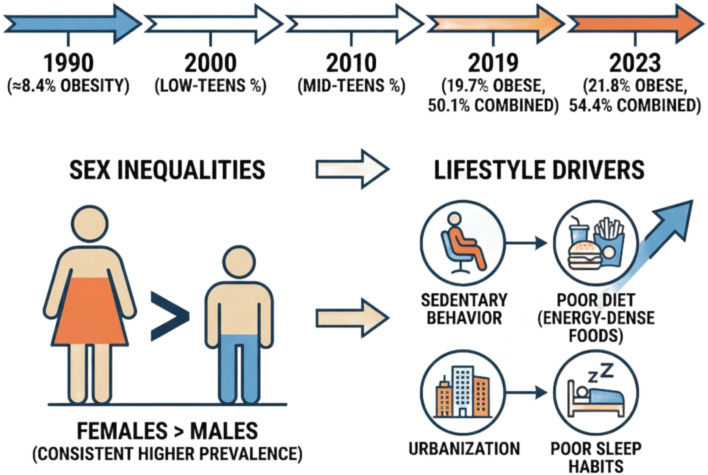 Figure 1
Peer Reviews
No public reviews on file for this paper yet. If you reviewed it on a platform where reviews are public (OpenReview, ICLR, NeurIPS, ICML), you can paste yours below so the community can read it here.
Videos
No videos yet. Explain this paper in a talk, walkthrough, or lecture? Add one.
Taxonomy
TopicsObesity, Physical Activity, Diet · Diabetes, Cardiovascular Risks, and Lipoproteins · Obesity and Health Practices
From 1990 to 2023, Malaysia transitioned from a low to moderate adult obesity prevalence to a high prevalence, highlighting a significant public health burden. In 1990, the WHO/NCD-RisC age-standardized estimate for adult obesity was approximately 8.4% [1]. By 2000, obesity had escalated, with NCD-RisC/WHO trend estimations indicating Malaysia’s prevalence in the low-teens percentage range at the century’s turn. By 2010, estimates had grown to the mid-teens, demonstrating consistent rises throughout the 1990s and 2000s, attributed to urbanization and dietary modifications. National surveys indicate an increasing prevalence of overweight and obesity throughout the 2010s. The NHMS 2011 documented an adult combined prevalence of overweight and obesity in the mid-40% range, as indicated by NHMS infographics and the 2011 prevalence research, which report significant obesity rates by sex [2]. In 2019, national NHMS statistics indicated that approximately 50.1% of adults were overweight or obese, with 19.7% categorized as obese (15.3% of males and 24.7% of women). The most recent NHMS 2023 revealed that the prevalence of combined overweight and obesity increased to 54.4% (overweight approximately 32.6%, obese approximately 21.8%), along with ongoing increases in abdominal obesity; WHO age-standardized data indicate an overall adult obesity estimate of approximately 17.9% (2022), aligning with this increasing trajectory [3].
Sex and lifestyle disparities are significant and consistent: females have consistently exhibited a higher prevalence of obesity than males in national surveys (e.g., NHMS 2019 and other studies: women ≈24–21% vs. men ≈15–16% depending on the year), and cohort analyses indicate more pronounced increases in BMI and waist circumference among women and certain ethnic groups. The NHMS 2023 identifies significant lifestyle factors such as elevated sedentary behavior, inadequate physical activity (with numerous adults reporting insufficient exercise, minimal active transportation, and low engagement in recreational physical activities), poor sleep habits, and dietary shifts towards energy-dense processed foods—all associated with the increasing prevalence of overweight and obesity. Ethnicity and urban residency are significant factors: Malays and Indians typically exhibit a greater prevalence of obesity compared to Chinese individuals in various studies, whereas urban populations generally demonstrate elevated rates of overweight, obesity, and abdominal obesity relative to rural populations [4].
As shown in Figure 1, Malaysia’s adult obesity rate nearly doubled from the 1990 baseline to the 2010s–2020s, with the latest national survey (NHMS 2023) indicating approximately 21.8% of the population is obese and 54.4% is overweight or obese overall. Women, specific ethnic groups (Malay, Indian), and sedentary individuals are disproportionately impacted, reflecting a pervasive, population-wide obesogenic transition influenced by dietary habits, physical activity, and demographic changes [3].
These prolonged patterns highlight a persistent obesogenic transition in Malaysia that currently jeopardizes health system resilience, worker productivity, and healthy aging. The enduring nature of sexual and ethnic disparities indicates that standardized interventions will be inadequate, necessitating the immediate implementation of culturally specific, gender-responsive solutions. Increasing abdominal obesity indicates elevated future risks of diabetes, cardiovascular disease, and metabolic diseases. The robust connections between sedentary lifestyles, urban habitation, and nutritional changes underscore the necessity for cohesive policies including urban planning, food systems, transportation, and occupational health. In the absence of effective, comprehensive preventative strategies, obesity-related health issues and healthcare expenditures are expected to increase significantly in the forthcoming decades.
The reference list from the paper itself. Each links out to its DOI / PubMed record.
- 1NCD Risk Factor Collaboration (NCD-Ris C). Worldwide Trends in Underweight and Obesity From 1990 to 2022: A Pooled Analysis of 3663 Population-Representative Studies With 222 Million Children, Adolescents, and Adults. Lancet (London, England) (2024) 403(10431):1027–50. 10.1016/S 0140-6736(23)02750-2 38432237 PMC 7615769 · doi ↗ · pubmed ↗
- 2Mohamud WN Musa KI Khir AS Ismail AAS Ismail IS Kadir KA Prevalence of Overweight and Obesity Among Adult Malaysians: An Update. Asia Pac J Clin Nutr (2011) 20(1):35–41. 10.6133/apjcn.2011.20.1.06 21393108 · doi ↗ · pubmed ↗
- 3National Health and Morbidity Survey 2019-2023. (2025).
- 4Teh CH Rampal S Kee CC Azahadi O Tahir A . Body Mass Index and Waist Circumference Trajectories Across the Life Course and Birth Cohorts, 1996-2015 Malaysia: Sex and Ethnicity Matter. Int J Obes (Lond) (2023) 47(12):1302–8. 10.1038/s 41366-023-01391-5 37833560 PMC 10663154 · doi ↗ · pubmed ↗