Pockets of Trouble: Diffuse Jejunal Diverticulosis Causing Refractory Intestinal Microbial Overgrowth
Eduardo Cruz, Richard Sukov, Jane Lim

Abstract
Genes, proteins, chemicals, diseases, species, mutations and cell lines named across the full text — each resolved to its canonical identifier and authoritative record.
Click any figure to enlarge with its caption.
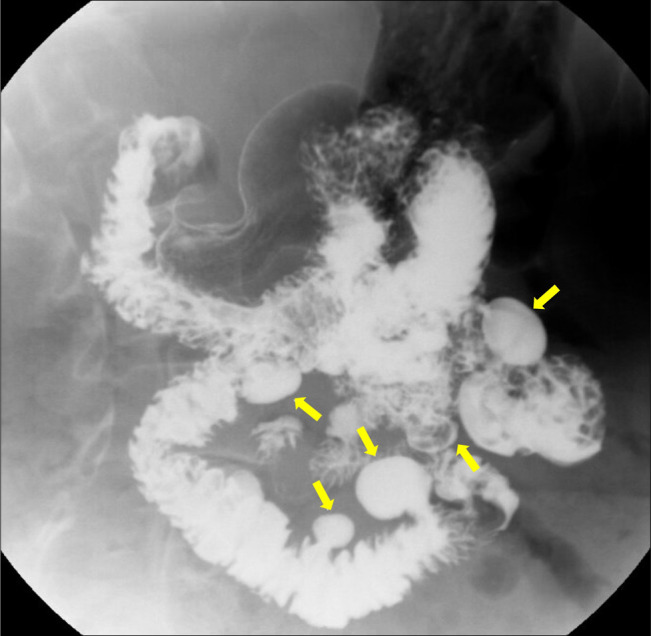 Figure 1
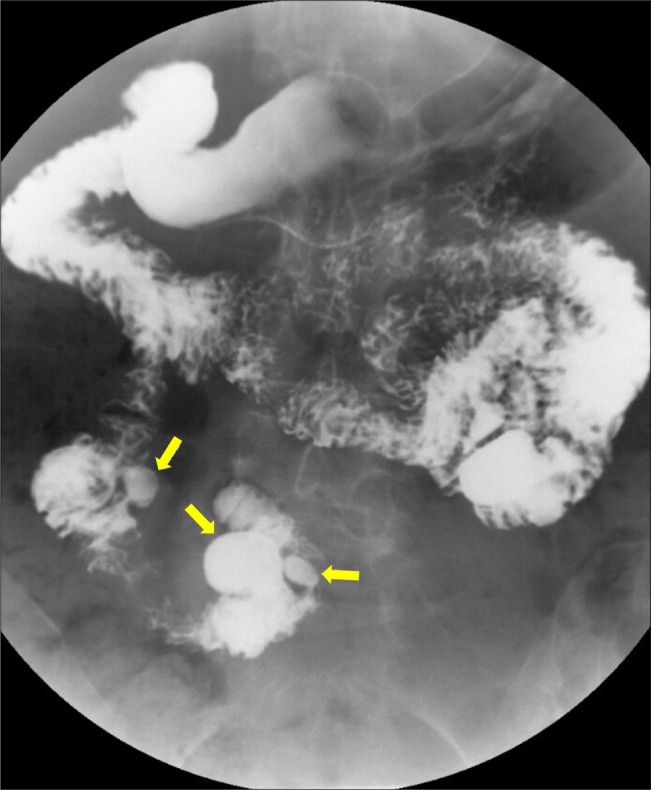 Figure 2
Peer Reviews
No public reviews on file for this paper yet. If you reviewed it on a platform where reviews are public (OpenReview, ICLR, NeurIPS, ICML), you can paste yours below so the community can read it here.
Videos
No videos yet. Explain this paper in a talk, walkthrough, or lecture? Add one.
Taxonomy
TopicsGastrointestinal disorders and treatments · Diverticular Disease and Complications · Gastrointestinal Bleeding Diagnosis and Treatment
CASE REPORT
A 69-year-old White woman with a body mass index of 23.38 kg/m^2^, chronic constipation, and small bowel diverticulosis complicated by prior diverticulitis presented with refractory small intestinal bacterial overgrowth (SIBO) and intestinal methanogen overgrowth (IMO). Despite four 2-week antibiotic courses of either rifaximin 550 mg 3 times daily or rifaximin plus neomycin 500 mg 2 times daily, symptom relief was short-lived, with bloating and abdominal distension recurring after treatment. Constipation was well controlled with polyethylene glycol. Lactulose breath testing revealed ongoing SIBO and IMO. To assess diverticular burden, a double-contrast upper gastrointestinal series with small bowel follow through was performed, revealing multiple moderate-to-large diverticula throughout the jejunum, a rare location (Figures 1 and 2).^1^ The extensive diverticulosis contributed to refractory SIBO and IMO by promoting intestinal stasis and bacterial fermentation of retained food debris within the diverticula.
Double-contrast upper gastrointestinal series with small bowel follow-through demonstrating multiple moderate- to large-sized diverticula throughout the jejunum.
Moderate-to-large sized divertiucla in the jejunum.
A nightly regimen of low-dose erythromycin 50 mg was initiated to augment migrating motor complexes and enhance clearance of the diverticula, leading to significant improvement of symptoms. Small bowel diverticulosis is rare and typically asymptomatic but may lead to refractory intestinal microbial overgrowth.^1–3^ Management options include low-dose prokinetics or when diverticula are localized, and symptom burden is severe, surgical resection.^1,2,4,5^
DISCLOSURES
Author contributions: E. Cruz drafted the manuscript. R. Sukov provided relevant images. J. Lim and R. Sukov revised the manuscript. All authors approved the submitted version of the manuscript. J. Lim is the article guarantor.
Financial disclosure: None to report.
Informed consent was obtained for this case report.
The reference list from the paper itself. Each links out to its DOI / PubMed record.
- 1Gross SA Katz S. Small bowel diverticulosis: An overlooked entity. Curr Treat Options Gastroenterol. 2003;6(1):3–11.12521566 10.1007/s 11938-003-0027-4 · doi ↗ · pubmed ↗
- 2Kassahun WT Fangmann J Harms J Bartels M Hauss J. Complicated small-bowel diverticulosis: A case report and review of the literature. World J Gastroenterol. 2007;13(15):2240–2.17465510 10.3748/wjg.v 13.i 15.2240 PMC 4146853 · doi ↗ · pubmed ↗
- 3Lamb R Kahlon A Sukumar S Layton B. Small bowel diverticulosis: Imaging appearances, complications, and pitfalls. Clin Radiol. 2022;77(4):264–73.35012738 10.1016/j.crad.2021.12.003 · doi ↗ · pubmed ↗
- 4Pimentel M Morales W Lezcano S Sun-Chuan D Low K Yang J. Low-dose nocturnal tegaserod or erythromycin delays symptom recurrence after treatment of irritable bowel syndrome based on presumed bacterial overgrowth. Gastroenterol Hepatol (N Y). 2009;5(6):435–42.20574504 PMC 2886395 · pubmed ↗
- 5Ghoshal UC Sachdeva S Ghoshal U . Asian-Pacific consensus on small intestinal bacterial overgrowth in gastrointestinal disorders: An initiative of the Indian Neurogastroenterology and Motility Association. Indian J Gastroenterol. 2022;41(5):483–507.36214973 10.1007/s 12664-022-01292-x PMC 9549446 · doi ↗ · pubmed ↗