Nasal Staphylococcus aureus in COVID-19 Patients Shows No Enrichment of High-Risk Clones
Lidia Piechowicz, Agnieszka Necel, Katarzyna Kosznik-Kwaśnicka, Magdalena Pałys, Anna Pałubicka, Jacek Międzobrodzki, Maja Kosecka-Strojek

TL;DR
The study found that S. aureus in the noses of hospitalized COVID-19 patients are not more dangerous or drug-resistant than usual.
Contribution
The study shows no selective enrichment of high-risk S. aureus clones in COVID-19 patients.
Findings
Only 6.4% of S. aureus isolates from COVID-19 patients were methicillin resistant.
Most isolates showed limited antimicrobial resistance beyond MLSB phenotype.
Genetic diversity was high with no dominant clone identified.
Abstract
Staphylococcus aureus nasal carriage is a potential source of secondary infections in COVID-19 patients, yet it remains unclear whether SARS-CoV-2 infection favors colonization by more virulent or resistant strains. We analyzed 31 nasal S. aureus isolates from hospitalized COVID-19 patients to assess antimicrobial resistance, virulence gene content, and genetic diversity. Only two isolates (6.4%) were methicillin resistant, and most strains showed limited resistance beyond the MLSB phenotype. Adhesin genes were highly prevalent, whereas toxin genes were detected in only 16.1% of isolates. Spa typing revealed high genetic diversity with no dominant clone. Overall, S. aureus isolates from COVID-19 patients did not differ substantially from previously described carriage strains, suggesting no selective enrichment of highly virulent or resistant lineages during SARS-CoV-2 infection.
Genes, proteins, chemicals, diseases, species, mutations and cell lines named across the full text — each resolved to its canonical identifier and authoritative record.
Click any figure to enlarge with its caption.
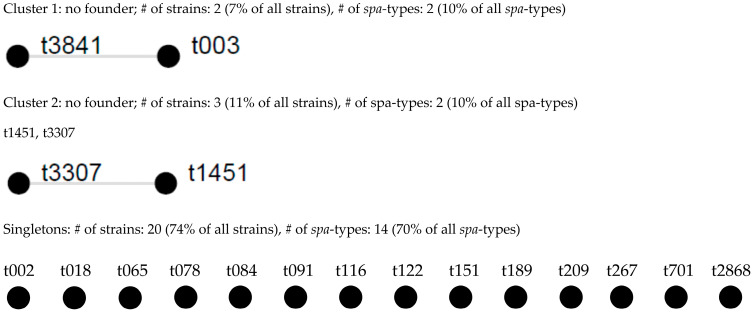 Figure 1
- —Medical University of Gdańsk
Peer Reviews
No public reviews on file for this paper yet. If you reviewed it on a platform where reviews are public (OpenReview, ICLR, NeurIPS, ICML), you can paste yours below so the community can read it here.
Videos
No videos yet. Explain this paper in a talk, walkthrough, or lecture? Add one.
Taxonomy
TopicsAntimicrobial Resistance in Staphylococcus · Antibiotic Use and Resistance · SARS-CoV-2 and COVID-19 Research
1. Introduction
Staphylococcus aureus is a major opportunistic pathogen responsible for a wide spectrum of infections ranging from mild skin disease to severe invasive conditions such as pneumonia, sepsis, and infective endocarditis [1]. Secondary bacterial infections have historically contributed substantially to morbidity and mortality during viral respiratory pandemics, and S. aureus remains one of the most frequently reported bacterial pathogens associated with severe viral illness [2,3]. In patients with COVID-19, S. aureus has been commonly identified as a cause of bacterial coinfection, particularly among hospitalized and critically ill individuals [4,5,6].
Nasal carriage of S. aureus represents a key endogenous reservoir for subsequent infection. Approximately 20–30% of healthy adults are persistent nasal carriers, and carriage is associated with a markedly increased risk of invasive disease, especially in elderly and hospitalized patients [7,8]. In individuals with SARS-CoV-2 infection, reported S. aureus carriage rates are comparable to those observed in the general population, yet concerns remain that viral infection, immune dysregulation, or antibiotic exposure may favor colonization by strains with increased virulence or antimicrobial resistance [7,9]. Therefore, detection of S. aureus carriage—especially methicillin-resistant S. aureus (MRSA)—is important for preventing and managing secondary infections in COVID-19 patients.
The pathogenic potential of S. aureus is determined by a combination of antimicrobial resistance, virulence gene content, and genetic background [10,11,12]. Adhesins facilitating colonization and tissue invasion, as well as toxin genes encoding superantigens, contribute to disease severity, while clonal lineage influences transmission dynamics and epidemiology. However, data addressing whether S. aureus strains colonizing COVID-19 patients differ from previously described carriage isolates remain limited.
In this Communication, we provide a concise molecular snapshot of nasal S. aureus isolates recovered from hospitalized COVID-19 patients, focusing on antimicrobial resistance patterns, selected virulence determinants, and genetic diversity assessed by spa typing. The aim of this study was to determine whether SARS-CoV-2 infection is associated with enrichment of particular S. aureus clones or virulence profiles among nasal carriers.
2. Results
A total of 31 nasal Staphylococcus aureus isolates from COVID-19 patients were analyzed. Overall antimicrobial resistance was low. Only two isolates (6.4%) were identified as MRSA, and resistance to antibiotics other than β-lactams was uncommon. The macrolide-lincosamide-streptogramin B (MLSB) resistance phenotype was observed in 35.5% of isolates, predominantly as inducible resistance, while resistance to ciprofloxacin and mupirocin was rare. All isolates were susceptible to glycopeptides, sulfamethoxazole/trimethoprim and aminoglycosides tested (Table 1).
Virulence gene profiling revealed a high prevalence of adhesin genes associated with nasal colonization. Genes encoding laminin-binding protein (eno) and clumping factors (clfA, clfB) were detected in all isolates, whereas other adhesin genes occurred at variable frequencies. In contrast, toxin genes were infrequently detected, with only five isolates (16.1%) carrying genes encoding toxic shock syndrome toxin or enterotoxins. Genes encoding Panton–Valentine leucocidin and exfoliative toxins were absent (Table 2).
Spa typing demonstrated substantial genetic heterogeneity among the isolates, as illustrated in Figure 1. Twenty different spa types were identified, with most isolates belonging to unrelated genetic backgrounds and no dominant clone observed. Both MRSA isolates and toxin-positive strains were distributed among distinct spa types, indicating the absence of clonal expansion of high-risk lineages among nasal S. aureus isolates from COVID-19 patients. Detailed spa types and associated resistance and virulence profiles are provided in Supplementary Table S1, while the occurrence of adhesins in relation to spa types is presented in Supplementary Table S2.
3. Discussion
Secondary bacterial infections, particularly those caused by Staphylococcus aureus, have been recognized as important contributors to adverse outcomes during viral respiratory infections, including COVID-19 [13]. However, whether SARS-CoV-2 infection promotes colonization by S. aureus strains with enhanced virulence or antimicrobial resistance has remained unclear [14]. In this Communication, we show that nasal S. aureus isolates from hospitalized COVID-19 patients do not differ substantially from previously described carriage strains with respect to resistance profiles, virulence gene content, or genetic structure.
Overall antimicrobial resistance among the analyzed isolates was low. Only a small proportion of strains were identified as MRSA, and resistance to non-β-lactam antibiotics was limited, with the MLSB phenotype being the most frequently observed. These findings are consistent with reports from the general population and hospitalized cohorts and do not indicate selective enrichment of multidrug-resistant S. aureus during SARS-CoV-2 infection [15,16,17,18,19,20,21,22,23,24]. Importantly, resistance to mupirocin and fluoroquinolones was rare, suggesting that nasal decolonization strategies remain effective in this setting [25].
Analysis of virulence determinants revealed a high prevalence of adhesin genes involved in colonization and host tissue interaction, which is characteristic of S. aureus nasal carriage isolates [11,26,27,28]. In contrast, toxin genes encoding superantigens were detected infrequently and were distributed among unrelated genetic backgrounds. The low prevalence of toxin genes and the absence of Panton–Valentine leucocidin or exfoliative toxin genes further support the conclusion that SARS-CoV-2 infection does not preferentially select for highly virulent S. aureus strains at the level of nasal carriage [17,29].
Genotyping by spa typing demonstrated substantial genetic diversity, with most isolates belonging to unrelated spa types and no dominant clone identified. This heterogeneous population structure mirrors that observed in asymptomatic carriers and indicates that colonization in COVID-19 patients arises from diverse endogenous strains rather than expansion of specific epidemic lineages. Although individual isolates carrying notable resistance or virulence traits were identified, these occurred sporadically and were not associated with a particular clonal background [30,31,32,33,34].
This study has limitations, including the relatively small sample size and single-center design, which restrict the generalizability of the findings. Nevertheless, the consistency of our results with existing carriage studies suggests that the observed patterns are representative rather than incidental.
In summary, nasal S. aureus isolates from COVID-19 patients exhibit genetic diversity, limited antimicrobial resistance, and virulence profiles comparable to those of previously described carrier strains. These data indicate that SARS-CoV-2 infection is not associated with enrichment of high-risk lineages among nasal carriers, while highlighting the importance of continued surveillance in elderly and hospitalized populations.
4. Materials and Methods
4.1. Isolation and Identification of S. aureus
Between December 2021 and April 2024, a total of 31 Staphylococcus aureus isolates were recovered from anterior nasal swabs of hospitalized patients with confirmed SARS-CoV-2 infection. Samples were collected during routine admission screening at a regional hospital in northern Poland, with one isolate included per patient. Bacterial identification was performed using standard microbiological methods. Ethical approval was obtained from the Local Independent Committee for Ethics in Scientific Research at the Medical University of Gdańsk (NKBBN/525/2021). The main clinical characteristics of the patients are summarized in Supplementary Table S3.
4.2. Antimicrobial Susceptibility Testing
Antimicrobial susceptibility was determined using the disk diffusion method in accordance with EUCAST guidelines accurate for the year of specimen’s isolation [35]. Methicillin resistance was identified using cefoxitin disks and confirmed by detection of the PBP2a protein. Inducible macrolide-lincosamide-streptogramin B (MLSB) resistance was assessed using the D-test. Susceptibility to vancomycin and teicoplanin was evaluated using E-test strips. Reference S. aureus strains ATCC 25923 and ATCC 43300 were used for quality control.
4.3. Detection of Virulence Genes
Genomic DNA was extracted from all isolates, and selected virulence genes encoding adhesins and toxins were detected by PCR using previously described protocols [36,37]. Target genes included adhesins associated with colonization and tissue interaction as well as genes encoding superantigenic toxins.
4.4. Spa Typing
Genetic diversity was assessed by spa typing based on sequencing of the polymorphic X region of the spa gene [38,39]. Spa types were assigned using the Ridom SpaServer database, and clonal relatedness was evaluated using the BURP algorithm. Detailed spa typing parameters and extended clustering results are provided in the Supplementary Materials.
The reference list from the paper itself. Each links out to its DOI / PubMed record.
- 1Cheung G.Y.C. Bae J.S. Otto M. Pathogenicity and virulence of Staphylococcus aureus Virulence 20211254756910.1080/21505594.2021.187868833522395 PMC 7872022 · doi ↗ · pubmed ↗
- 2Leung C.-H. Tseng H.-K. Wang W.-S. Chiang H.-T. Wu A.Y.-J. Liu C.-P. Clinical characteristics of children and adults hospitalized for influenza virus infection J. Microbiol. Immunol. Infect.20144751852510.1016/j.jmii.2013.06.00223932366 · doi ↗ · pubmed ↗
- 3Mirzaei R. Goodarzi P. Asadi M. Soltani A. Aljanabi H.A.A. Jeda A.S. Dashtbin S. Jalalifar S. Mohammadzadeh R. Teimoori A. Bacterial co-infections with SARS-Co V-2IUBMB Life 2020722097211110.1002/iub.235632770825 PMC 7436231 · doi ↗ · pubmed ↗
- 4Pandey M. May A. Tan L. Hughes H. Jones J.P. Harrison W. Bradburn S. Tyrrel S. Muthuswamy B. Berry N. Comparative incidence of early and late bloodstream and respiratory tract co-infection in patients admitted to ICU with COVID-19 pneumonia versus Influenza A or B pneumonia versus no viral pneumonia: Wales multicentre ICU cohort study Crit. Care 20222615810.1186/s 13054-022-04026-935655224 PMC 9160852 · doi ↗ · pubmed ↗
- 5Baskaran V. Lawrence H. Lansbury L.E. Webb K. Safavi S. Zainuddin N.I. Huq T. Eggleston C. Ellis J. Thakker C. Co-infection in critically ill patients with COVID-19: An observational cohort study from England: Read the story behind the paper on the Microbe Post here J. Med. Microbiol.20217000135010.1099/jmm.0.00135033861190 PMC 8289210 · doi ↗ · pubmed ↗
- 6Rawson T.M. Moore L.S.P. Zhu N. Ranganathan N. Skolimowska K. Gilchrist M. Satta G. Cooke G. Holmes A. Bacterial and Fungal Coinfection in Individuals With Coronavirus: A Rapid Review To Support COVID-19 Antimicrobial Prescribing Clin. Infect. Dis.2020712459246810.1093/cid/ciaa 53032358954 PMC 7197596 · doi ↗ · pubmed ↗
- 7Nouwen J.L. Ott A. Kluytmans-Vandenbergh M.F.Q. Boelens H.A.M. Hofman A. Van Belkum A. Verbrugh H.A. Predicting the Staphylococcus aureus Nasal Carrier State: Derivation and Validation of a “Culture Rule”Clin. Infect. Dis.20043980681110.1086/42337615472812 · doi ↗ · pubmed ↗
- 8Susethira A. Management of Methicillin Resistant Staphylococcus aureus Infection of Endogenous Origin in an Electrical Burns Patient—A Case Report Br. Microbiol. Res. J.201441138114110.9734/BMRJ/2014/10044 · doi ↗