Expanding the evidence base: The impact of Tobacco 21 policies on youth tobacco use
Danyi Li, Linyun Fu, Nathan Davies, Steve Sussman, Mary A. Pentz

Abstract
Genes, proteins, chemicals, diseases, species, mutations and cell lines named across the full text — each resolved to its canonical identifier and authoritative record.
Click any figure to enlarge with its caption.
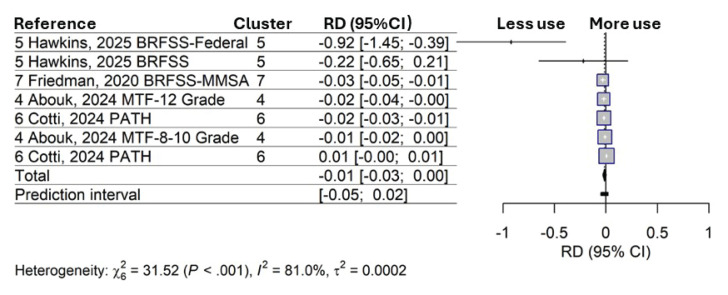 Figure 1
Peer Reviews
No public reviews on file for this paper yet. If you reviewed it on a platform where reviews are public (OpenReview, ICLR, NeurIPS, ICML), you can paste yours below so the community can read it here.
Videos
No videos yet. Explain this paper in a talk, walkthrough, or lecture? Add one.
Taxonomy
TopicsSmoking Behavior and Cessation · Global Public Health Policies and Epidemiology · Obesity, Physical Activity, Diet
Dear Editor,
The minimum age for tobacco sales was raised to 21 years by the United States federal government in 2019 (known as Tobacco-21 or T21-policy).
Two recent systematic reviews, one with a meta-analysis, have synthesized the effects of T21 and found that T21 may reduce current cigarette-smoking in youth; however, the evidence quality was moderate and did not reach statistical significance^1-3^. The published meta-analysis was on odds ratios, and excluded effects from linear probability models and marginal effects of a unit probability change, both of which are risk differences (RDs)^1,2^. As the evidence on T21 continues to expand, we updated the systematic review and conducted a meta-analysis on RDs to offer a more comprehensive view.
Following the same search strategy and inclusion criteria as a previous meta-analysis^1,2^, we updated the literature search in 14 databases from the last search date, 1 January to 20 October 2025, and identified an additional 405 studies for eligibility screening. We included empirical studies evaluating T21’s effect on current cigarette-smoking in youth (aged 11–20 years) in the US. We constrained the analysis to the effects comparing youth smoking pre- and post-policy in areas with versus without a T21. Four studies, reporting a total of seven effect sizes, were included in a random-effects model^4-7^. Overall, the studies were well-designed and adjusted for key confounders; however, the effects included in the meta-analysis relied on self-reported smoking, which may introduce information and social expectation biases.
As shown in Figure 1, the T21s revealed a one-percentage-point lower risk of current cigarette-smoking (RD= -0.01; 95% CI: -0.03–0.003) compared to the non-T21 areas before policy implementation, although the effect was not statistically significant. The prediction interval (PI) quantifies the range of estimated true effects of future T21 evaluations across different settings^8^. The 95% CI: -0.05–0.02 suggests that for 95% of future studies, the true effects may vary from small increases (2%) to as much as a 5% reduction in current smoking.
Policy adoption does not always lead to reductions in youth smoking; implementation, enforcement, evaluation, and contextual factors must be considered. For example, primacy and recency effects were observed in the Needham 2005 T21 evaluation^9^. The study found a greater decline in youth smoking in Needham than in comparison areas within the first five years following T21 adoption; however, the effect diminished after five years, suggesting a potential floor effect^9^. Policy enforcement strength also plays a role, as shown in one of the recent evaluations on state T21s^10^. Although the study found an overall null policy effect on smoking, further differentiation of policy components revealed that stronger T21s (allowing stricter local policies, requiring retailers to be licensed, and including a violation penalty scheme) were associated with reduced smoking^10^. In addition, T21 may be more effective in areas with higher smoking prevalence and for populations with lower socioeconomic status^3^. Better protection of youth from tobacco use does not solely rely on policy adoption, but also on thoughtful policy design, consistent enforcement, and continuous equity-focused evaluation, as contextual factors and public awareness interact with policies and shape policy effectiveness.
The reference list from the paper itself. Each links out to its DOI / PubMed record.
- 1Li D, Wu S, Sussman S, Pentz MA. A systematic review and meta-analysis of Tobacco 21 policies and youth tobacco use: implications for future policy research. Lancet Reg Health Am. 2025;50:101208. doi:10.1016/j.lana.2025.10120840822646 PMC 12356382 · doi ↗ · pubmed ↗
- 2Li D, Wu S, Sussman S, Pentz MA. Corrigendum to “A systematic review and meta-analysis of Tobacco 21 policies and youth tobacco use: implications for future policy research”- The Lancet Regional Health-Americas 2025; Volume 50: 101208; DOI: 10.1016/j.lana.2025.101208. Lancet Reg Health Am. 2025;51:101277. doi:10.1016/j.lana.2025.10127740822646 PMC 12356382 · doi ↗ · pubmed ↗
- 3Davies N, Bogdanovica I, Mc Gill S, Murray RL. What is the relationship between raising the minimum legal sales age of tobacco above 20 and cigarette smoking? A systematic review. Nicotine Tob Res. 2025;27(3):369-377. doi:10.1093/ntr/ntae 20639234626 PMC 11847775 · doi ↗ · pubmed ↗
- 4Abouk R, De P, Pesko MF. Estimating the effects of Tobacco 21 on youth tobacco use and sales. J Health Econ. 2024;94:102860. doi:10.1016/j.jhealeco.2024.10286038341937 PMC 12104388 · doi ↗ · pubmed ↗
- 5Hawkins SS, Carey N, Coley RL, Baum CF. Associations between Tobacco 21 and state flavour restrictions with young adult tobacco use. Tob Control. 2025;34:571-578. doi:10.1136/tc-2023-05844838527790 PMC 11693773 · doi ↗ · pubmed ↗
- 6Cotti C, De Cicca P, Nesson E. The effects of Tobacco 21 laws on smoking and vaping: evidence from panel data and biomarkers. J Health Econ. 2024;98:102932. doi:10.1016/j.jhealeco.2024.10293239405807 · doi ↗ · pubmed ↗
- 7Friedman AS, Wu RJ. Do local Tobacco 21 laws reduce smoking among 18- to 20-year-olds? Nicotine Tob Res. 2020;22(7):1195-1201. doi:10.1093/ntr/ntz 12331348515 · doi ↗ · pubmed ↗
- 8Int Hout J, Ioannidis JPA, Rovers MM, Goeman JJ. Plea for routinely presenting prediction intervals in meta-analyses. BMJ Open. 2016;6(7):e 010247. doi:10.1136/bmjopen-2015-010247 PMC 494775127406637 · doi ↗ · pubmed ↗