Artificial Intelligence for Exosomal Biomarker Discovery for Cardiovascular Diseases: Multi-Omics Integration, Reproducibility, and Translational Prospects
Rasit Dinc, Nurittin Ardic

TL;DR
This paper explores how artificial intelligence can help discover exosome-based biomarkers for cardiovascular diseases by integrating multi-omics data and improving reproducibility.
Contribution
The paper introduces a practical framework for AI-driven exosomal biomarker discovery with reproducibility and translational criteria.
Findings
Ensemble methods like Random Forest and gradient boosting show consistent performance for EV biomarker classification.
Graph neural networks are promising for path integration but need larger validation.
EV-derived biomarker panels show promise in acute myocardial infarction and heart failure.
Abstract
Exosomes and other extracellular vesicles (EVs) carry microRNAs, proteins, and lipids that reflect cardiovascular pathophysiology and can enable minimally invasive biomarker discovery. However, EV datasets are highly dimensional and heterogeneous, strongly influenced by pre-analytic variables and non-standardized isolation/characterization workflows, limiting reproducibility across studies. Artificial intelligence (AI), including machine learning (ML), deep learning (DL), and network-based approaches, can support EV biomarker development by integrating multi-omics profiles with clinical metadata. These approaches enable feature selection, disease subtyping, and interpretable model development. Among the AI approaches evaluated, ensemble methods (Random Forest, gradient boosting) demonstrate the most consistent performance for EV biomarker classification (AUC 0.80–0.92), while graph…
Genes, proteins, chemicals, diseases, species, mutations and cell lines named across the full text — each resolved to its canonical identifier and authoritative record.
Click any figure to enlarge with its caption.
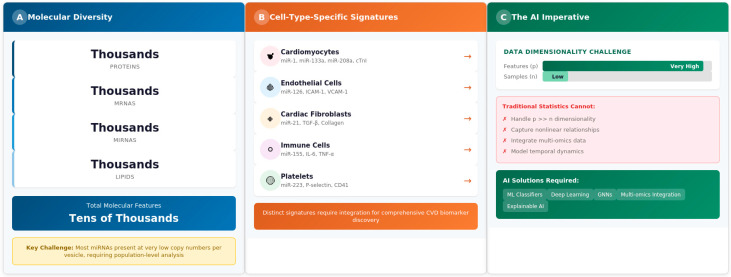 Figure 1
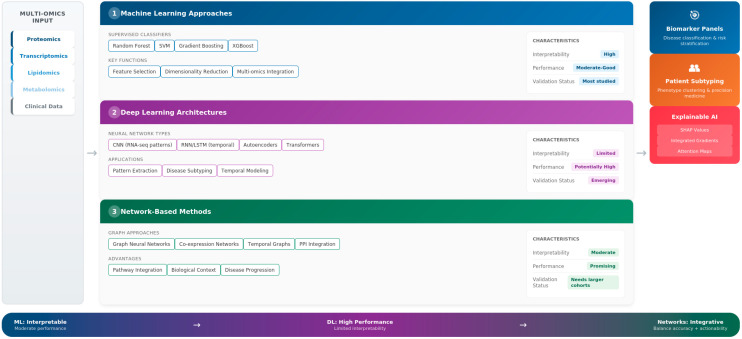 Figure 2
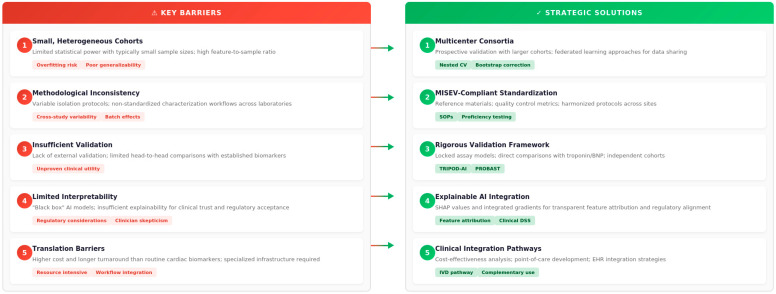 Figure 3
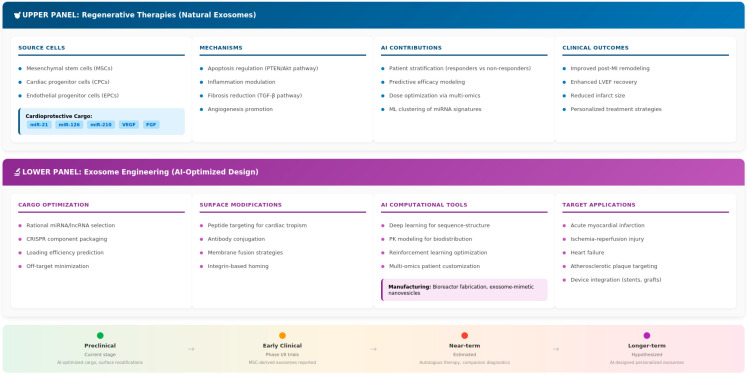 Figure 4
Peer Reviews
No public reviews on file for this paper yet. If you reviewed it on a platform where reviews are public (OpenReview, ICLR, NeurIPS, ICML), you can paste yours below so the community can read it here.
Videos
No videos yet. Explain this paper in a talk, walkthrough, or lecture? Add one.
Taxonomy
TopicsExtracellular vesicles in disease · Ferroptosis and cancer prognosis · Single-cell and spatial transcriptomics