Point-of-Care Veterinary Diagnostics Using Vis–NIR Spectroscopy: Current Opportunities and Future Directions
Sofia Rosa, Ana C. Silvestre-Ferreira, Rui Martins, Felisbina Luísa Queiroga

TL;DR
This paper explores how Vis-NIR spectroscopy can enable fast, portable diagnostics in veterinary medicine, with AI helping to overcome technical challenges.
Contribution
The study highlights the integration of Vis-NIR spectroscopy with self-learning AI to enhance veterinary diagnostics at the point of care.
Findings
Vis-NIR spectroscopy is rapid, non-invasive, and suitable for portable devices in veterinary diagnostics.
Combining Vis-NIR with self-learning AI improves accuracy by mitigating spectral interferences.
Applications include hemogram analysis in dogs, cats, and salmon, and parasite detection in sheep.
Abstract
This study explores how Visible-Near-Infrared (Vis-NIR) spectroscopy can transform veterinary diagnostics at the point of care (POC). Unlike more complex laboratory techniques, Vis-NIR is fast, non-invasive, and compatible with portable, low-cost POC devices. By measuring how light interacts with biological samples, this technology provides immediate biochemical results without the need for chemical reagents. Although challenges remain, combining Vis-NIR with Self-Learning Artificial Intelligence (SLAI) is essential to improve accuracy and filter out technical interferences. This synergy not only speeds up diagnosis but also makes healthcare more accessible, directly supporting the One Health initiative. Visible-Near-Infrared (Vis-NIR) spectroscopy, spanning approximately 400 to 2500 nm, is an innovative technology with growing relevance for diagnostics performed at the point of care…
Genes, proteins, chemicals, diseases, species, mutations and cell lines named across the full text — each resolved to its canonical identifier and authoritative record.
Click any figure to enlarge with its caption.
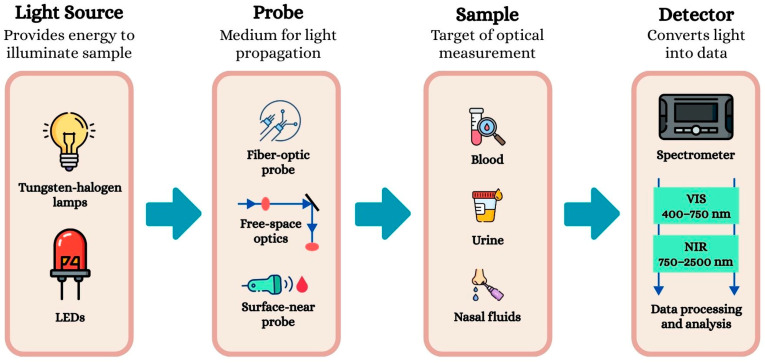 Figure 1
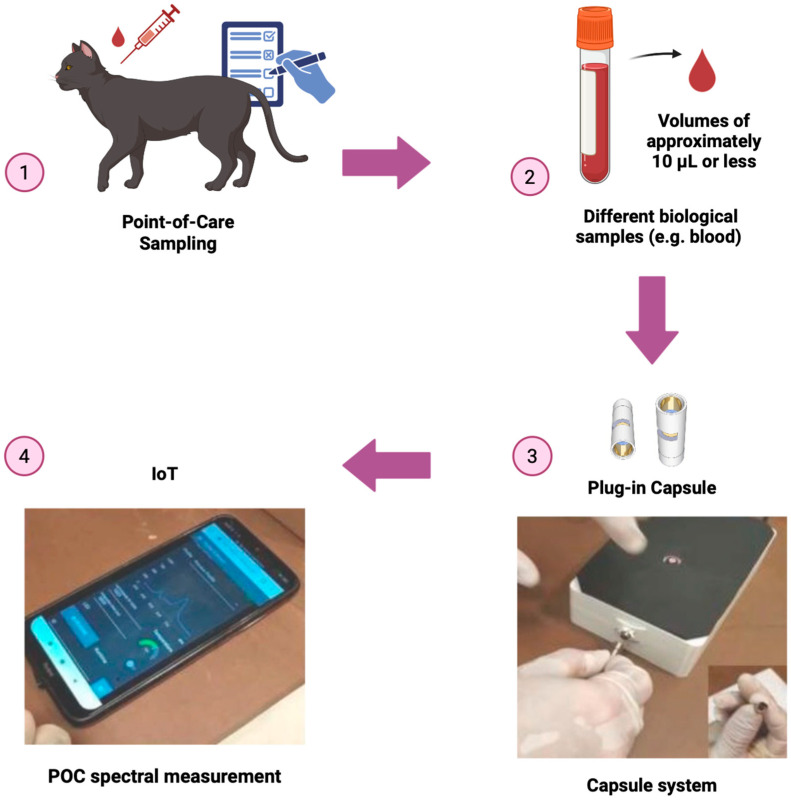 Figure 2
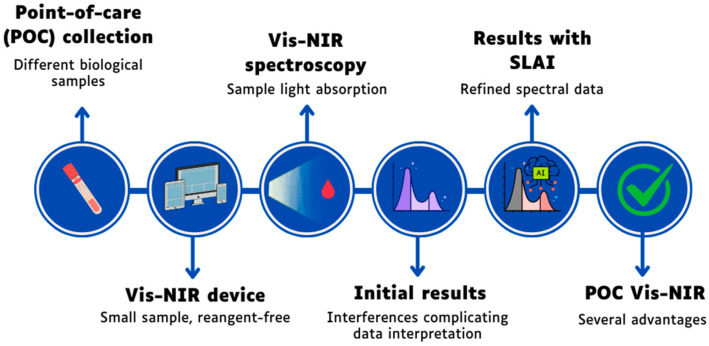 Figure 3
Peer Reviews
No public reviews on file for this paper yet. If you reviewed it on a platform where reviews are public (OpenReview, ICLR, NeurIPS, ICML), you can paste yours below so the community can read it here.
Videos
No videos yet. Explain this paper in a talk, walkthrough, or lecture? Add one.
Taxonomy
TopicsSpectroscopy Techniques in Biomedical and Chemical Research · Spectroscopy and Chemometric Analyses · Optical Imaging and Spectroscopy Techniques