MAGE (Multimodal AI-Enhanced Gastrectomy Evaluation): Comparative Analysis of Machine Learning Models for Postoperative Complications in Central European Gastric Cancer Population
Wojciech Górski, Marcin Kubiak, Amir Nour Mohammadi, Maksymilian Podleśny, Gian Luca Baiocchi, Manuele Gaioni, S. Vincent Grasso, Andrew Gumbs, Timothy M. Pawlik, Bartłomiej Drop, Albert Chomątowski, Zuzanna Pelc, Katarzyna Sędłak, Michał Woś, Karol Rawicz-Pruszyński

TL;DR
This study uses machine learning to predict postoperative complications in gastric cancer patients, aiming to improve surgical risk assessment and treatment planning.
Contribution
The study introduces a free online risk calculator and demonstrates superior performance of non-linear ML models in predicting complications.
Findings
XGBoost and Random Forest models achieved the highest accuracy in predicting postoperative complications.
Non-linear machine learning models outperformed traditional linear approaches in complication prediction.
A publicly accessible online risk calculator was developed for clinical use.
Abstract
Patients undergoing surgery for gastric cancer face a meaningful risk of postoperative complications, yet reliable tools to predict who is most at risk are still limited. In this study, we aimed to support preoperative decision-making by developing machine-learning models trained on data from gastric cancer patients receiving multimodal therapy at the Department of Surgical Oncology, Medical University of Lublin. If validated in future studies, this approach could help clinicians estimate surgical risk more accurately, individualize treatment planning, and improve perioperative safety. We also developed a free, user-friendly online risk calculator to facilitate clinical use. Introduction: By leveraging dedicated datasets and predictive modeling, machine-learning (ML) algorithms can estimate the probability of both short- and long-term outcomes after surgery. The aim of this study was…
Genes, proteins, chemicals, diseases, species, mutations and cell lines named across the full text — each resolved to its canonical identifier and authoritative record.
Click any figure to enlarge with its caption.
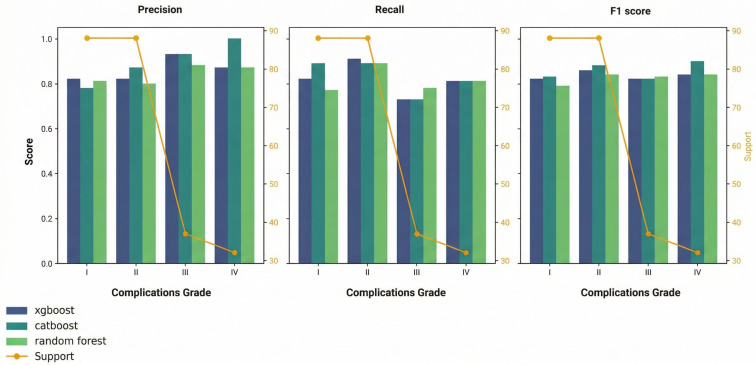 Figure 1
 Figure 2
 Figure 3
Peer Reviews
No public reviews on file for this paper yet. If you reviewed it on a platform where reviews are public (OpenReview, ICLR, NeurIPS, ICML), you can paste yours below so the community can read it here.
Videos
No videos yet. Explain this paper in a talk, walkthrough, or lecture? Add one.
Taxonomy
TopicsGastric Cancer Management and Outcomes · Radiomics and Machine Learning in Medical Imaging · Gastrointestinal Tumor Research and Treatment