Association of p53 Pro72Arg Polymorphism with Hepatocellular Carcinoma Risk in Hepatitis B Across Multiethnic Populations
Ulfa Kholili, Amal Arifi Hidayat, Ugroseno Yudho Bintoro, Soetjipto Soetjipto, Aryati Aryati, Alwi Alaydrus, Muhammad Miftahussurur

TL;DR
This study examines how a genetic variation in the p53 gene affects liver cancer risk in hepatitis B patients from Indonesia, finding ethnic and clinical subgroup differences.
Contribution
The study identifies ethnic-specific and clinical subgroup associations of the p53 Pro72Arg polymorphism with hepatocellular carcinoma in a multiethnic Indonesian population.
Findings
No overall association between p53 Pro72Arg and HCC risk was found in the general population.
Madurese patients with Pro/Arg or Arg/Arg genotypes showed increased HCC susceptibility.
Pro/Arg carriers with decompensated cirrhosis were more likely to develop HCC.
Abstract
Hepatocellular carcinoma (HCC) is a complex, multistage disease influenced by viral and genetic factors. The tumor suppressor p53 gene, located on chromosome 17p13.1, plays a central role in genome protection through cell cycle arrest, apoptosis, senescence, and Deoxyribonucleic Acid (DNA) repair. A common single-nucleotide polymorphism at codon 72 (Pro72Arg, rs1042522) alters p53 function, with the arginine variant favoring apoptosis and the proline variant enhancing cell cycle arrest. To investigate its role in the diverse multiethnic population of Indonesia, we analyzed Pro72Arg polymorphism on 140 Chronic Hepatitis B (CHB) patients (79 with HCC, 61 controls) by direct DNA sequencing. Genotype frequencies were 12.9% Pro/Pro, 31.4% Arg/Arg, and 55.7% Pro/Arg. No overall association with HCC risk was observed; however, Madurese patients carrying Pro/Arg or Arg/Arg genotypes showed…
Genes, proteins, chemicals, diseases, species, mutations and cell lines named across the full text — each resolved to its canonical identifier and authoritative record.
Click any figure to enlarge with its caption.
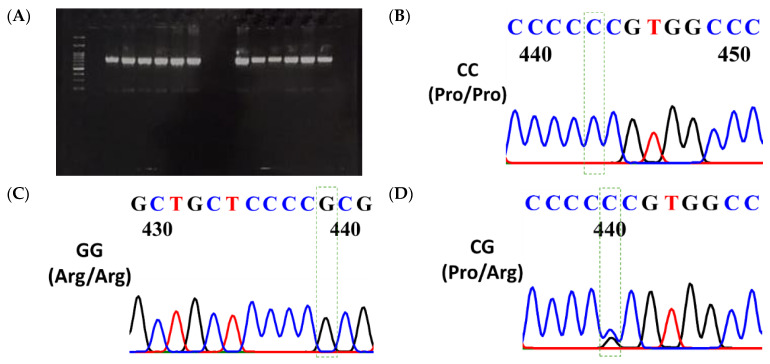 Figure 1
Peer Reviews
No public reviews on file for this paper yet. If you reviewed it on a platform where reviews are public (OpenReview, ICLR, NeurIPS, ICML), you can paste yours below so the community can read it here.
Videos
No videos yet. Explain this paper in a talk, walkthrough, or lecture? Add one.
Taxonomy
TopicsCancer-related Molecular Pathways · Virus-based gene therapy research · Hepatitis B Virus Studies