Prognostic Value of Qualitative Splenic [18F]FDG Uptake on Baseline PET/CT in Newly Diagnosed Diffuse Large B-Cell Lymphoma
Yunhwi Hwang, Sung Hwa Bae, Sang Jun Byun, Byungwook Choi

TL;DR
This study shows that increased splenic uptake on baseline PET/CT scans in blood cancer patients predicts worse outcomes and relapse, independent of other risk factors.
Contribution
The study introduces a simple visual assessment of splenic [18F]FDG uptake as an independent prognostic factor in diffuse large B-cell lymphoma.
Findings
Patients with visually increased splenic uptake had significantly higher relapse rates and poorer survival outcomes.
Positive splenic uptake remained an independent predictor of relapse-free survival in multivariable analysis.
The feature is easily applicable in routine clinical practice without complex measurements.
Abstract
Diffuse large B-cell lymphoma is an aggressive blood cancer where predicting outcomes at diagnosis is vital for treatment planning. [18F]FDG positron emission tomography/computed tomography ([18F]FDG PET/CT) is routinely used to assess disease extent by detecting metabolic activity, yet visual features outside tumor sites remain underutilized. This study focused on the qualitative visual assessment of splenic [18F]FDG uptake on baseline scans, avoiding complex quantitative measurements. We found that patients showing visually increased splenic uptake at diagnosis were significantly more likely to experience relapse and had poorer survival outcomes. Importantly, this feature predicted relapse independent of established clinical risk factors. These findings suggest that a simple visual check of the spleen on routine [18F]FDG PET/CT provides valuable prognostic information and is easily…
Genes, proteins, chemicals, diseases, species, mutations and cell lines named across the full text — each resolved to its canonical identifier and authoritative record.
Click any figure to enlarge with its caption.
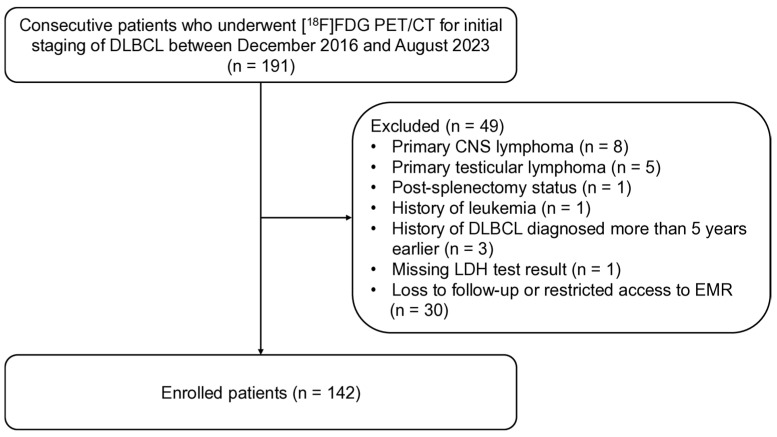 Figure 1
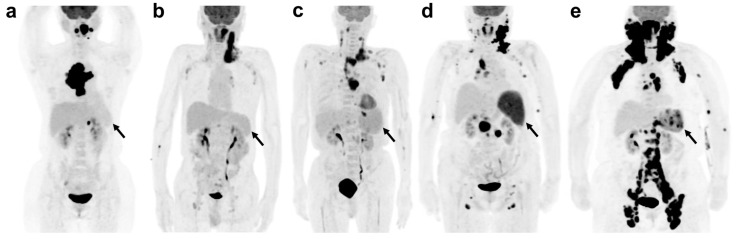 Figure 2
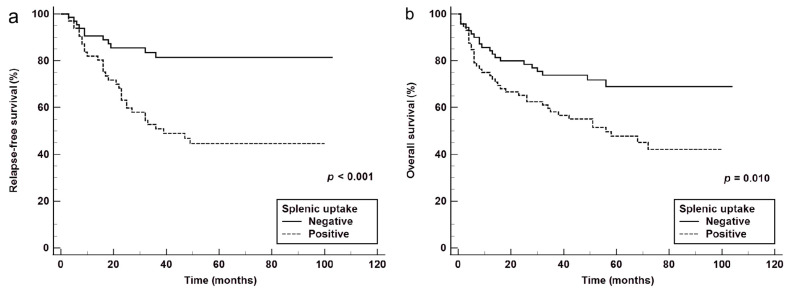 Figure 3
Peer Reviews
No public reviews on file for this paper yet. If you reviewed it on a platform where reviews are public (OpenReview, ICLR, NeurIPS, ICML), you can paste yours below so the community can read it here.
Videos
No videos yet. Explain this paper in a talk, walkthrough, or lecture? Add one.
Taxonomy
TopicsLymphoma Diagnosis and Treatment · CNS Lymphoma Diagnosis and Treatment · Cutaneous lymphoproliferative disorders research