Molecular and Cellular Mechanisms of Myocardial Ischemia and Reperfusion Injury: A Narrative Review
Stefan Juricic, Jovana Klac, Sinisa Stojkovic, Branko Beleslin, Milorad Tesic, Ivana Jovanovic, Marko Banovic, Olga Petrovic, Srdjan Aleksandric, Natalija Vasic, Filip Simeunovic, Dejan Lazovic, Milica Stoiljkovic, Sashko Nikolov, Dejan Simeunovic

TL;DR
This review explains how reduced blood flow and subsequent reperfusion damage heart cells, highlighting key molecular and cellular processes involved in heart injury.
Contribution
The paper provides a comprehensive overview of the molecular and cellular mechanisms underlying myocardial ischemia and reperfusion injury.
Findings
Ischemia causes ATP depletion and calcium overload in cardiomyocytes.
Reperfusion leads to oxidative stress, inflammation, and cell death via mitochondrial dysfunction.
Targeting mPTP and ROS could reduce reperfusion injury and improve heart recovery.
Abstract
Myocardial ischemia represents a state of reduced coronary perfusion with oxygenated blood, insufficient to meet the metabolic demands of the myocardium. Both acute and chronic ischemia trigger a cascade of cellular events that lead to disturbances in ionic balance, mitochondrial function and energy metabolism. During ischemia, cardiomyocytes (CMs) shift from aerobic to anaerobic metabolism, resulting in adenosine triphosphate (ATP) depletion, loss of ionic homeostasis and calcium (Ca2+) overload that activate proteases, phospholipases and membrane damage. Reperfusion restores oxygen supply and prevents irreversible necrosis but paradoxically initiates additional injury in marginally viable myocardium. The reoxygenation phase induces excessive production of reactive oxygen species (ROS), endothelial dysfunction and a strong inflammatory response mediated by neutrophils, platelets and…
Genes, proteins, chemicals, diseases, species, mutations and cell lines named across the full text — each resolved to its canonical identifier and authoritative record.
Click any figure to enlarge with its caption.
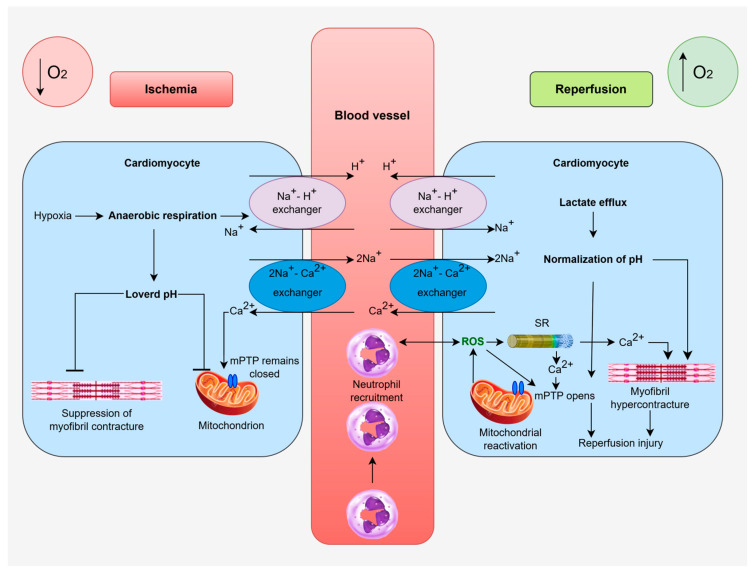 Figure 1
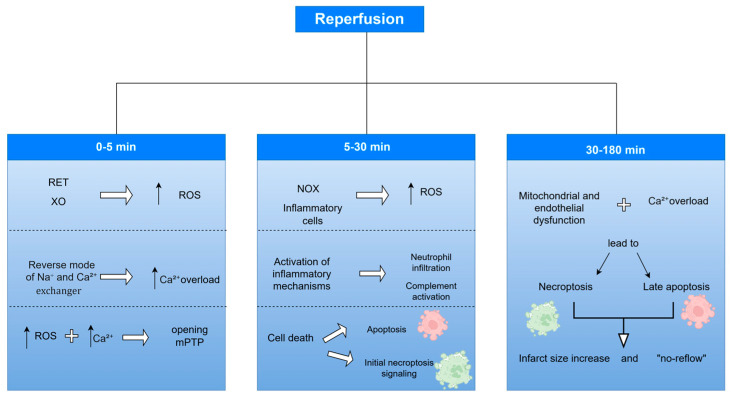 Figure 2
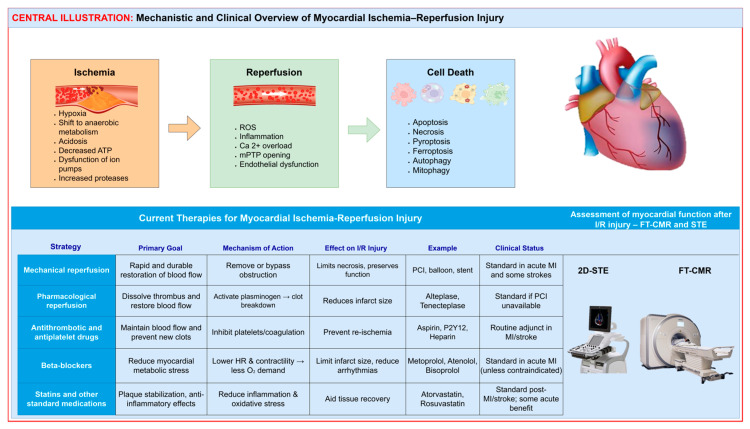 Figure 3
Peer Reviews
No public reviews on file for this paper yet. If you reviewed it on a platform where reviews are public (OpenReview, ICLR, NeurIPS, ICML), you can paste yours below so the community can read it here.
Videos
No videos yet. Explain this paper in a talk, walkthrough, or lecture? Add one.
Taxonomy
TopicsCardiac Ischemia and Reperfusion · Hydrogen's biological and therapeutic effects · Cardiac Fibrosis and Remodeling