Long-term follow-up of individuals at risk of or who developed resignation syndrome in childhood, were granted residence permits and cared for within the Stockholm region: a register study
Kasra Zarei, Karl Sallin, Mathias Mattsson, Predrag Petrovic, Olle Lindevall, Anna Ohlis, Anna-Clara Hollander

TL;DR
This study examines the long-term mental health and educational outcomes of individuals who were at risk of or developed resignation syndrome in childhood and were granted residency in Sweden.
Contribution
The study provides novel insights into the long-term psychiatric and educational outcomes of individuals with resignation syndrome compared to various comparison groups.
Findings
Individuals at risk of or who developed resignation syndrome did not show significantly higher psychiatric care utilization compared to Swedish-born individuals.
Siblings of the exposed group had a significantly lower risk of outpatient psychiatric care.
Fully developed resignation syndrome cases had higher psychiatric care utilization compared to Swedish-born children.
Abstract
To investigate long-term outcomes of individuals at risk of or who developed resignation syndrome (RS) in childhood and who received residence permits in Sweden. We followed individuals born 1988–2002, living in Stockholm, in healthcare registers until December 2016 (N = 5,226). The exposed group was defined as exhibiting potential symptoms of RS of varying severity in childhood (n = 107), and compared with their siblings, refugees, unaccompanied migrants, individuals who received child and adolescent mental health services (CAMHS) without RS, and Swedish-born individuals with Swedish-born parents. We estimated the cumulative incidence of psychiatric diagnoses until age 18. Outcomes included psychiatric care utilization, prescribed/purchased psychotropic medication in adulthood, and education attainment. We estimated crude and adjusted hazard ratios (aHR) using Cox proportional hazards…
Genes, proteins, chemicals, diseases, species, mutations and cell lines named across the full text — each resolved to its canonical identifier and authoritative record.
Click any figure to enlarge with its caption.
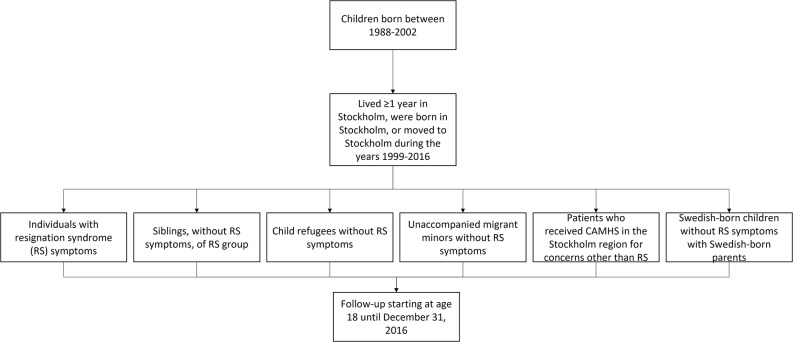 Figure 1
Peer Reviews
No public reviews on file for this paper yet. If you reviewed it on a platform where reviews are public (OpenReview, ICLR, NeurIPS, ICML), you can paste yours below so the community can read it here.
Videos
No videos yet. Explain this paper in a talk, walkthrough, or lecture? Add one.
Taxonomy
TopicsNeuroscience of respiration and sleep · Infant Health and Development · Sympathectomy and Hyperhidrosis Treatments