Use of a self-completed life history calendar in relation to data completeness and accuracy
Jennifer Yu, Prevost Jantchou, Rui Ning Gong, Belinda Nicolau, Sreenath Madathil, Miceline Mesidor, Marie-Claude Rousseau

TL;DR
Using a life history calendar helped participants recall more details accurately during a study on inflammatory bowel disease.
Contribution
This study shows that using a life history calendar improves data completeness in retrospective research.
Findings
Participants who prepared a life history calendar had 22% fewer missing data points.
More frequent consultation of the calendar led to even fewer missing values.
Calendar use slightly improved agreement between self-reported and registry data for parents' ages.
Abstract
A life history calendar allows mapping personal events to improve recall of past events in retrospective data collection. We estimated whether the use of a life history calendar was related to data completeness and accuracy. Participants in a case-control study on inflammatory bowel disease in Quebec, Canada in 2021, were invited to complete a preparatory life history calendar and encouraged to consult it during data collection. For data completeness, associations between life history calendar preparation/consultation frequency and number of missing values were estimated using negative binomial regression (Sample Mean Ratio, SMR) with inverse-probability-weighting to balance participants’ characteristics across life history calendar preparation/consultation groups. One hundred and thirty variables were considered. For accuracy, parents’ age at participants’ birth and number of older…
Genes, proteins, chemicals, diseases, species, mutations and cell lines named across the full text — each resolved to its canonical identifier and authoritative record.
Click any figure to enlarge with its caption.
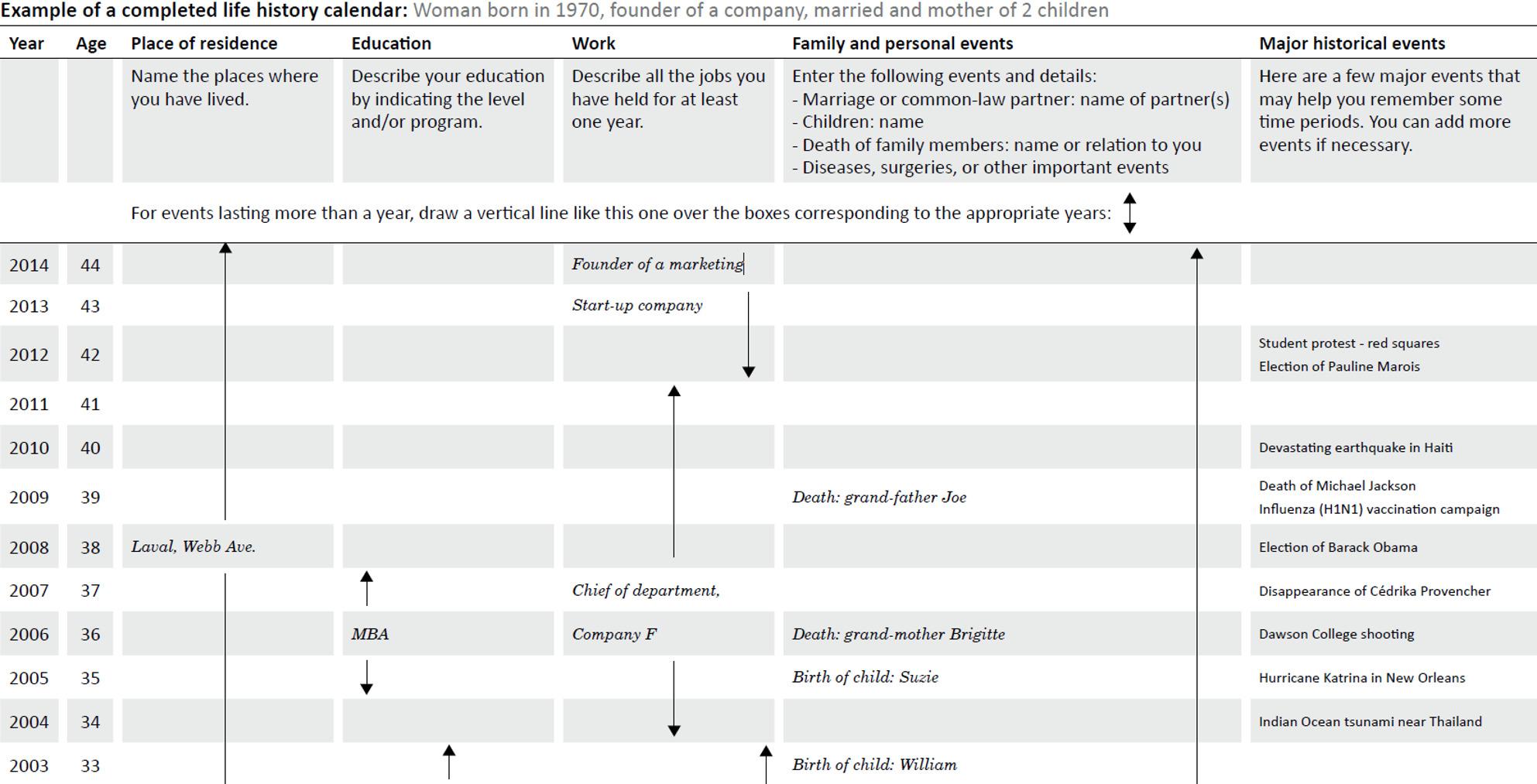 Figure 1
Peer Reviews
No public reviews on file for this paper yet. If you reviewed it on a platform where reviews are public (OpenReview, ICLR, NeurIPS, ICML), you can paste yours below so the community can read it here.
Videos
No videos yet. Explain this paper in a talk, walkthrough, or lecture? Add one.
Taxonomy
TopicsSurvey Methodology and Nonresponse · Health, Environment, Cognitive Aging · Data Analysis and Archiving