Longitudinal Dynamics of Physical Function With Anxiety and Depression in Parkinson's Disease: A Cross‐Lagged Panel Analysis of the PPMI Dataset
Philip Hodgson, Alastair Jordan, Charikleia Sinani, Divine Charura, Adam Hodgson, Hanna L. Glandorf

TL;DR
This study finds that depression and self-reported physical function in Parkinson's disease are linked over time, highlighting the importance of mental health in managing the disease.
Contribution
The study reveals a bidirectional relationship between depressive symptoms and self-reported physical function in Parkinson's disease using longitudinal analysis.
Findings
Worsening depression scores predict a decline in self-reported physical function in Parkinson's disease.
Self-reported physical function can precede objective motor decline as rated by clinicians.
No significant link was found between psychological symptoms and clinician-rated motor function.
Abstract
Parkinson's disease (PD) is characterized by a complex interplay of motor and non‐motor symptoms. While cross‐sectional studies have shown a link between psychological symptoms and self‐reported physical function, the longitudinal and directional nature of this relationship remains unclear. This study aimed to clarify the temporal relationships between psychological symptoms (depression and anxiety) and physical function (both participant‐reported and clinician‐rated) in individuals with PD. We used a rigorous longitudinal analytical approach, random‐intercept cross‐lagged panel modeling (RI‐CLPM), on data from 1128 individuals with PD from the Parkinson's Progression Markers Initiative (PPMI) dataset. We examined directional cross‐lagged paths between psychological symptoms (via GDS and STAI) and physical function measures (via MDS‐UPDRS Parts II and III). Our analysis revealed…
Genes, proteins, chemicals, diseases, species, mutations and cell lines named across the full text — each resolved to its canonical identifier and authoritative record.
Click any figure to enlarge with its caption.
 Figure 1
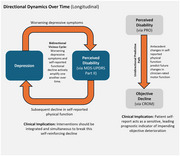 Figure 2
Peer Reviews
No public reviews on file for this paper yet. If you reviewed it on a platform where reviews are public (OpenReview, ICLR, NeurIPS, ICML), you can paste yours below so the community can read it here.
Videos
No videos yet. Explain this paper in a talk, walkthrough, or lecture? Add one.
Taxonomy
TopicsParkinson's Disease Mechanisms and Treatments · Balance, Gait, and Falls Prevention · Parkinson's Disease and Spinal Disorders