Austrian Pompe Outcome Consensus (APOC): a national Delphi study
Florian B. Lagler, Thomas Scherer, Jörg Weber, Martina Huemer, Wolfgang Löscher

TL;DR
The APOC study created a consensus on follow-up assessments for Pompe disease to improve treatment and care.
Contribution
The study provides systematically weighted, AGREE II-compliant recommendations for Pompe disease follow-up assessments in Austria.
Findings
34 statements reached consensus on essential and optional follow-up assessments for Pompe disease.
Strong recommendations include functional tests, muscle assessments, and patient-reported outcomes.
The Delphi method proved effective for rare disease consensus-building in the Austrian healthcare context.
Abstract
Follow-up assessments form the basis for the continuous optimization of therapy and supportive care on an individual level, for confirming treatment efficacy, and for detecting newly emerging or unexpectedly progressive symptoms early enough to permit timely therapeutic intervention. For Pompe disease, evidence based guidelines on which assessments should constitute the minimum standard and which are required in specific situations only, were missing. Therefore, we started the Austrian Pompe Outcome Consensus (APOC) Study. APOC was a Delphi process with two classical online and a modified third round, implemented September 2023–May 2024, following the AWMF S2k guideline. A five-member interdisciplinary steering committee invited 23 clinical experts, achieving response rates of 69.6% and 100%. A questionnaire was developed via literature scoping and an expert workshop. The importance…
Genes, proteins, chemicals, diseases, species, mutations and cell lines named across the full text — each resolved to its canonical identifier and authoritative record.
Click any figure to enlarge with its caption.
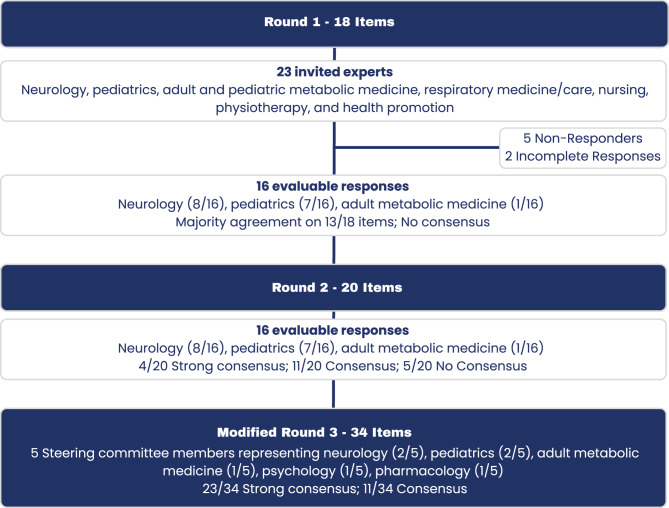 Figure 1
Peer Reviews
No public reviews on file for this paper yet. If you reviewed it on a platform where reviews are public (OpenReview, ICLR, NeurIPS, ICML), you can paste yours below so the community can read it here.
Videos
No videos yet. Explain this paper in a talk, walkthrough, or lecture? Add one.
Taxonomy
TopicsLysosomal Storage Disorders Research · Glycogen Storage Diseases and Myoclonus · Whipple's Disease and Interleukins