Urazole-Functionalized Carbon Nanotubes as Artificial DNA Strands and Their In Vivo Toxicity
Shwu-Chen Tsay, Deepa R. Landge, Wen-Chieh Huang, Uttam Patil, Jia-Cherng Horng, Chun-Cheng Lin, Yu-Chen Hu, Syed N. Barmaver, Oliver I. Wagner, Jih Ru Hwu

TL;DR
Researchers created DNA-like carbon nanotubes that bind selectively to DNA and found them to be highly biocompatible in tests with worms.
Contribution
Urazole-functionalized SWCNTs show strong DNA-binding selectivity and low toxicity, offering a new platform for biocompatible nanomaterials.
Findings
f-SWCNT 1c with urazoles binds strongly to ss-dA25 and d(A•T) pairs, showing nucleobase selectivity.
Under acidic conditions, f-SWCNT 1c exhibits the strongest DNA-binding affinity.
f-SWCNT 1c shows no significant toxicity to C. elegans at 250 μg/mL, being ∼2500-fold less toxic than SWCNT–COOH.
Abstract
Single-walled carbon nanotubes (SWCNTs) are grafted with multiple phenoxy–triazole–(ethylene glycol) ligands, whose terminals are uniformly functionalized with DNA-binding moieties. Each binder contains one to three binding sites for imidazolidin-2-one, hydantoin, or urazole. Entwinement of these “artificial strands” with ss- and dsDNAs forms pseudoduplex or pseudotriplex DNA structures, respectively. The hybridization preference between the functionalized SWCNTs (i.e., f-SWCNTs 1a–c) and ssDNA is investigated using homo-oligomers ss-dA25, ss-dT25, and ss-dC25. Results show that ss-dA25 bound strongly to f-SWCNT 1c bearing urazoles, ss-dT25 bound exclusively to 1c, and ss-dC25 bound selectively to 1a (imidazolidin-2-one) and 1b (hydantoin). For the formation of pseudotriplets with duplex oligomers dA25•dT25 and dG25•dC25 at pH 7.4, d(A•T) pairs bound strongly to 1c but weakly to 1a and…
Genes, proteins, chemicals, diseases, species, mutations and cell lines named across the full text — each resolved to its canonical identifier and authoritative record.
Click any figure to enlarge with its caption.
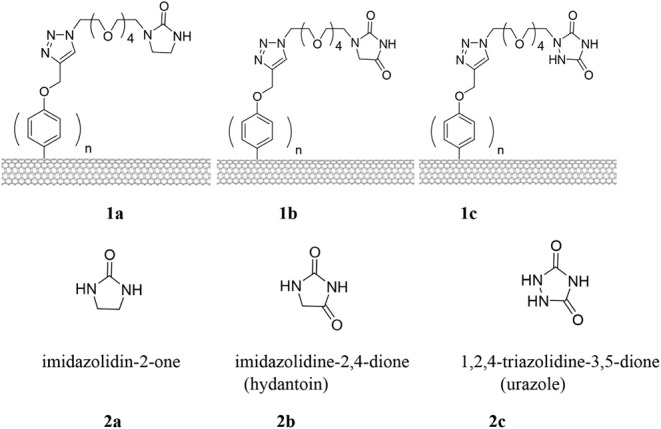 Figure 1
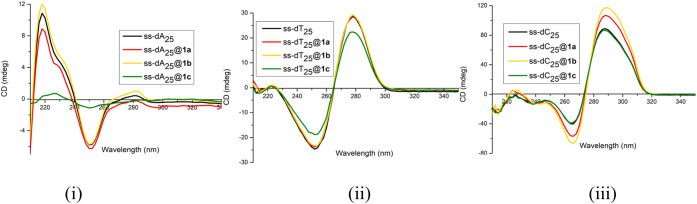 Figure 2
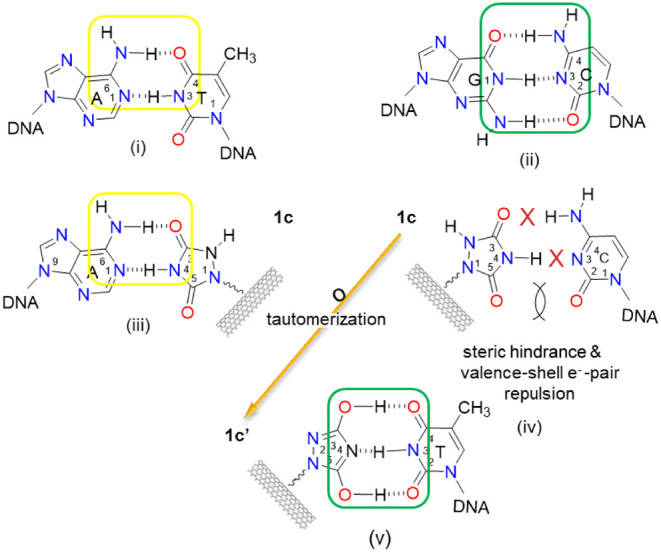 Figure 3
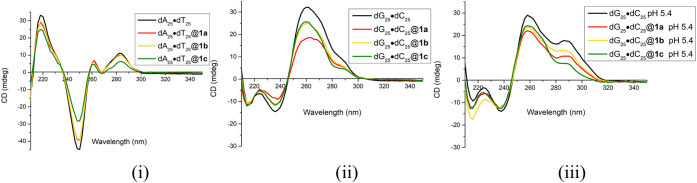 Figure 4
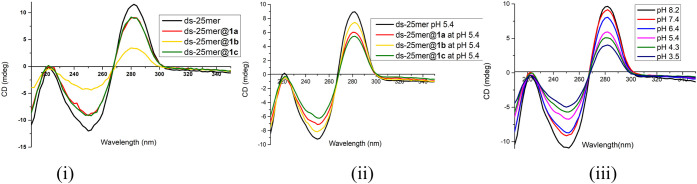 Figure 5
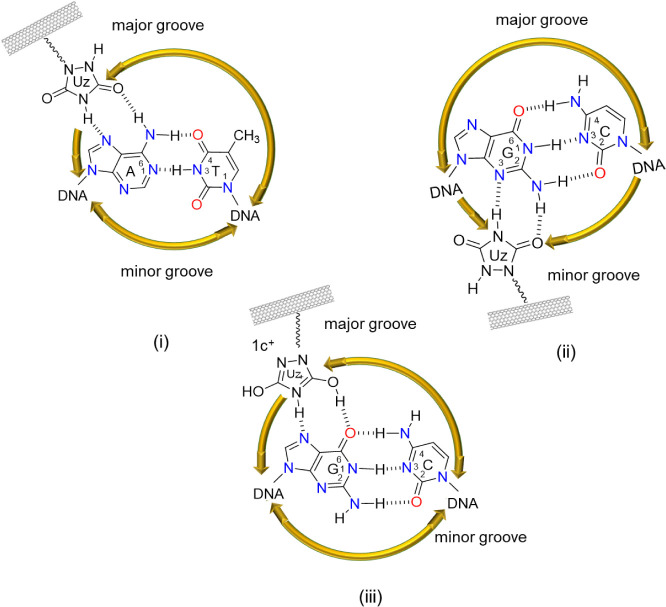 Figure 6
 Figure 7
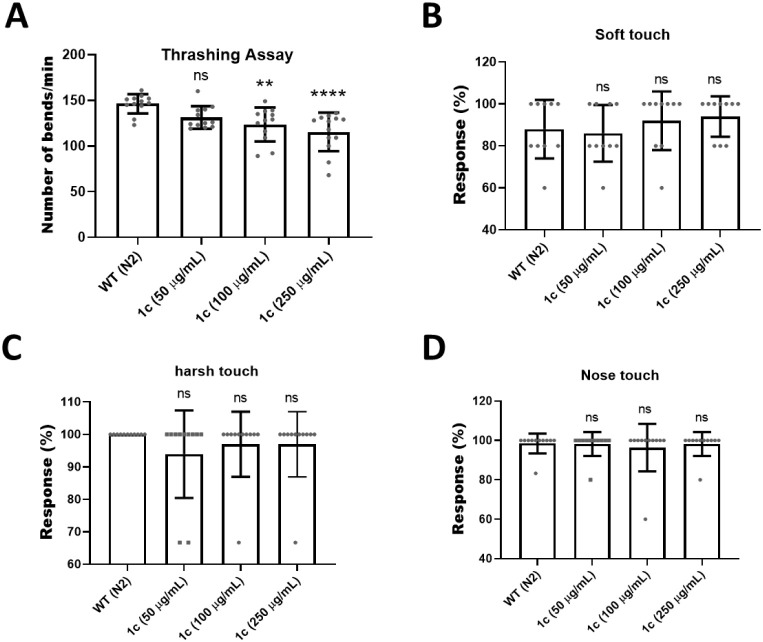 Figure 8
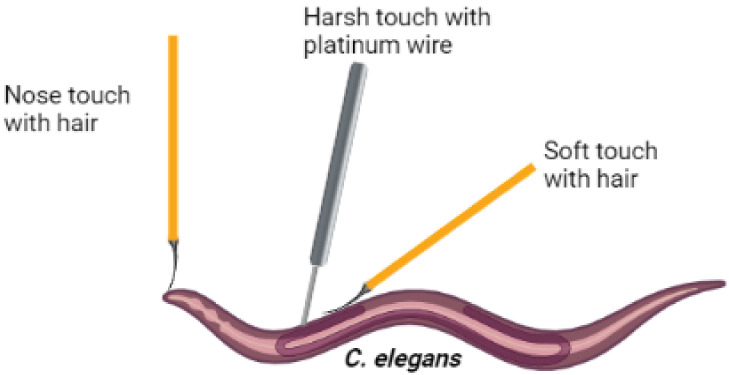 Figure 9
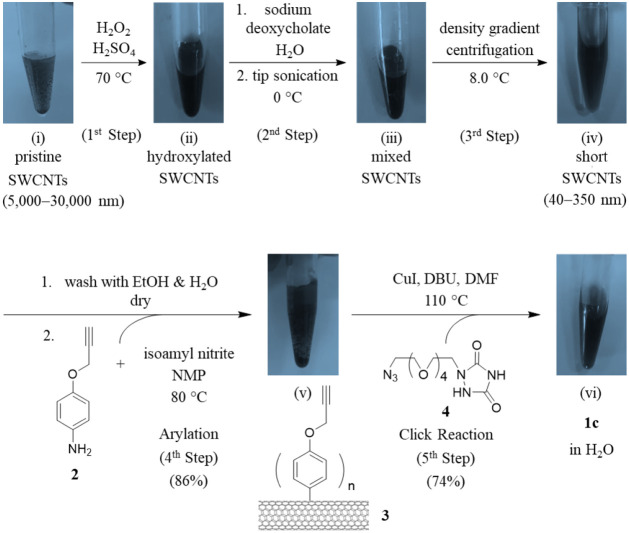 Figure 10
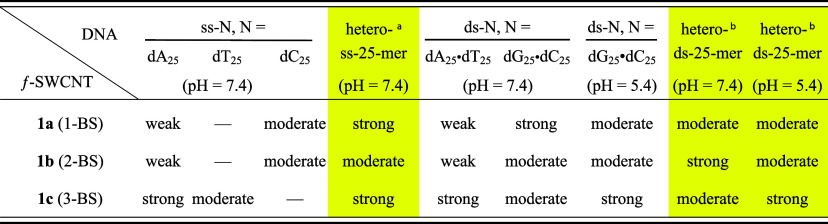 Figure 11
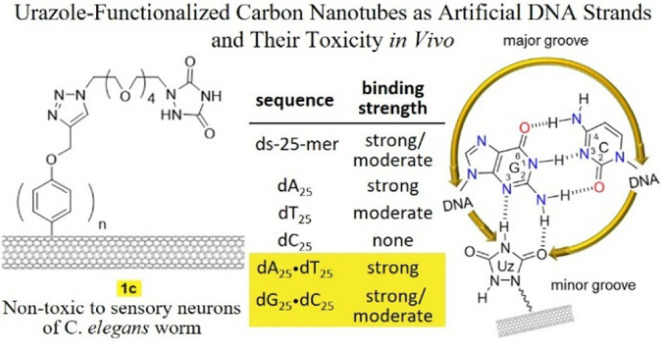 Figure 12
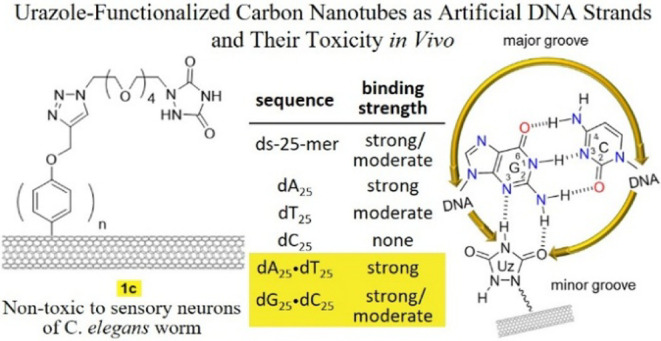 Figure 13
Peer Reviews
No public reviews on file for this paper yet. If you reviewed it on a platform where reviews are public (OpenReview, ICLR, NeurIPS, ICML), you can paste yours below so the community can read it here.
Videos
No videos yet. Explain this paper in a talk, walkthrough, or lecture? Add one.
Taxonomy
TopicsAdvanced biosensing and bioanalysis techniques · DNA and Nucleic Acid Chemistry · Carbon Nanotubes in Composites