Chloronitramide Anion Quantitation in Tap Waters by Ion Chromatography with Electrical Conductivity and Ultraviolet Absorbance Detection
Jason A. Thornhill, Juliana R. Laszakovits, Barrett E. Johnson, Justin R. Chimka, Julian L. Fairey

TL;DR
A new method using ion chromatography detects a recently discovered chemical in tap water, showing it's present in both chloramine and free chlorine systems.
Contribution
First report of Cl–N–NO2– in free chlorine systems and concentrations above 200 μg L–1 in chloramine systems using IC methods.
Findings
IC-EC and IC-UV243 detection limits for Cl–N–NO2– were 9.3 μg L–1 and 6.2 μg L–1 respectively.
Cl–N–NO2– concentrations in chloramine systems ranged from 22–314 μg L–1 and in free chlorine systems from 2–7 μg L–1.
IC-UV243 showed strong correlation (R2 = 0.997) with HILIC–UHRMS measurements and less measurement bias.
Abstract
Chloronitramide anion (Cl–N–NO2 –) is a recently discovered inorganic chloramine decomposition product, with prior quantitation by hydrophilic interaction liquid chromatography–ultrahigh-resolution mass spectrometry (HILIC–UHRMS). Here, Cl–N–NO2 – quantitation was evaluated by ion chromatography (IC) separation with electrical conductivity (EC) and ultraviolet absorbance at 243 nm (UV243) detection. Using a 5 mL injection loop and a 14.4 mM Na2CO3 eluent, the Cl–N–NO2 – method detection limit was 9.3 μg L–1 by IC-EC and 6.2 μg L–1 by IC-UV243. Matrix testing with Cl–N–NO2 – spiked at 15, 25, 50, and 100 μg L–1 into 12 waters in triplicate matched the expected Cl–N–NO2 – for IC-EC (R2 = 0.994) and IC-UV243 (R2 = 0.993). Cl–N–NO2 – was found by HILIC–UHRMS in all tested tap waters disinfected with chloramines (n = 8) at 22–314 μg L–1 and free chlorine (n = 3) at 2–7 μg L–1, and strongly…
Genes, proteins, chemicals, diseases, species, mutations and cell lines named across the full text — each resolved to its canonical identifier and authoritative record.
Click any figure to enlarge with its caption.
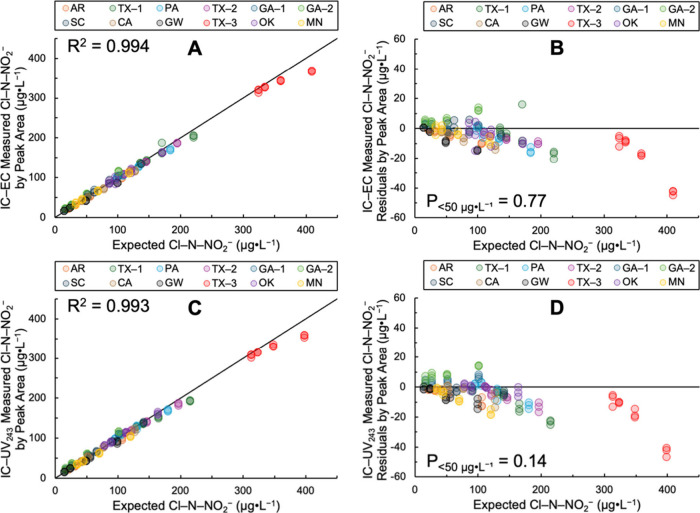 Figure 1
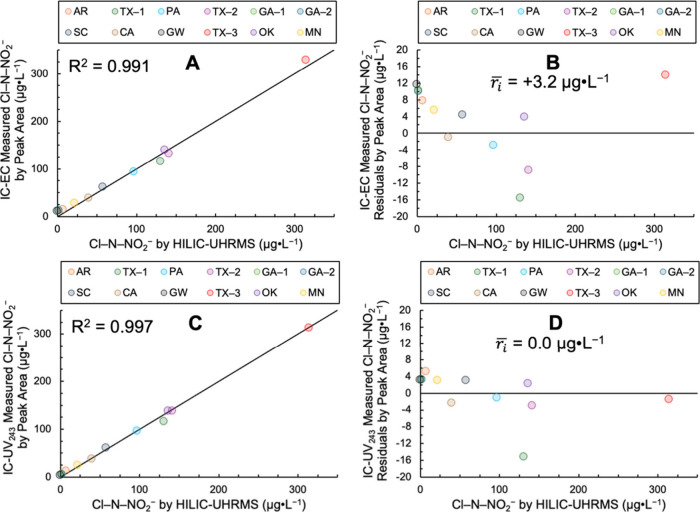 Figure 2
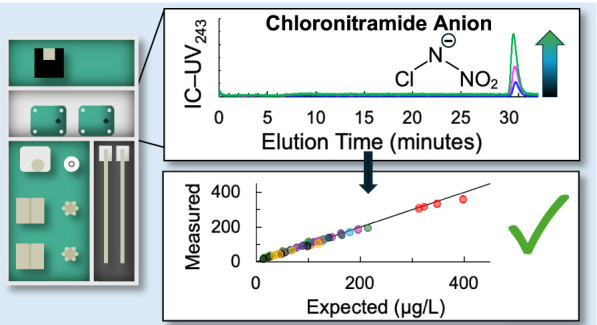 Figure 3
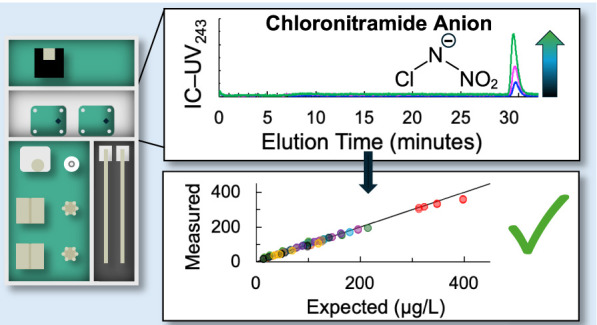 Figure 4
 Figure 5
 Figure 6
 Figure 7
 Figure 8
 Figure 9
 Figure 10
 Figure 11
 Figure 12
 Figure 13
Peer Reviews
No public reviews on file for this paper yet. If you reviewed it on a platform where reviews are public (OpenReview, ICLR, NeurIPS, ICML), you can paste yours below so the community can read it here.
Videos
No videos yet. Explain this paper in a talk, walkthrough, or lecture? Add one.
Taxonomy
TopicsWater Treatment and Disinfection · Pharmaceutical and Antibiotic Environmental Impacts · Chemical Analysis and Environmental Impact