Flushing as a Control Measure for Legionella spp.: Impacts of Water Age, Chloramine Disinfection, and Elevated Temperature
Charuka S. Meegoda, Michael B. Waak, Taegyu Kim, Raymond M. Hozalski, Cynthia Hallé

TL;DR
This study shows that flushing hot water systems can temporarily reduce bacteria like Legionella, but chloramines are more effective at long-term control.
Contribution
The study reveals how chloramine disinfection prolongs Legionella suppression compared to temperature or flow interventions in premise plumbing.
Findings
Flushing and showering temporarily reduce bacterial concentrations but lead to rapid rebound within 1–4 days.
Chloramines suppress Legionella spp. for over 10 days even after they decay during water use.
Flushing is more effective than showering at removing Legionella from biofilms.
Abstract
Pilot-scale experiments were used to examine how hot-water temperature, chloramine disinfection, and pipe material (copper or PE-Xa) influence the effectiveness of two flow-based interventionshigh-flow flushing vs showeringin controlling total bacteria, Legionella spp., and Vermamoeba vermiformis in premise plumbing. Flushing (ca. 16 L/min for 5 min) and showering (ca. 7 L/min for 8 min) both temporarily reduced bacterial concentrations by removing accumulated planktonic biomass. However, total bacteria rebounded within 1–4 days after a flush or shower, regardless of the presence of chloramines (1 mg/L Cl2). In the absence of chloramines, Legionella spp. ssrA gene concentrations increased over 3–10 days following flushing or showering, whereas chloramines suppressed Legionella spp. for >10 days despite completely decaying within hours of water use. Without chloramines, hot-water…
Genes, proteins, chemicals, diseases, species, mutations and cell lines named across the full text — each resolved to its canonical identifier and authoritative record.
Click any figure to enlarge with its caption.
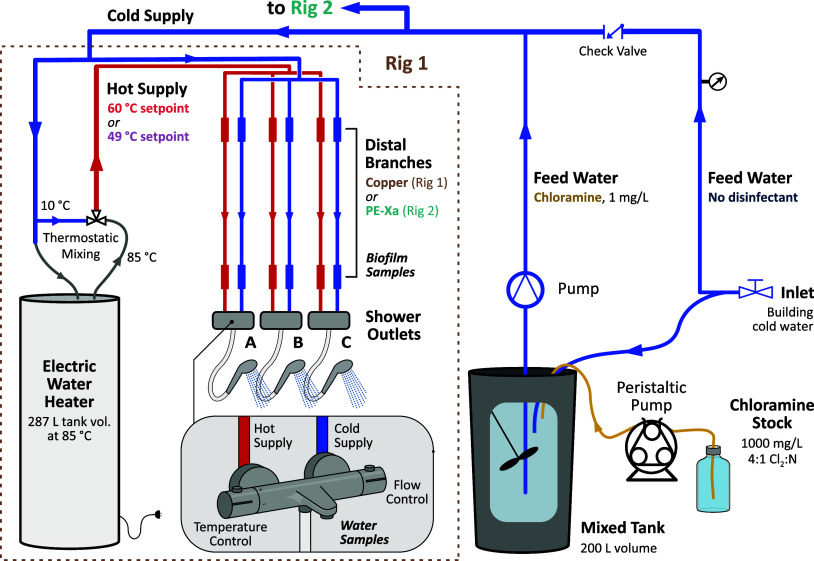 Figure 1
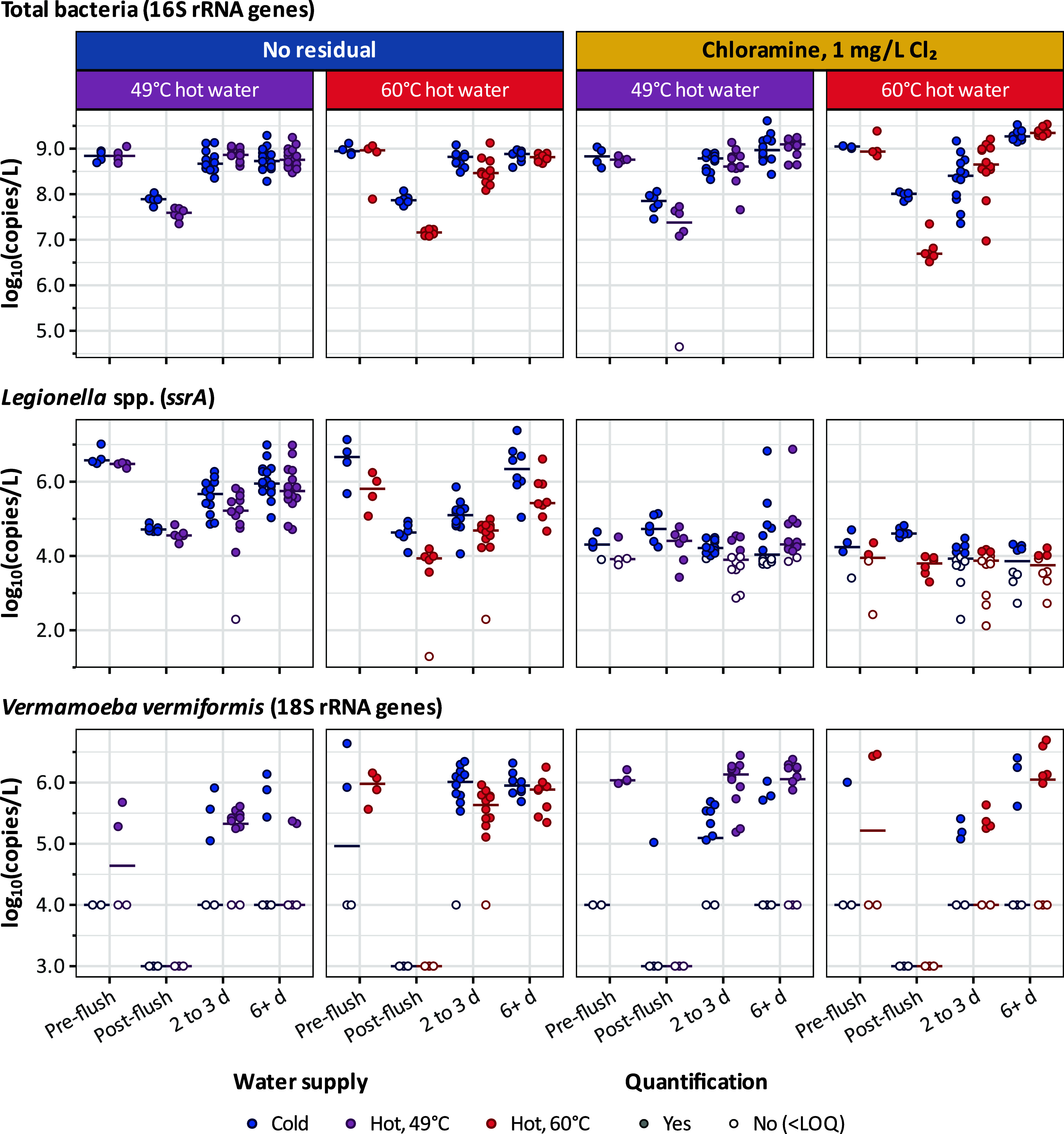 Figure 2
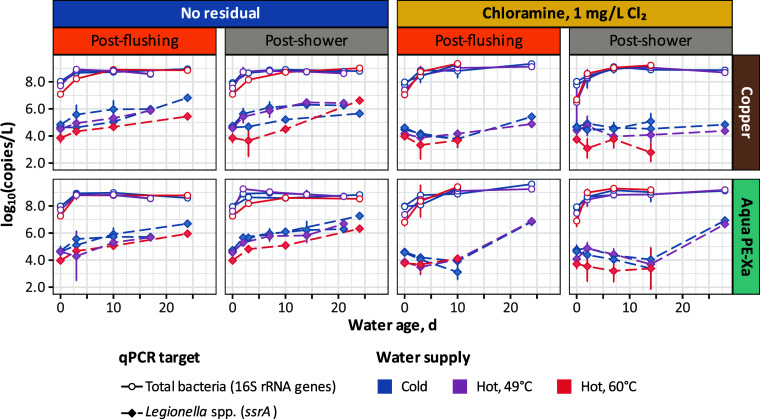 Figure 3
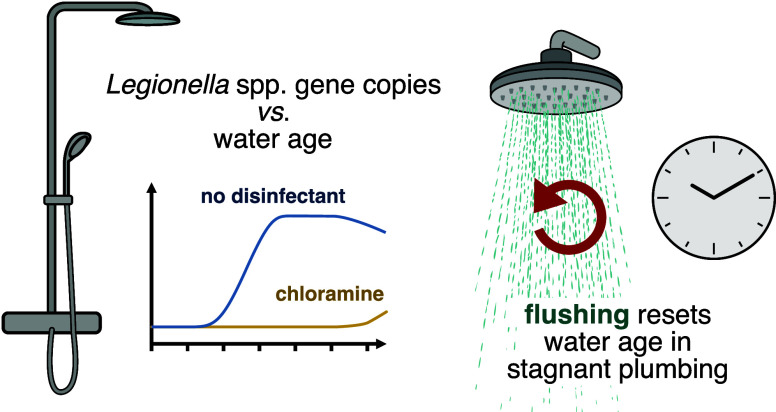 Figure 4
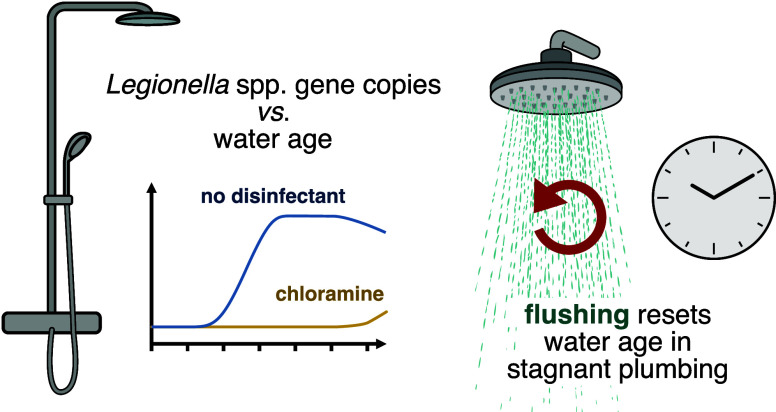 Figure 5
Peer Reviews
No public reviews on file for this paper yet. If you reviewed it on a platform where reviews are public (OpenReview, ICLR, NeurIPS, ICML), you can paste yours below so the community can read it here.
Videos
No videos yet. Explain this paper in a talk, walkthrough, or lecture? Add one.
Taxonomy
TopicsLegionella and Acanthamoeba research · Water Treatment and Disinfection · Neutrophil, Myeloperoxidase and Oxidative Mechanisms