Solution-Friction Analytical Approximation as a Robust Model Framework for Low-Salt-Rejection Reverse Osmosis
Rayan Alghanayem, Weifan Liu, Rui Chen, Shihong Lin

TL;DR
This paper introduces a new model for low-salt-rejection reverse osmosis membranes that works well across a wide range of salt concentrations.
Contribution
The SF-AA model is presented as a physically grounded and accurate alternative to empirical models for low-salt-rejection membranes.
Findings
The SF-AA model accurately captures salt transport dependence on feed concentration and permeate flux.
The model outperforms conventional models using only three intrinsic membrane parameters.
The SF-AA is shown to be robust and generalizable for high salinity and leaky membranes.
Abstract
Low-salt-rejection reverse osmosis (LSRRO) is a promising approach for concentrating hypersaline brines using moderate hydraulic pressures, but predictive modeling of LSRRO membranes remains limited by empirical frameworks that require salinity-dependent fitting parameters. Here, we adapt and validate the solution-friction analytical approximation (SF-AA) as a simple, closed-form, and physically grounded model for low-salt-rejection membranes across a wide salinity range. Using three low-salt-rejection membranes, including a highly “leaky” membrane prepared by controlled chlorination, we conducted experiments with NaCl solutions of up to 3.64 M to measure water flux, salt rejection, and salinity-dependent salt permeability. With only three intrinsic membrane parameters, the SF-AA accurately captures the dependence of salt transport on both feed concentration and permeate flux,…
Genes, proteins, chemicals, diseases, species, mutations and cell lines named across the full text — each resolved to its canonical identifier and authoritative record.
Click any figure to enlarge with its caption.
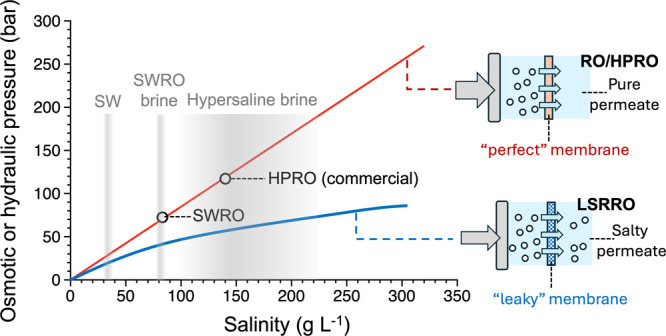 Figure 1
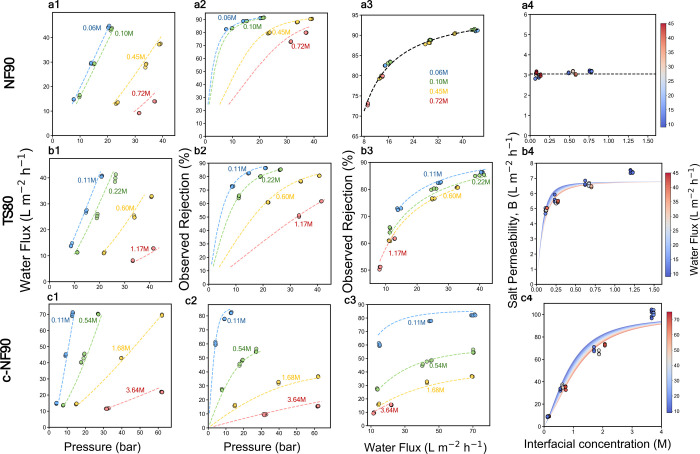 Figure 2
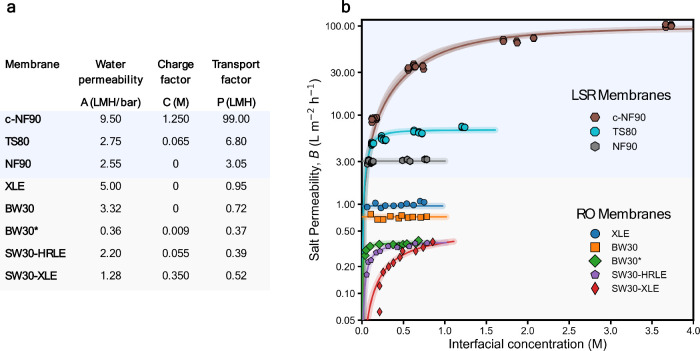 Figure 3
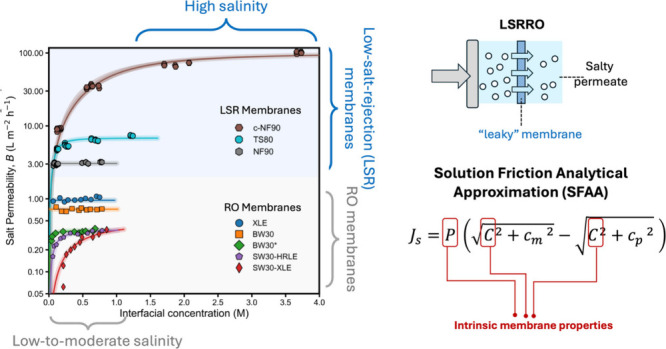 Figure 4
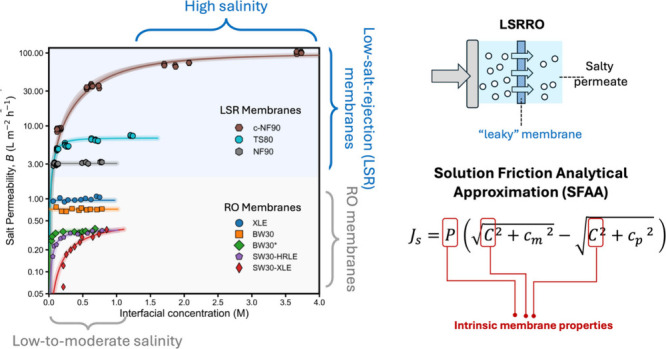 Figure 5
 Figure 6
 Figure 7
 Figure 8
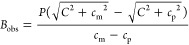 Figure 9
Peer Reviews
No public reviews on file for this paper yet. If you reviewed it on a platform where reviews are public (OpenReview, ICLR, NeurIPS, ICML), you can paste yours below so the community can read it here.
Videos
No videos yet. Explain this paper in a talk, walkthrough, or lecture? Add one.
Taxonomy
TopicsMembrane Separation Technologies · Membrane-based Ion Separation Techniques · Nanopore and Nanochannel Transport Studies