Effect of extending the oral administration period of 5‐aminolevulinic acid on diagnostic accuracy and treatment outcomes for non–muscle‐invasive bladder cancer
Hideo Fukuhara, Ryu Shigehisa, Shinkuro Yamamoto, Satoshi Fukata, Kenta Saito, Yasuhiko Shibanaka, Keiji Inoue

TL;DR
This study shows that extending the administration period of 5-aminolevulinic acid before bladder cancer surgery does not reduce diagnostic accuracy or treatment effectiveness.
Contribution
The study demonstrates that extending 5-ALA administration time up to 8 hours before surgery maintains diagnostic sensitivity and improves recurrence-free survival.
Findings
Fluorescent light mode had higher sensitivity (93.2%) compared to white-light mode (62.6%).
Recurrence-free survival was significantly better in ALA-PDD groups compared to white-light groups.
Extending 5-ALA administration time up to 8 hours did not reduce diagnostic accuracy.
Abstract
To evaluate the treatment outcomes of 5‐aminolevulinic acid hydrochloride (5‐ALA) photodynamic diagnosis (PDD)‐assisted transurethral resection of bladder tumour (TURBT) (ALA PDD‐TURBT, hereinafter referred to as ‘ALA‐PDD’) exceeding 4 h after ALA administration for non–muscle‐invasive bladder cancer (NMIBC). This retrospective single‐centre study included 386 patients who had undergone TURBT with or without 5‐ALA for NMIBC between January 2018 and December 2024. Patients who received 5‐ALA were divided into two groups based on 5‐ALA exposure times before TURBT: 2–4 h and 4–8 h groups. The diagnostic sensitivity and specificity of procedures performed after the two exposure times were calculated by comparing cystoscopy findings with pathological findings in the ALA‐PDD group. Recurrence‐free survival (RFS) and progression‐free survival (PFS) rates of NMIBC patients in the white‐light…
Genes, proteins, chemicals, diseases, species, mutations and cell lines named across the full text — each resolved to its canonical identifier and authoritative record.
Click any figure to enlarge with its caption.
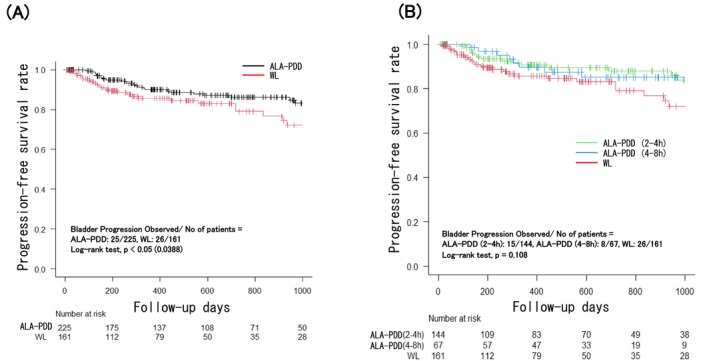 Figure 1
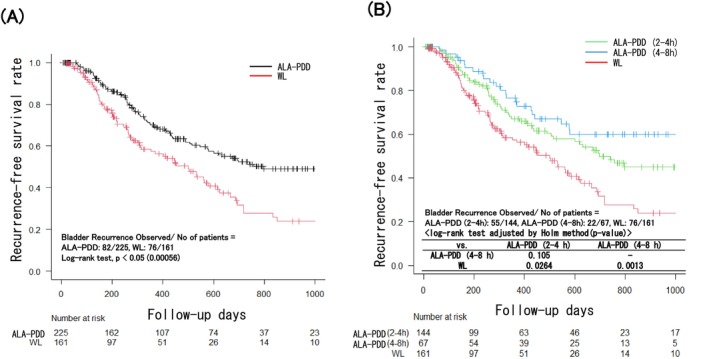 Figure 2
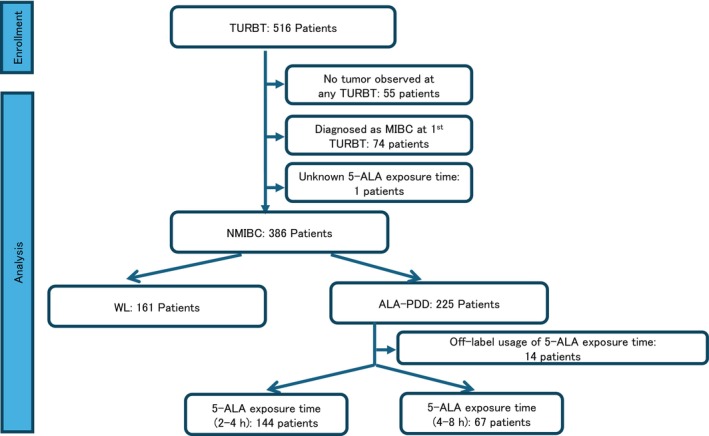 Figure 3
Peer Reviews
No public reviews on file for this paper yet. If you reviewed it on a platform where reviews are public (OpenReview, ICLR, NeurIPS, ICML), you can paste yours below so the community can read it here.
Videos
No videos yet. Explain this paper in a talk, walkthrough, or lecture? Add one.
Taxonomy
TopicsPhotodynamic Therapy Research Studies · Bladder and Urothelial Cancer Treatments · Nonmelanoma Skin Cancer Studies