Plasma Proteome Signature for Leukocyte Telomere Length and Its Link to Abdominal Aortic Aneurysm
Aixin Li, Thomas R. Austin, Brian T. Steffen, Ingrid Jacobson, Jiaqi Xie, Nathan Pankratz, John A. Lane, Annette Fitzpatrick, Joshua C. Bis, Dan E. Arking, Thomas Mosley, Sanaz Sedaghat, James S. Pankow, Pamela L. Lutsey, Weihua Guan, Weihong Tang

TL;DR
This study identifies plasma proteins linked to leukocyte telomere length and shows how one protein, GDF15, connects telomere shortening to abdominal aortic aneurysm risk.
Contribution
The paper discovers five proteins causally influenced by telomere length and identifies GDF15 as a mediator of aneurysm risk.
Findings
Fifteen proteins were associated with leukocyte telomere length in White participants.
GDF15 mediates 12.4% of the link between telomere length and abdominal aortic aneurysm risk.
Three proteins (MZB1, PLOD3, COL28A1) showed consistent associations across different populations.
Abstract
Shorter leukocyte telomere length (LTL) is an aging biomarker and risk factor for aging‐related diseases, including abdominal aortic aneurysm (AAA). This study aimed to identify plasma proteins causally associated with LTL and investigate their roles in linking LTL to AAA. A proteomics analysis was conducted for LTL and a polygenic risk score (PRS) for LTL using 4955 plasma proteins by SomaScan in self‐identified White participants (N = 7587–8055) from the Atherosclerosis Risk in Communities (ARIC) study. Replications were evaluated in self‐identified Black participants (N = 1668–2094) from ARIC and White participants (N = 2333–2431) from the Cardiovascular Health Study (CHS). Mendelian randomization (MR) analysis assessed causality between LTL and proteins. Survival and mediation analyses explored protein‐mediated associations between LTL and AAA risk. In ARIC White participants, 15…
Genes, proteins, chemicals, diseases, species, mutations and cell lines named across the full text — each resolved to its canonical identifier and authoritative record.
Click any figure to enlarge with its caption.
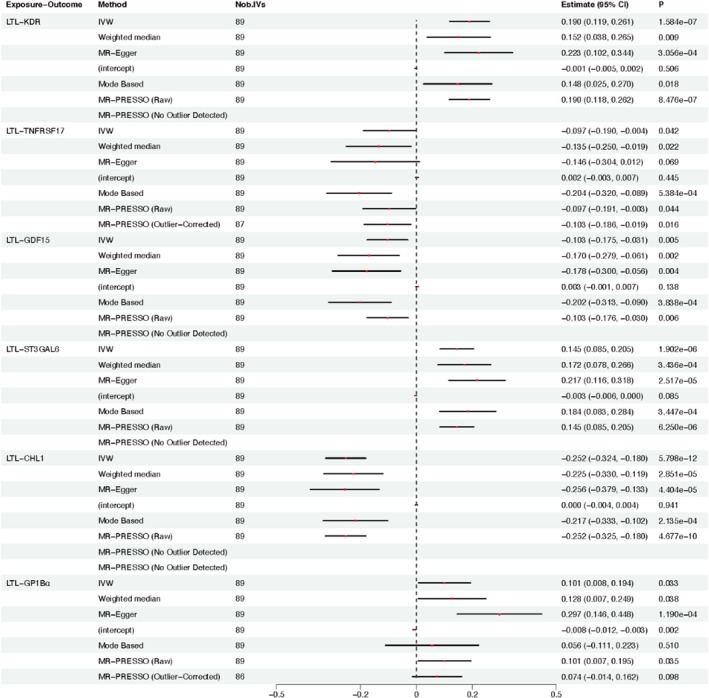 Figure 1
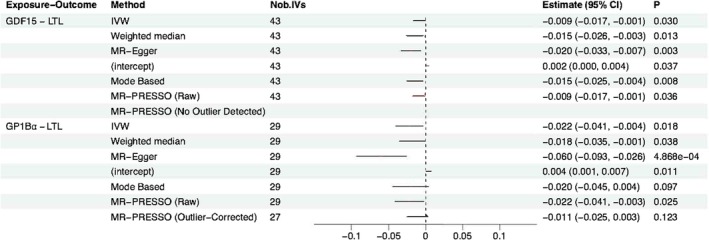 Figure 2
 Figure 3
Peer Reviews
No public reviews on file for this paper yet. If you reviewed it on a platform where reviews are public (OpenReview, ICLR, NeurIPS, ICML), you can paste yours below so the community can read it here.
Videos
No videos yet. Explain this paper in a talk, walkthrough, or lecture? Add one.
Taxonomy
TopicsTelomeres, Telomerase, and Senescence · Aortic aneurysm repair treatments · Frailty in Older Adults