Accounting for Electronic Coherences Induced by Broadband Pulses by Using Pulse-Independent Trajectories
Joachim Galiana, Stefano M. Cavaletto, Gilbert Grell, Francisco Fernández-Villoria, Alicia Palacios, Jesús González-Vázquez, Fernando Martín

TL;DR
This paper introduces new methods to model the effects of laser pulses on molecular dynamics without recalculating for each pulse, improving efficiency and accuracy in simulations.
Contribution
The paper presents two trajectory-surface-hopping approaches that account for pump-generated coherences without requiring separate calculations for each pulse.
Findings
The new methods show excellent agreement with simulations that include coherences from the start.
Initial coherences play a significant role in early nonadiabatic dynamics in glycine molecules.
The approaches enable accurate and flexible simulations for pump–probe experiments with broadband laser sources.
Abstract
Recent advances in the generation of ultrashort, few-femtosecond laser pulses in the ultraviolet–visible domain are now enabling the coherent excitation of several electronic states in neutral molecules, with new opportunities for the manipulation of molecular dynamics on ultrafast time scales. Current time-resolved pump–probe experiments can monitor the ensuing coupled electron–nuclear dynamics with ultrashort resolution. Computational modeling of the observables measured in such experiments can be very challenging for medium-sized and large molecules because of (i) the nontrivial treatment of pump-generated coherences with mixed quantum–classical methods and (ii) the high computational cost of probe-step calculations, which cannot be afforded when many different pump pulses have to be considered, as e.g., in control schemes. In this work, we present two trajectory-surface-hopping…
Genes, proteins, chemicals, diseases, species, mutations and cell lines named across the full text — each resolved to its canonical identifier and authoritative record.
Click any figure to enlarge with its caption.
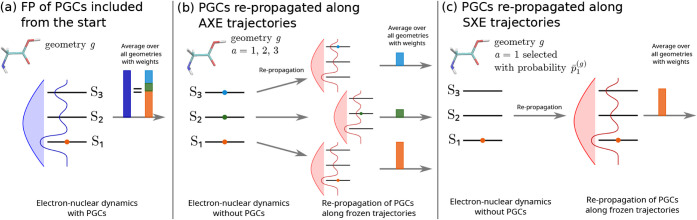 Figure 1
 Figure 2
 Figure 3
 Figure 4
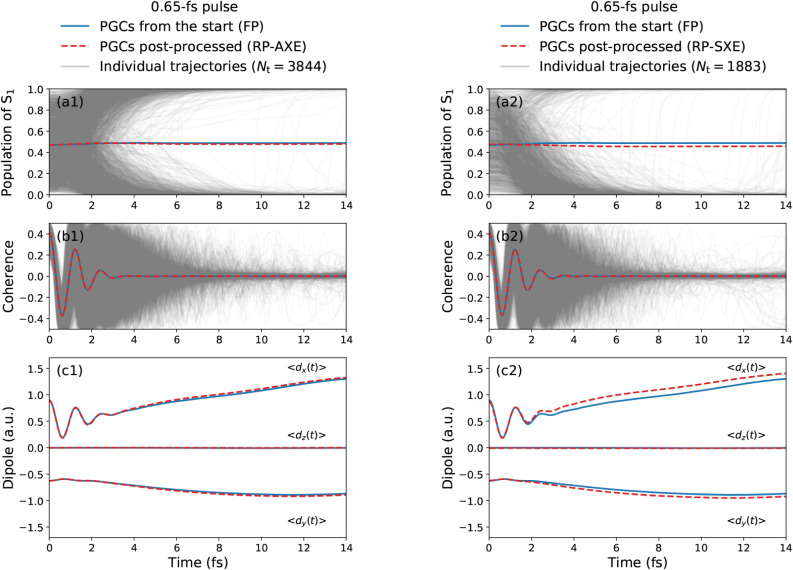 Figure 5
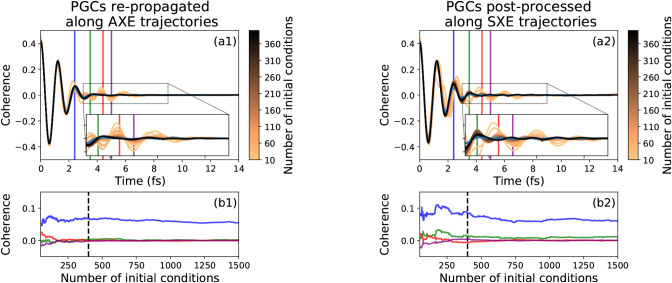 Figure 6
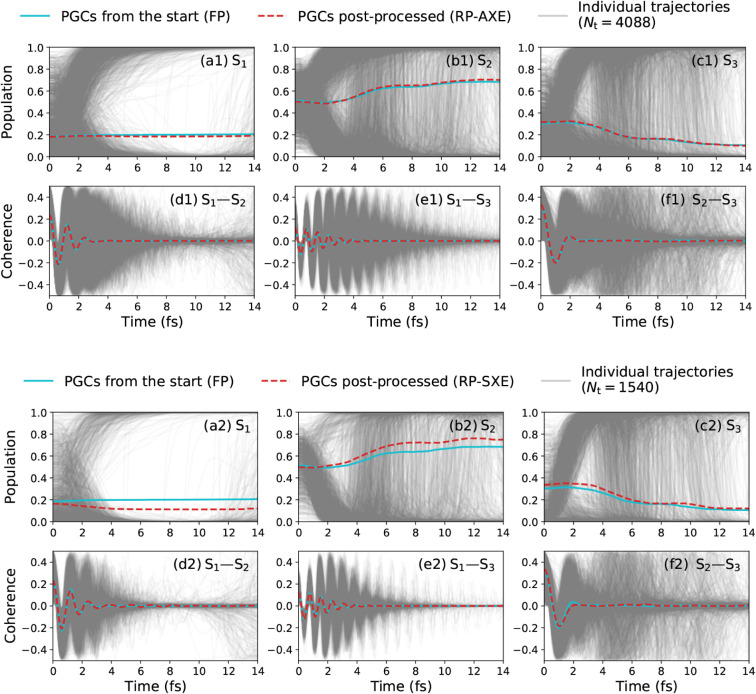 Figure 7
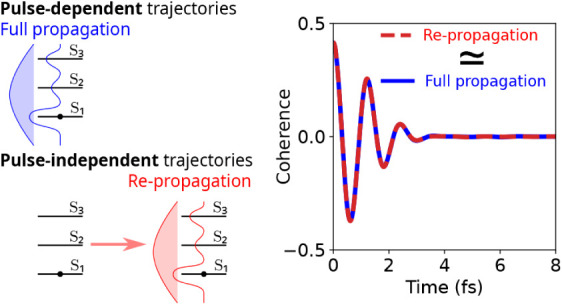 Figure 8
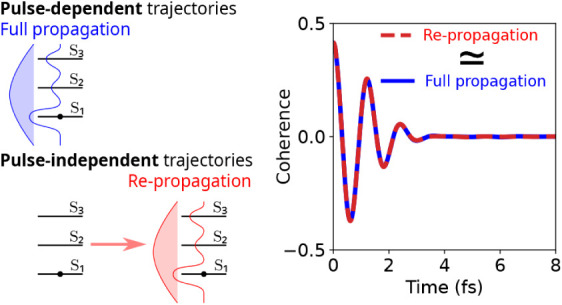 Figure 9
 Figure 10
 Figure 11
 Figure 12
 Figure 13
 Figure 14
 Figure 15
 Figure 16
 Figure 17
 Figure 18
 Figure 19
 Figure 20
 Figure 21
 Figure 22
 Figure 23
 Figure 24
 Figure 25
 Figure 26
 Figure 27
 Figure 28
 Figure 29
 Figure 30
 Figure 31
 Figure 32
 Figure 33
 Figure 34
 Figure 35
 Figure 36
 Figure 37
 Figure 38
 Figure 39
 Figure 40
 Figure 41
 Figure 42
 Figure 43
 Figure 44
 Figure 45
 Figure 46
 Figure 47
 Figure 48
 Figure 49
 Figure 50
Peer Reviews
No public reviews on file for this paper yet. If you reviewed it on a platform where reviews are public (OpenReview, ICLR, NeurIPS, ICML), you can paste yours below so the community can read it here.
Videos
No videos yet. Explain this paper in a talk, walkthrough, or lecture? Add one.
Taxonomy
TopicsLaser-Matter Interactions and Applications · Spectroscopy and Quantum Chemical Studies · Photoreceptor and optogenetics research