Enhanced Photostability through Rapid Exciton Decay in Desymmetrized Cyclopentannulated Acenes with Strong Face-to-Face pi Stacking
Chad D. Cruz, Karl J. Thorley, Zachary J. Knepp, Jared Wahlstrand, Gil M. Repa, John C. Stephenson, Sean Parkin, Lisa A. Fredin, John E. Anthony, Emily G. Bittle

TL;DR
Researchers designed acene molecules that rapidly return to their ground state, preventing triplet formation and improving photostability in optoelectronic applications.
Contribution
The study introduces desymmetrized cyclopentannulated acenes with rapid exciton decay and suppressed triplet formation through molecular design.
Findings
The synthesized acenes exhibit rapid exciton decay and photostability in both solution and single crystals.
Strong face-to-face pi stacking does not affect the rapid decay due to short excited-state lifetimes.
DFT calculations suggest five-membered ring twisting drives internal conversion.
Abstract
The photophysics of organic semiconductors impacts their efficiency in optoelectronic devices where exciton transitions, including singlet fission, intersystem crossing and the formation of charge transfer states influence the ability to convert between bright and dark states and to dissociate into free charges. Unfortunately, photodegradation and spurious signals often confound the results of optical studies, especially of important triplet states. Here four asymmetric cyclopentannulated acenes are synthesized and studied. This system represents an extreme in photophysics achieved via molecular design to fully quench the photoluminescence and bypass triplet formation allowing for comparative studies with other highly absorbing acenes. Rapid molecular exciton decay that is unaffected by strong electronic coupling induced by the crystal packing is found. The quick return to the ground…
Genes, proteins, chemicals, diseases, species, mutations and cell lines named across the full text — each resolved to its canonical identifier and authoritative record.
Click any figure to enlarge with its caption.
 Figure 1
 Figure 2
 Figure 3
 Figure 4
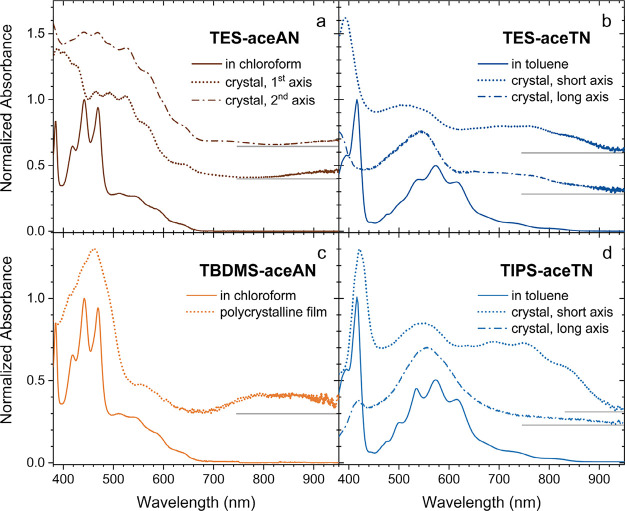 Figure 5
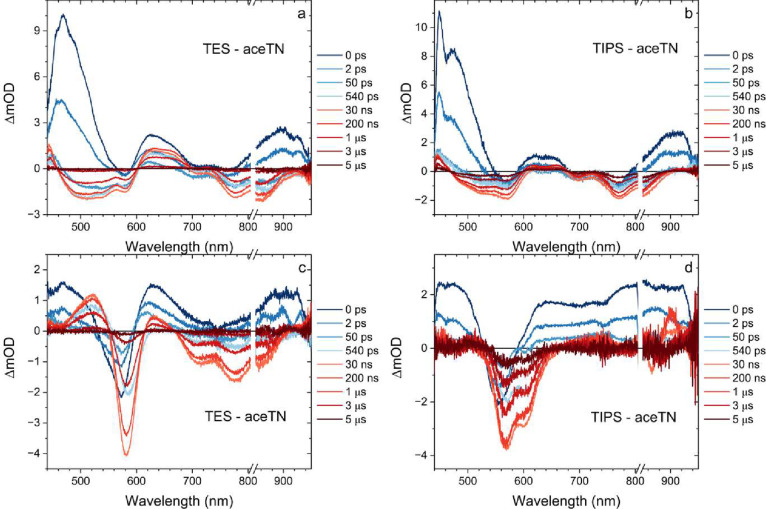 Figure 6
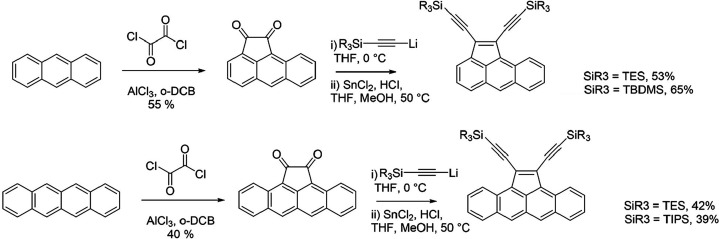 Figure 7
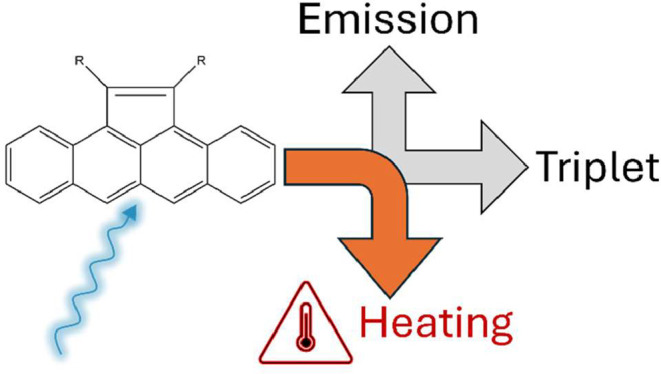 Figure 8
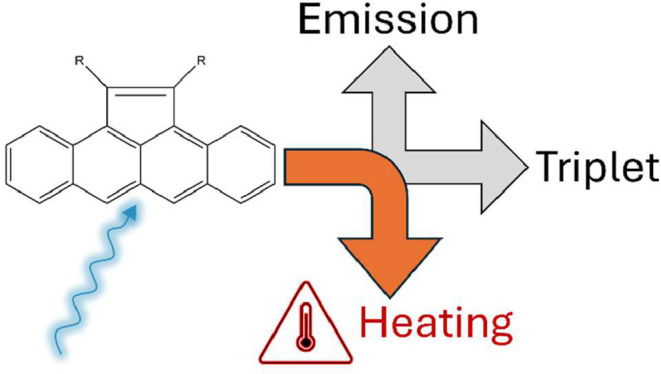 Figure 9
 Figure 10
Peer Reviews
No public reviews on file for this paper yet. If you reviewed it on a platform where reviews are public (OpenReview, ICLR, NeurIPS, ICML), you can paste yours below so the community can read it here.
Videos
No videos yet. Explain this paper in a talk, walkthrough, or lecture? Add one.
Taxonomy
TopicsOrganic Electronics and Photovoltaics · Luminescence and Fluorescent Materials · Synthesis and Properties of Aromatic Compounds