Air pollution, temperature, and HbA1c levels among children in Mexico City, Mexico
Jeanne Wu, Pablo Knobel, Mike Z. He, Itai Kloog, Allan C. Just, Ivàn Gutiérrez-Avila, Elena Colicino, Martha M. Téllez-Rojo, María Luisa Pizano-Zárate, Marcela Tamayo-Ortiz, Alejandra Cantoral, Diana C. Soria-Contreras, Andrea A. Baccarelli, Robert O. Wright, Maayan Yitshak Sade

TL;DR
The study finds that higher PM2.5 pollution and lower temperatures are linked to increased HbA1c levels in children, suggesting a potential link to future diabetes risk.
Contribution
This study is among the first to examine the simultaneous effects of PM2.5, temperature, and NO2 on HbA1c levels in children.
Findings
A 1-μg/m³ increase in PM2.5 was associated with a 0.311% relative increase in HbA1c.
A 1-degree Celsius increase in temperature was associated with a 0.626% relative decrease in HbA1c.
NO2 exposure showed no significant association with HbA1c levels.
Abstract
Glycated hemoglobin (HbA1c), a strong indicator of diabetes, is affected by air pollution and temperature exposures. However, studies examining the association between HbA1c, temperature, fine particulate matter (PM2.5), and nitrogen dioxide (NO2) among children are scarce, especially looking at all exposures simultaneously. We investigated the associations between these exposures and HbA1c among children, known to be a highly susceptible group. We included children enrolled in the Programming Research in Obesity, Growth, Environment, and Social Stressors (PROGRESS) cohort based in Mexico City (2013–2019). We obtained exposures from spatiotemporal models. HbA1c levels were measured at 4–5 years, 6–7 years, and 8–11 years post-birth. We used multivariable linear mixed-effects models to assess the simultaneous associations of three-month averages of PM2.5, temperature, and NO2 exposures…
Genes, proteins, chemicals, diseases, species, mutations and cell lines named across the full text — each resolved to its canonical identifier and authoritative record.
Click any figure to enlarge with its caption.
 Figure 1
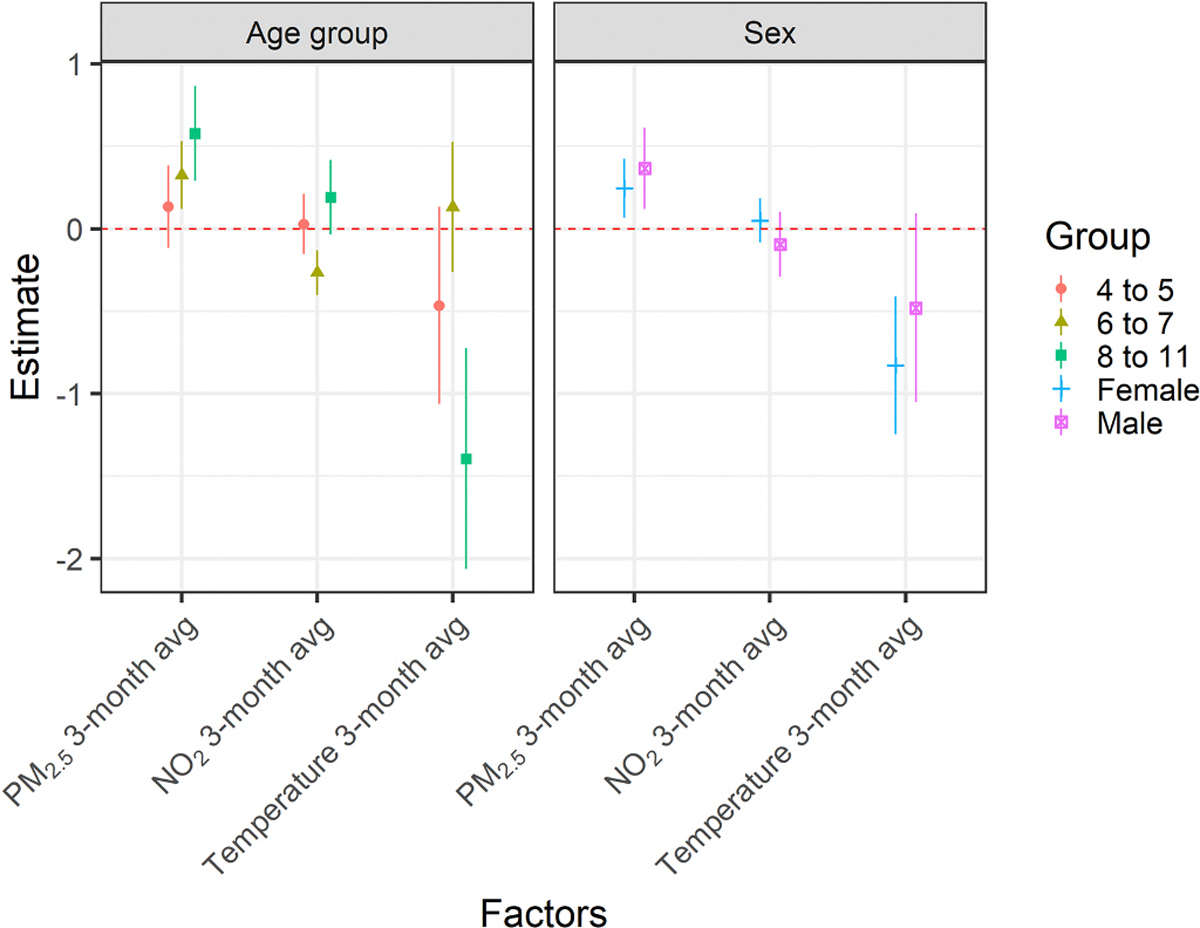 Figure 2
Peer Reviews
No public reviews on file for this paper yet. If you reviewed it on a platform where reviews are public (OpenReview, ICLR, NeurIPS, ICML), you can paste yours below so the community can read it here.
Videos
No videos yet. Explain this paper in a talk, walkthrough, or lecture? Add one.
Taxonomy
TopicsAir Quality and Health Impacts · Health, Environment, Cognitive Aging · Climate Change and Health Impacts