Post-Intensive Care Syndrome Awareness and Communication: Surveys of ICU Providers and Patients
Mark L. Rolfsen, Matthew F. Mart, Hannah Kieffer, David Krasinski, Timothy D. Girard, Lauren E. Ferrante, Robert L. Owens, Ana Lucia Fuentes, Nathan Brummel, Carla M. Sevin, John P. Kress, Jaspal Singh, Sukhvinder Nagi, Kevin Shaw, Edward Qian, James C. Jackson

TL;DR
This study finds that ICU providers and patients have low awareness and communication about post-intensive care syndrome (PICS), highlighting a need for better communication strategies.
Contribution
The study reveals a significant communication gap between ICU providers and patients regarding post-intensive care syndrome (PICS).
Findings
Only 73.8% of providers reported being aware of PICS, while only 16.6% of patients remembered being told about it.
Less than one-third of providers discuss potential impairments after critical illness with patients or families regularly.
Few patients (35.6%) remembered conversations about possible new or worsening impairments after critical illness.
Abstract
Survivors of critical illness often experience new or worsening impairments in various domains of health after discharge, collectively referred to as post-intensive care syndrome (PICS). Although this condition is common, it remains unclear whether providers are communicating routinely about survivorship and PICS to patients and families and whether patients are remembering these conversations. How often do ICU providers discuss the concept of PICS with at-risk patients or families, and how often do patients remember being told about the concept of PICS? We distributed online surveys to ICU health care providers at 9 US institutions and to patients who survived critical illness in the preceding year at a single site. We collected a convenience sample of 382 provider responses and 148 patient responses. The providers were registered nurses (53.7%), physician fellows or attending…
Genes, proteins, chemicals, diseases, species, mutations and cell lines named across the full text — each resolved to its canonical identifier and authoritative record.
Click any figure to enlarge with its caption.
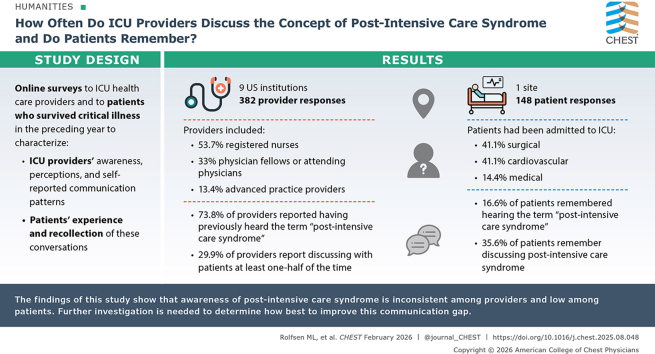 Figure 1
 Figure 2
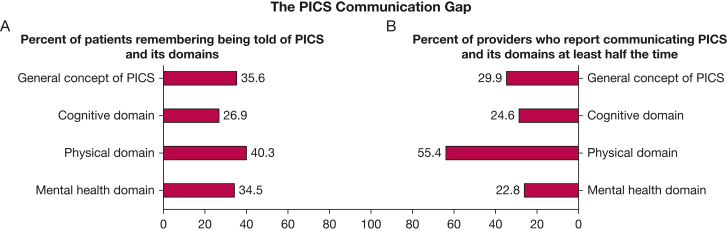 Figure 3
Peer Reviews
No public reviews on file for this paper yet. If you reviewed it on a platform where reviews are public (OpenReview, ICLR, NeurIPS, ICML), you can paste yours below so the community can read it here.
Videos
No videos yet. Explain this paper in a talk, walkthrough, or lecture? Add one.
Taxonomy
TopicsFamily and Patient Care in Intensive Care Units · Intensive Care Unit Cognitive Disorders