A Comparative Analysis of Long‐Term Effective Population Sizes Across Eukaryotes
Loveday Lewin, Adam Eyre‐Walker

TL;DR
This study compares long-term effective population sizes across 120 eukaryotic species, revealing how life history traits and evolutionary factors influence genetic diversity and selection.
Contribution
The paper provides the first broad comparative analysis of long-term Nₑ across diverse eukaryotes using nucleotide diversity and mutation rates.
Findings
Effective population size (Nₑ) varies by nearly 4 orders of magnitude across species.
Nucleotide diversity is a useful proxy for Nₑ and correlates with life history traits like generation time.
Small Nₑ is linked to reduced selection efficacy but not increased genome size after phylogenetic correction.
Abstract
The effective population size (N e) is a fundamental parameter in population genetics. Despite its central importance, there are relatively few estimates of N e available and there have been limited attempts to compare values across eukaryotes. Here, we estimate long‐term effective population sizes for 120 species, broadly distributed across the eukaryotic tree of life, using nucleotide diversity and direct mutation rate estimates. We find that N e varies by nearly 4 orders of magnitude and that it shows strong phylogenetic structure across broad taxonomic scales but not within individual lineages. Phylogenetically controlled regressions reveal that Nₑ correlates with key life history traits, including generation time and propagule size, and that nucleotide diversity serves as a useful proxy for Nₑ. Finally, we show that small Nₑ is generally associated with a reduction in the efficacy…
Genes, proteins, chemicals, diseases, species, mutations and cell lines named across the full text — each resolved to its canonical identifier and authoritative record.
Click any figure to enlarge with its caption.
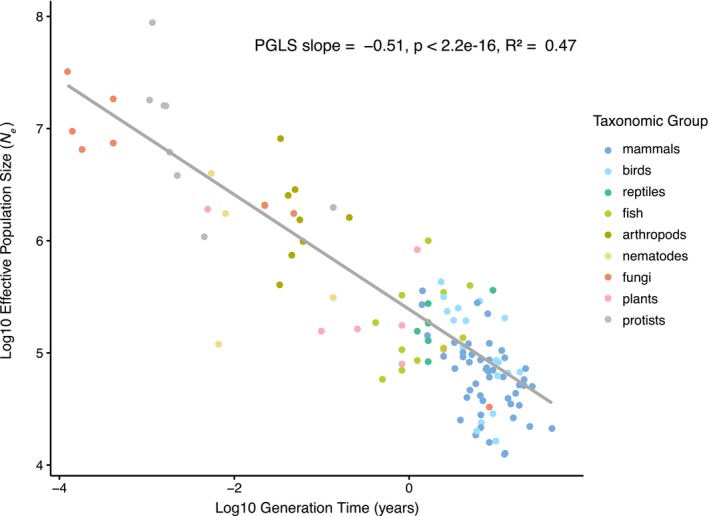 Figure 1
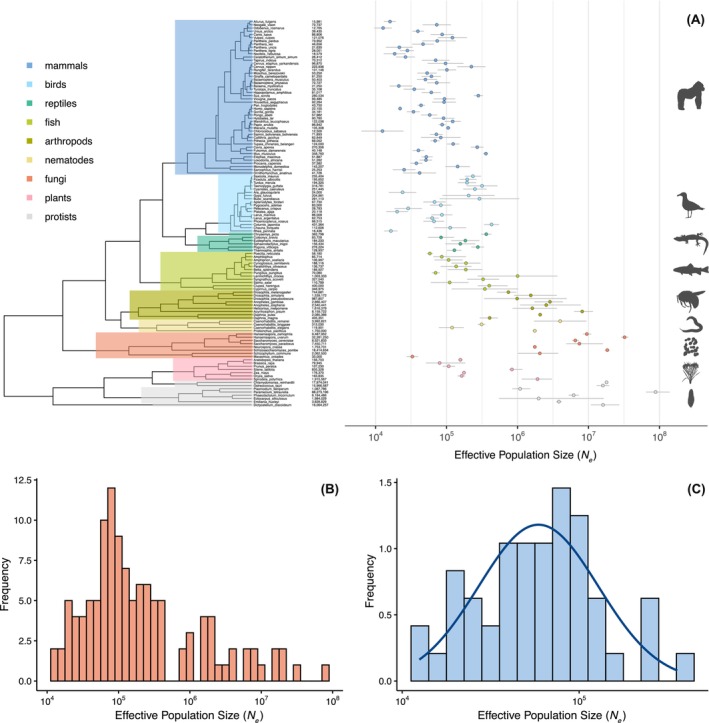 Figure 2
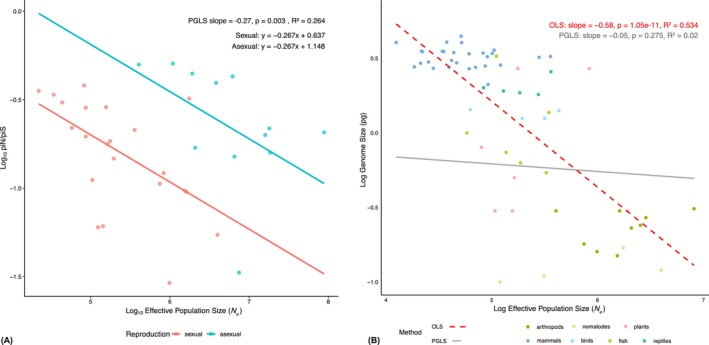 Figure 3
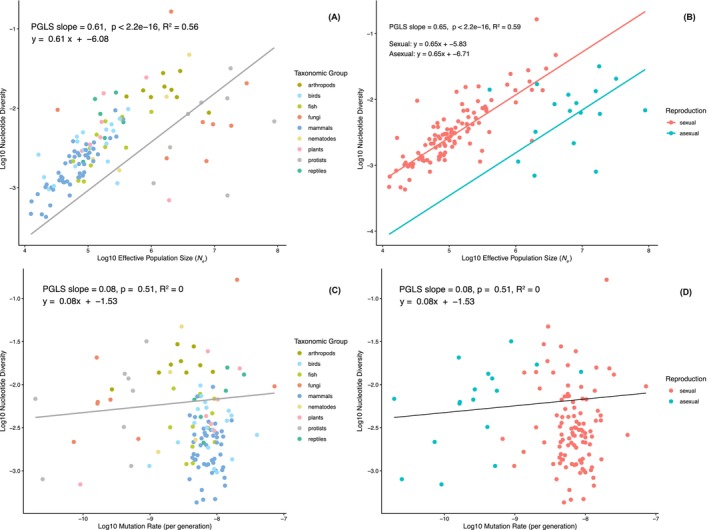 Figure 4
Peer Reviews
No public reviews on file for this paper yet. If you reviewed it on a platform where reviews are public (OpenReview, ICLR, NeurIPS, ICML), you can paste yours below so the community can read it here.
Videos
No videos yet. Explain this paper in a talk, walkthrough, or lecture? Add one.
Taxonomy
TopicsEvolution and Genetic Dynamics · Genomics and Phylogenetic Studies · Genetic diversity and population structure