Air Pollution and the Progression of Physical Function Limitations and Disability in Aging Adults
Jiaqi Gao, Carlos F. Mendes de Leon, Adam A. Szpiro, Jennifer Weuve, Kenneth M. Langa, Richard A. Hirth, Kelly M. Bakulski, Jinkook Lee, Boya Zhang, Jennifer D’Souza, Kayleigh P. Keller, Joel D. Kaufman, Jessica Faul, Sara D. Adar

TL;DR
Long-term exposure to certain air pollutants like PM2.5 and NO2 increases the risk of physical disability progression in older adults, while ozone may have a protective effect.
Contribution
This study is the first to examine how air pollution affects transitions between physical function states in aging adults using a multistate model.
Findings
Higher PM2.5 and NO2 concentrations are linked to increased disability progression.
Ozone exposure is associated with reduced disability risk and progression.
PM2.5 exposure reduces the likelihood of recovery from physical function limitations.
Abstract
Is long-term exposure to air pollution associated with the dynamic physical disability process? In this cohort study of 29 790 adults older than 50 years who were followed up for nearly 20 years, higher concentrations of particulate matter with a diameter of 2.5 µm or less (PM2.5), PM with a diameter between 2.5 and 10 µm (PM10-2.5), and nitrogen dioxide (NO2) were associated with a higher risk of transitioning to more severe states of physical disability, and a higher concentration of PM2.5 was associated with a lower likelihood of reverting from physical function limitation to healthy physical function. Unexpectedly, higher concentrations of ozone (O3) were associated with a lower risk of disability development and progression. These findings suggest that reducing air pollution levels may help to delay and mitigate physical disability in aging adults. This cohort study evaluates…
Genes, proteins, chemicals, diseases, species, mutations and cell lines named across the full text — each resolved to its canonical identifier and authoritative record.
Click any figure to enlarge with its caption.
 Figure 1
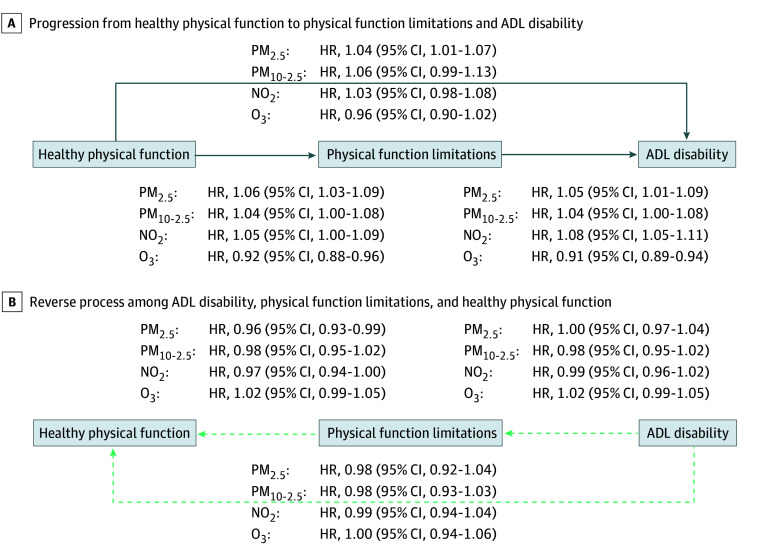 Figure 2
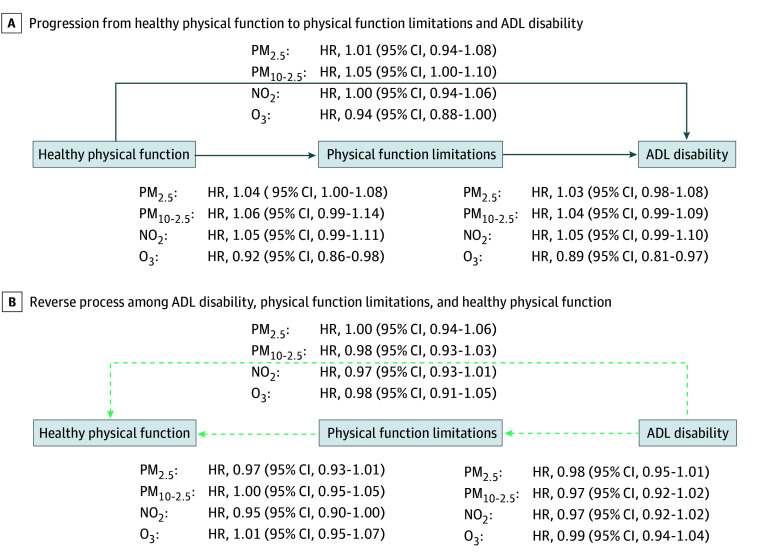 Figure 3
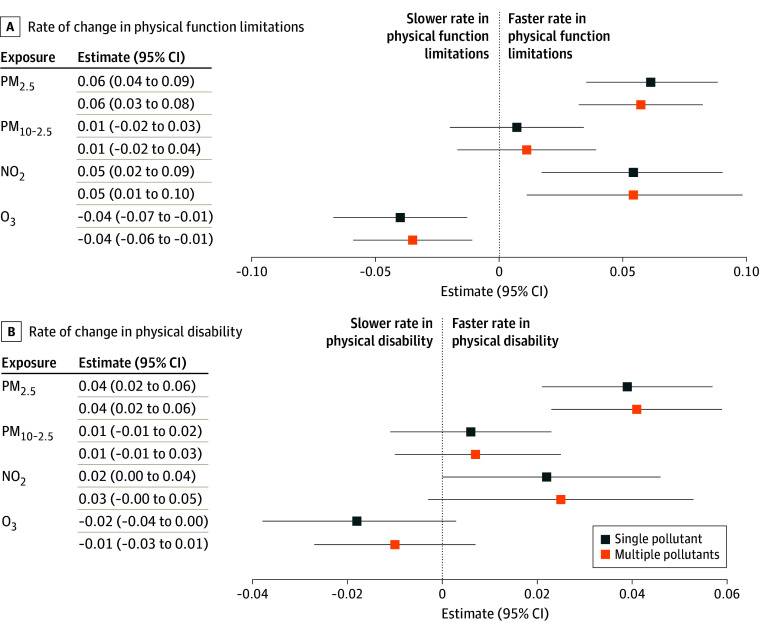 Figure 4
Peer Reviews
No public reviews on file for this paper yet. If you reviewed it on a platform where reviews are public (OpenReview, ICLR, NeurIPS, ICML), you can paste yours below so the community can read it here.
Videos
No videos yet. Explain this paper in a talk, walkthrough, or lecture? Add one.
Taxonomy
TopicsAir Quality and Health Impacts · Indoor Air Quality and Microbial Exposure · Air Quality Monitoring and Forecasting