Mitochondrial presequences are more than just address labels
Erik Marcel Heller, Svenja Lenhard, Doron Rapaport, Johannes Herrmann

TL;DR
Mitochondrial presequences do more than direct proteins to mitochondria; they also control protein lifespan and folding, and can target proteins to other cell locations.
Contribution
The paper reveals that mitochondrial presequences have multifaceted roles beyond targeting, including degradation signaling and chaperone interaction.
Findings
Presequences can act as degradation signals recognized by the ubiquitin-proteasome system.
Presequences can interact with cytosolic chaperones to delay precursor protein folding.
Some presequences also contain targeting information for non-mitochondrial cellular locations.
Abstract
Most mitochondrial proteins are synthesized in the cytosol as precursor proteins with N‐terminal presequences. These presequences serve as targeting signals that facilitate the binding to mitochondrial surface receptors and translocation across the mitochondrial membranes. However, recent studies showed that presequences can be more than address tags. They can contain degradation signals recognized by components of the ubiquitin‐proteasome system, and therefore, serve as timers that determine the lifespan of newly synthesized precursor proteins. Moreover, presequences can interact with components of the cytosolic chaperone system to prevent or delay precursor folding. Finally, presequences of some dually localized proteins contain targeting information not only for mitochondria but also for other cellular destinations such as the nuclear lumen or chloroplasts in plant cells. Thus,…
Genes, proteins, chemicals, diseases, species, mutations and cell lines named across the full text — each resolved to its canonical identifier and authoritative record.
Click any figure to enlarge with its caption.
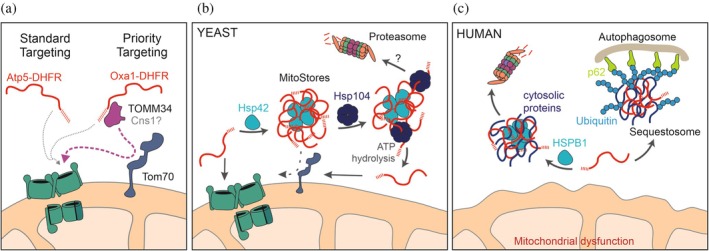 Figure 1
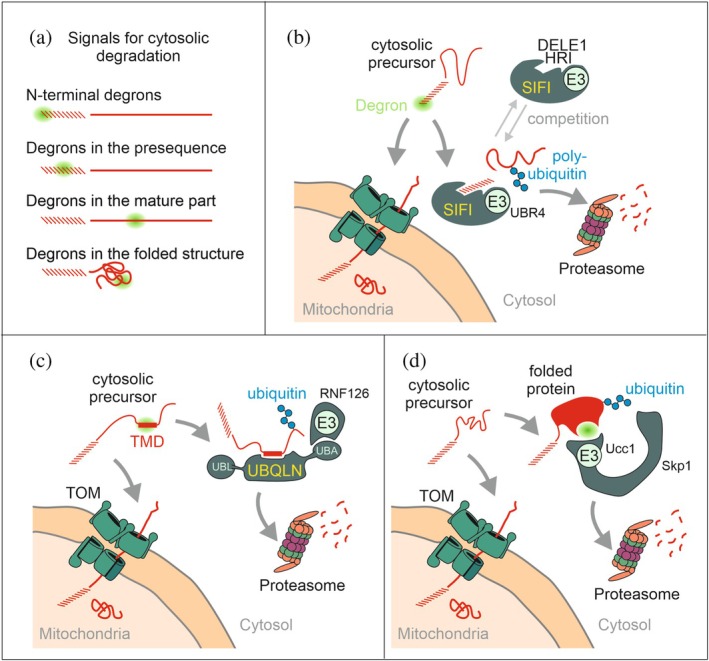 Figure 2
 Figure 3
 Figure 4
Peer Reviews
No public reviews on file for this paper yet. If you reviewed it on a platform where reviews are public (OpenReview, ICLR, NeurIPS, ICML), you can paste yours below so the community can read it here.
Videos
No videos yet. Explain this paper in a talk, walkthrough, or lecture? Add one.
Taxonomy
TopicsMitochondrial Function and Pathology · Photosynthetic Processes and Mechanisms · Ubiquitin and proteasome pathways