The Effect of 4‐7‐8 Breathing Exercise Technique on Tinnitus Handicap, Psychological Factors, and Sleep Quality in Tinnitus Patients: A Randomized Controlled Study
Gulce Kirazli, Suheda Baran, Gokce Saygi Uysal, Aykut Ozdogan, Serpil Mungan Durankaya, Mehmet Fatih Ogut

TL;DR
A 6-week 4-7-8 breathing exercise improved tinnitus symptoms, sleep, and stress in patients compared to a control group.
Contribution
The study demonstrates the 4-7-8 breathing technique as a novel, non-invasive supportive therapy for tinnitus management.
Findings
The experimental group showed significant decreases in tinnitus handicap, anxiety, and stress scores.
Sleep quality improved significantly in the experimental group after the 6-week program.
Control group scores did not show significant changes compared to baseline.
Abstract
The aim of our study was to evaluate the effect of the 4‐7‐8 breathing exercise on tinnitus handicap, psychological factors, and sleep quality. The present study employed a parallel‐group randomized controlled trial design. A total of 23 patients with subjective tinnitus in the experimental group and 25 patients with subjective tinnitus in the control group took part in the study. Both groups received 1 hour of informative session on tinnitus, and the experimental group also performed 4‐7‐8 breathing exercises for 6 weeks. Visual analog scale (VAS), tinnitus handicap inventory (THI), insomnia severity index (ISI), trait anxiety inventory (TAI), and perceived stress scale‐10 (PSS‐10) were applied before and on the day the 6‐week program is done or 6 weeks after the informative session is completed. When the experimental group and the control group were compared after the intervention,…
Genes, proteins, chemicals, diseases, species, mutations and cell lines named across the full text — each resolved to its canonical identifier and authoritative record.
Click any figure to enlarge with its caption.
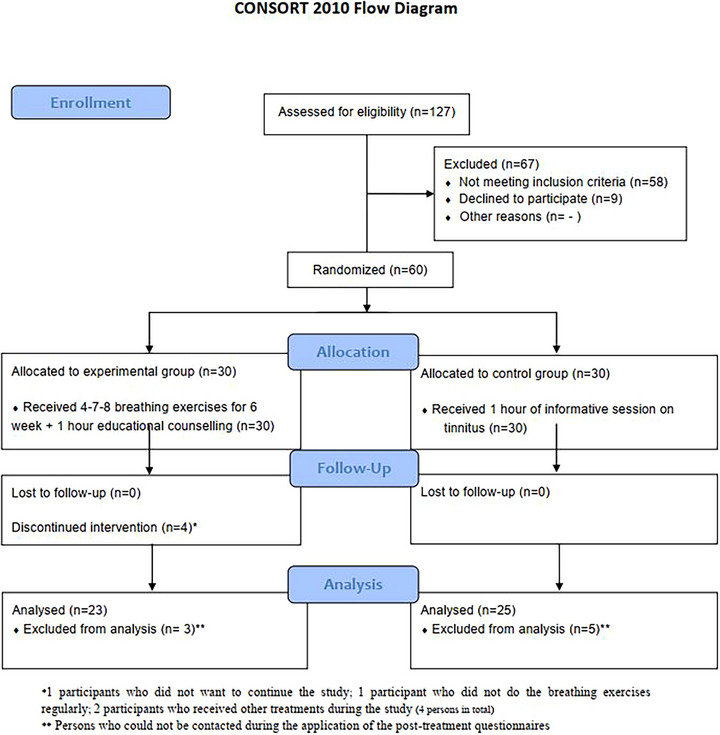 Figure 1
 Figure 2
 Figure 3
Peer Reviews
No public reviews on file for this paper yet. If you reviewed it on a platform where reviews are public (OpenReview, ICLR, NeurIPS, ICML), you can paste yours below so the community can read it here.
Videos
No videos yet. Explain this paper in a talk, walkthrough, or lecture? Add one.
Taxonomy
TopicsHearing, Cochlea, Tinnitus, Genetics · Vestibular and auditory disorders · Hearing Loss and Rehabilitation