Origin of the Magnetization Anisotropy of Superparamagnetic Beads
Sebastian Belau, Fabian Welzel, Dominik J. Kauert, Aidin Lak, Ralf Seidel

TL;DR
The paper explains why superparamagnetic beads used in magnetic tweezers experiments have a weak magnetic anisotropy, which affects the accuracy of measurements.
Contribution
The study reveals that bead anisotropy arises from the finite sum of randomly oriented nanoparticle anisotropies.
Findings
Bead anisotropy is an inherent property due to randomly oriented magnetic domains.
Brownian fluctuations of beads occur up to ~100 Hz and affect biomolecule dynamics.
Simulations show that a single anisotropy axis forms from ensembles of nanoparticles.
Abstract
Superparamagnetic beads are used in single‐molecule magnetic tweezers experiments to investigate the mechanics and dynamics of biomolecules. The beads exhibit a weak anisotropy, such that they align with the applied magnetic field. This allows to rotate the beads and thus to twist of attached biomolecules. To quantitatively understand the origin of the magnetization anisotropy, we use high‐speed magnetic tweezers experiments, numerical simulations, as well as fluxgate magnetorelaxometry measurements. We find that Brownian orientation fluctuations of the beads occur up to cut‐off frequencies of ∼100 Hz being only weakly dependent on the applied field, which superimpose the dynamics of attached biomolecules. When simulating the equilibrium magnetization of single beads as ensembles of ∼105 anisotropic and randomly oriented superparamagnetic nanoparticles, a single anisotropy axis is…
Genes, proteins, chemicals, diseases, species, mutations and cell lines named across the full text — each resolved to its canonical identifier and authoritative record.
Click any figure to enlarge with its caption.
 Figure 1
 Figure 2
 Figure 3
 Figure 4
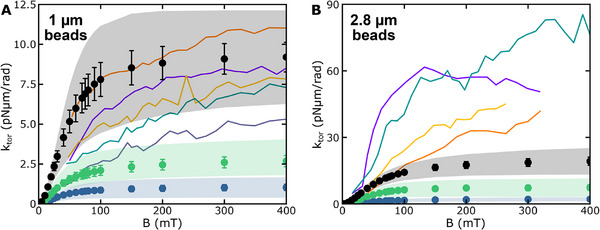 Figure 5
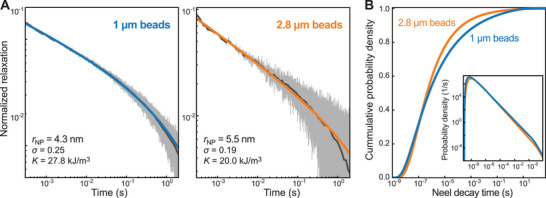 Figure 6
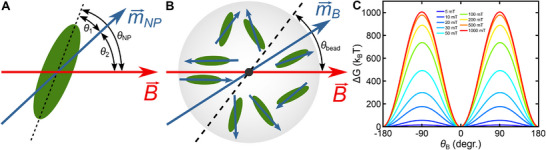 Figure 7
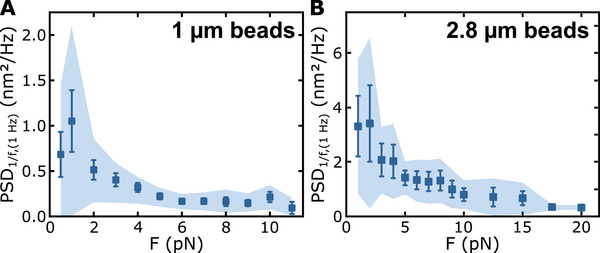 Figure 8
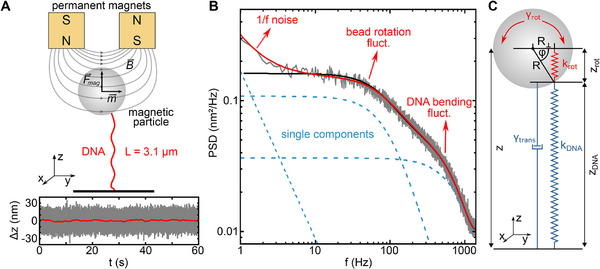 Figure 9
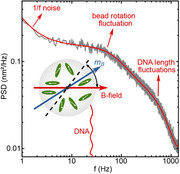 Figure 10
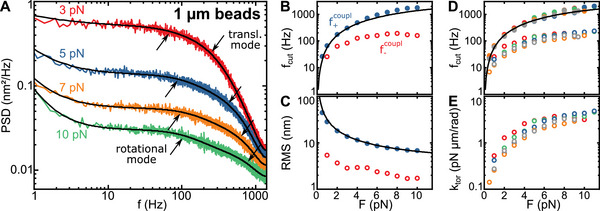 Figure 11
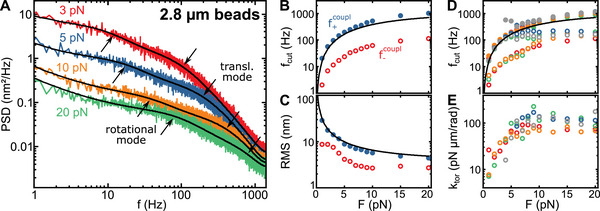 Figure 12
Peer Reviews
No public reviews on file for this paper yet. If you reviewed it on a platform where reviews are public (OpenReview, ICLR, NeurIPS, ICML), you can paste yours below so the community can read it here.
Videos
No videos yet. Explain this paper in a talk, walkthrough, or lecture? Add one.
Taxonomy
TopicsCharacterization and Applications of Magnetic Nanoparticles · Micro and Nano Robotics · Magnetic and Electromagnetic Effects