Heart‐On‐a‐Chip with Integrated Ultrasoft Mechanosensors for Continuous Measurement of Cell‐ and Tissue‐Scale Contractile Stresses
Ali Mousavi, Christina‐Marie Boghdady, Shihao Cui, Sabra Rostami, Amid Shakeri, Naimeh Rafatian, Mark Aurousseau, Gregor Andelfinger, Milica Radisic, Christopher Moraes, Houman Savoji

TL;DR
A heart-on-a-chip device with soft sensors measures real-time mechanical stresses at both cell and tissue levels for drug testing and biomechanical studies.
Contribution
A novel non-destructive optical method using ultrasoft mechanosensors enables multi-scale stress mapping in engineered cardiac tissues.
Findings
eMSGs deform in response to cellular and ECM stresses, allowing real-time lateral and longitudinal stress measurements.
Reduced fibrin concentration in the hydrogel improved contractile frequency, regularity, and force generation.
Pharmacological agents like norepinephrine and blebbistatin showed expected effects on contractile force and inhibition.
Abstract
Heart‐on‐a‐chip platforms aim to recapitulate cardiac tissue structure and function in vitro. Traditionally, microfabricated pillars are used to estimate contractile forces based on pillar deflection. However, this approach measures only global forces at the pillar interface and lacks the spatial resolution needed to capture local mechanical stresses. In this study, we present a non‐destructive optical method for continuous, multi‐scale stress mapping using ultrasoft edge‐labeled micro‐spherical stress gauges (eMSGs). These embedded mechanosensors visibly deform in response to cellular and extracellular matrix (ECM)‐generated stresses, enabling real‐time measurements at cell and tissue scales. Our platform features dual cell‐seeding chambers with flexible polydimethylsiloxane pillars, into which neonatal rat cardiomyocytes are seeded within a fibrin/Geltrex hydrogel containing eMSGs.…
Genes, proteins, chemicals, diseases, species, mutations and cell lines named across the full text — each resolved to its canonical identifier and authoritative record.
Click any figure to enlarge with its caption.
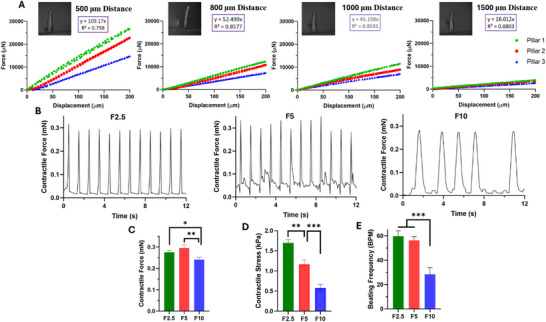 Figure 1
 Figure 2
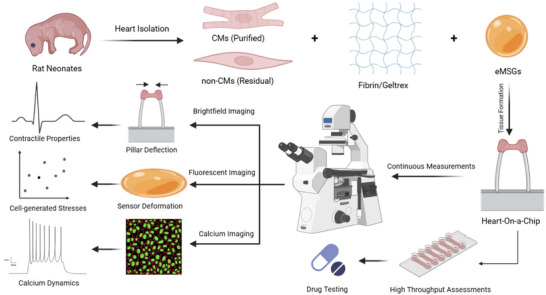 Figure 3
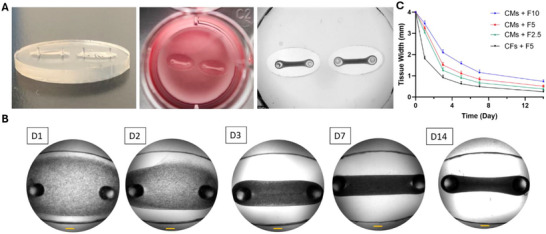 Figure 4
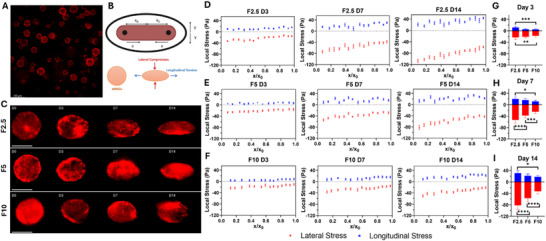 Figure 5
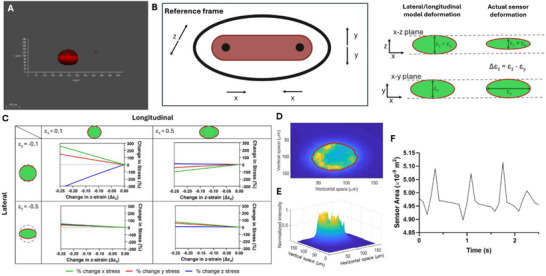 Figure 6
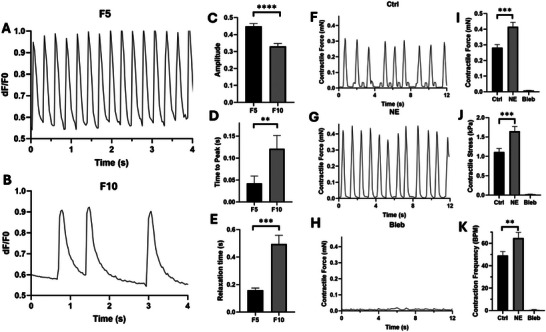 Figure 7
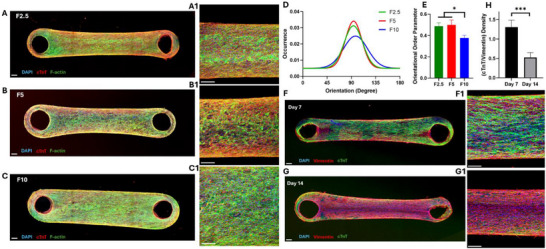 Figure 8
Peer Reviews
No public reviews on file for this paper yet. If you reviewed it on a platform where reviews are public (OpenReview, ICLR, NeurIPS, ICML), you can paste yours below so the community can read it here.
Videos
No videos yet. Explain this paper in a talk, walkthrough, or lecture? Add one.
Taxonomy
Topics3D Printing in Biomedical Research · Cellular Mechanics and Interactions · Advanced Materials and Mechanics