Volumetric Single‐Molecule Tracking Inside Subcellular Structures
Sam Daly, Joseph E. Chambers, Caroline Jones, Bin Fu, James D. Manton, Joseph S. Beckwith, Stefan J. Marciniak, David C. Gershlick, Steven F. Lee

TL;DR
This paper introduces a new microscopy method to track molecules in 3D within cells, revealing how disease-related proteins affect molecular movement in organelles.
Contribution
A correlative microscopy approach combining SMLFM and FLFM for 3D single-molecule tracking in living mammalian cells.
Findings
Instantaneous volumetric segmentation improves sensitivity in measuring molecular organization and diffusion.
Heterogeneous molecular motion was observed in endoplasmic reticulum inclusions linked to α1-antitrypsin deficiency.
Abstract
The non‐covalent interactions that underpin major cellular functions depend on molecular motion within 3D environments. Large depth‐of‐field single‐molecule localization microscopy (3D‐SMLM) methods facilitate these measurements, but their increased optical complexity and bespoke post‐processing pipelines often sacrifice important cellular context. Here, we combine single‐molecule light‐field microscopy (SMLFM) with widefield Fourier light‐field microscopy for correlative volumetric organelle imaging. The instantaneous acquisition of subcellular volumes improves the sensitivity of molecular organization, chemical environment, and diffusion measurements through the use of volumetric sub‐cellular segmentation. We first demonstrate our approach by measuring the molecular organization of a nuclear‐localized HaloTag protein relative to cell nuclei. Next, we characterize the molecular…
Genes, proteins, chemicals, diseases, species, mutations and cell lines named across the full text — each resolved to its canonical identifier and authoritative record.
Click any figure to enlarge with its caption.
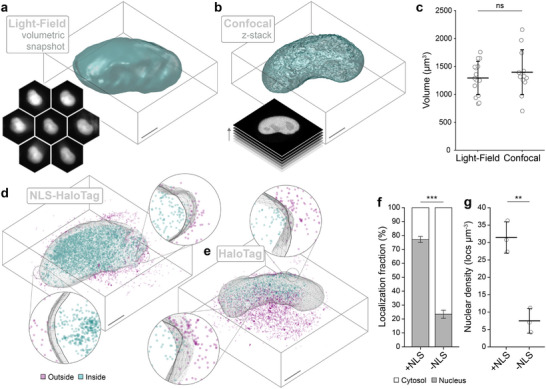 Figure 1
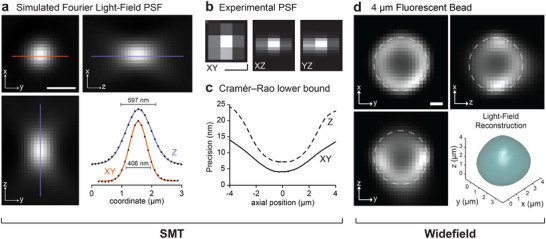 Figure 2
 Figure 3
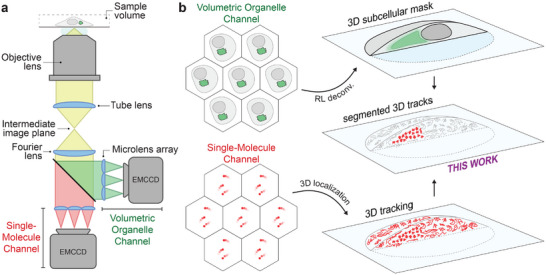 Figure 4
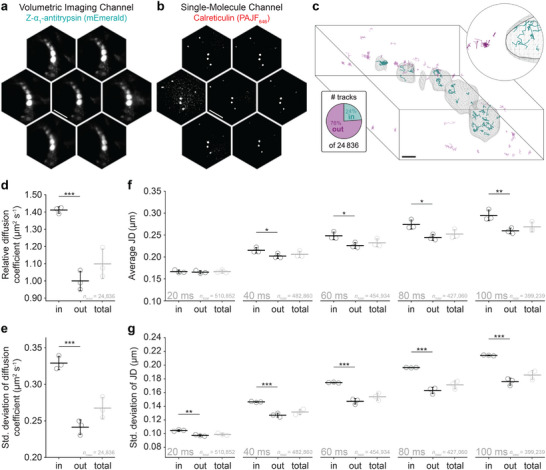 Figure 5
Peer Reviews
No public reviews on file for this paper yet. If you reviewed it on a platform where reviews are public (OpenReview, ICLR, NeurIPS, ICML), you can paste yours below so the community can read it here.
Videos
No videos yet. Explain this paper in a talk, walkthrough, or lecture? Add one.
Taxonomy
TopicsAdvanced Fluorescence Microscopy Techniques · Force Microscopy Techniques and Applications · Near-Field Optical Microscopy