Ultra‐Fast Isothermal Formation of DNA Nanostructures in Culture Media: Application to In Situ Assembly of DNA Origami With Living Cells
Laura Bourdon, Gerrit David Wilkens, Samy Dehissi, Salammbô Hotte, Sergii Rudiuk, Mathieu Morel, Ayako Yamada, Gaëtan Bellot, Damien Baigl

TL;DR
Scientists developed a fast method to create DNA nanostructures directly in cell culture media at body temperature, enabling direct interactions with living cells.
Contribution
First demonstration of isothermal DNA origami self-assembly in cell culture media at 37°C, compatible with living cells.
Findings
2D and 3D DNA origami structures self-assemble in 5 to 15 minutes at 37°C in cell culture media.
DNA nanotubes and other extended structures can self-assemble in the presence of living human cells.
Stability of assembled structures is maintained for up to 3 days with actin monomers.
Abstract
Synthetic DNA strands are programmable and biocompatible building blocks that can be combined through hybridization to form user‐defined nanostructures, but their assembly traditionally requires cell‐incompatible conditions, imposing a lengthy ex situ fabrication step before any application with living matter. Here we demonstrate for the first time that 2D and 3D DNA origami structures can isothermally self‐assemble at 37°C within minutes, directly in cell culture media, both in the absence and in the presence of living cells. Scaffold‐free structures of extended dimensions, such as micrometer‐long DNA nanotubes, can also self‐assemble when the system is given more time to evolve. With human cell lines, 2D and 3D origami structures in situ self‐assemble in 5 to 15 min, and remain stable for about 24 h and up to 3 days when actin monomers are added. Similar self‐assembly performance is…
Genes, proteins, chemicals, diseases, species, mutations and cell lines named across the full text — each resolved to its canonical identifier and authoritative record.
Click any figure to enlarge with its caption.
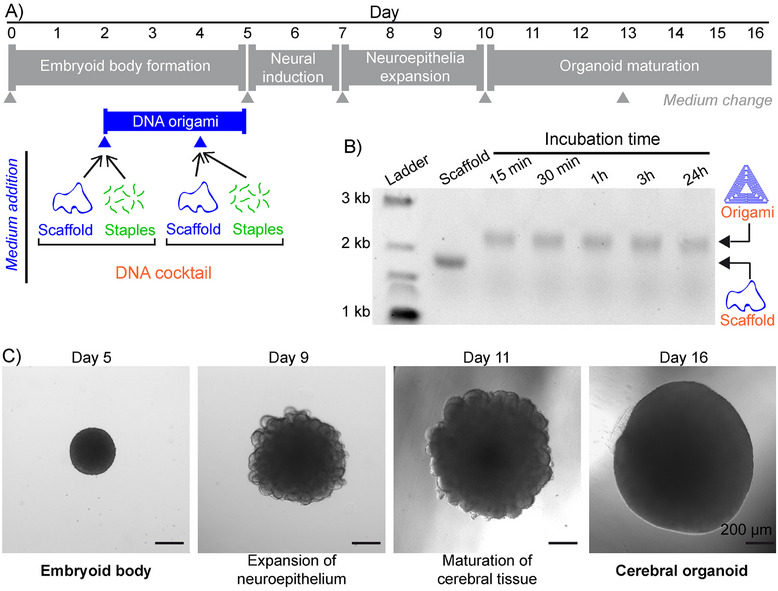 Figure 1
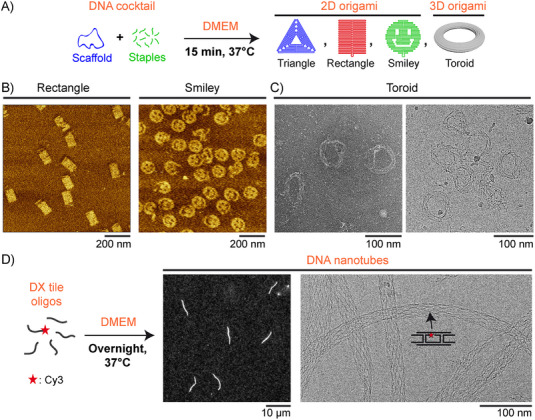 Figure 2
 Figure 3
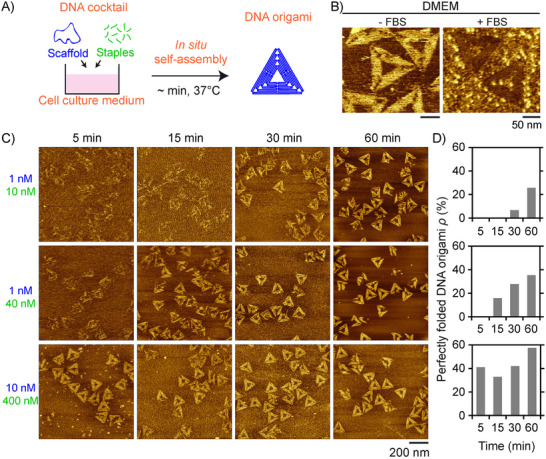 Figure 4
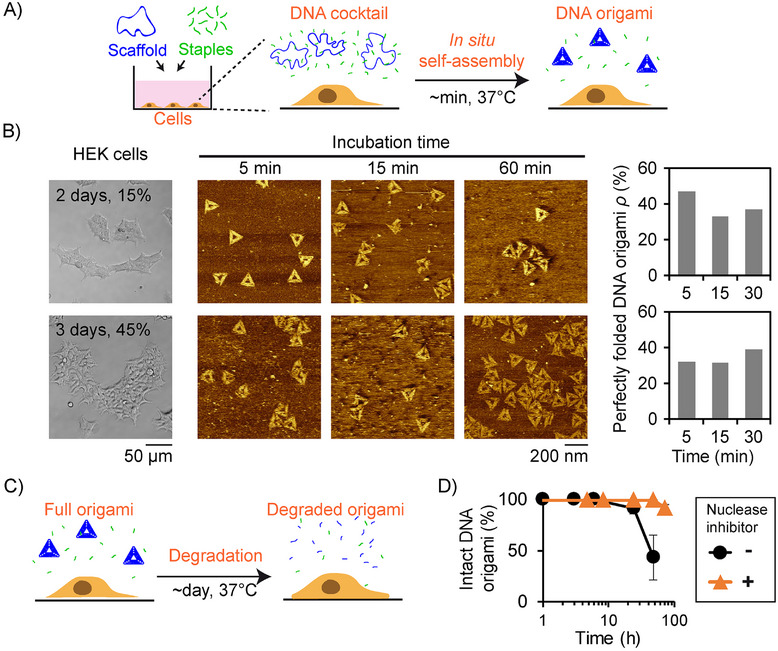 Figure 5
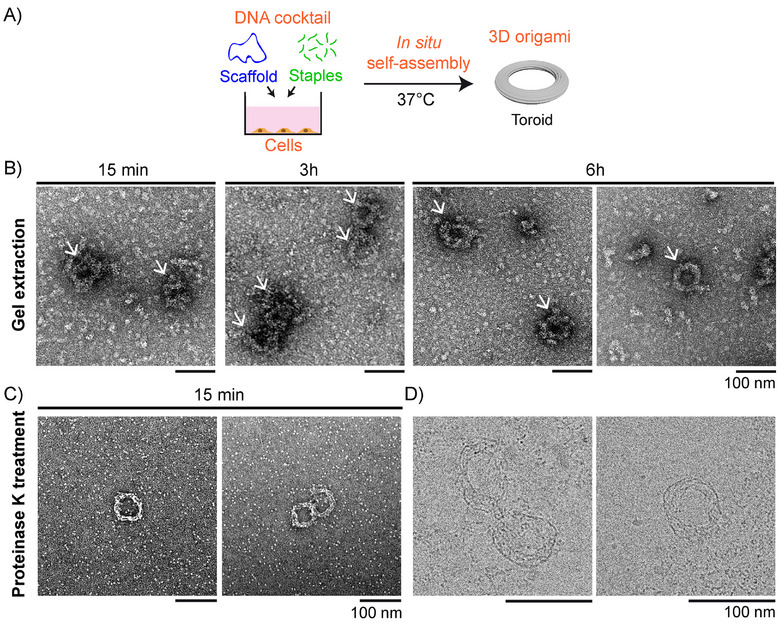 Figure 6
Peer Reviews
No public reviews on file for this paper yet. If you reviewed it on a platform where reviews are public (OpenReview, ICLR, NeurIPS, ICML), you can paste yours below so the community can read it here.
Videos
No videos yet. Explain this paper in a talk, walkthrough, or lecture? Add one.
Taxonomy
TopicsAdvanced biosensing and bioanalysis techniques · Advanced Materials and Mechanics · Supramolecular Self-Assembly in Materials