Combining EEG and eye-tracking for cognitive and physiological states monitoring: a systematic review
Maria Rivas-Vidal, Alberto Calvo Cordoba, Cecilia E. García Cena, Fernando Daniel Farfán

TL;DR
This paper reviews how combining EEG and eye-tracking can better detect mental states like fatigue and stress, improving safety in high-stakes environments.
Contribution
The study systematically reviews concurrent EEG and eye-tracking research to identify shared and distinct physiological patterns in perception-related states.
Findings
EEG theta, alpha, and beta activity and ET metrics like PERCLOS are commonly used to monitor cognitive states.
Multimodal EEG and ET data improve classification accuracy of fatigue, stress, and drowsiness compared to single modality.
Fatigue and drowsiness share physiological patterns but can be distinguished using combined EEG and ET features.
Abstract
Monitoring situational awareness is critical in highly demanding environments where sustained attention and vigilance are essential for safety and performance. Electroencephalography (EEG) and eye-tracking (ET) provide complementary insights into the perceptual layer of situational awareness, capturing neural and ocular signatures of information processing, attention, and fatigue. However, studies have typically examined perception-related conditions such as workload, fatigue, stress, and drowsiness in isolation, limiting understanding of their shared and distinct physiological patterns. This systematic review synthesizes findings from studies that recorded EEG and ET concurrently to investigate perception-related conditions. Following the PRISMA 2020 statement, five databases were searched, and 47 studies met the inclusion criteria. The most frequently reported EEG features included…
Genes, proteins, chemicals, diseases, species, mutations and cell lines named across the full text — each resolved to its canonical identifier and authoritative record.
Click any figure to enlarge with its caption.
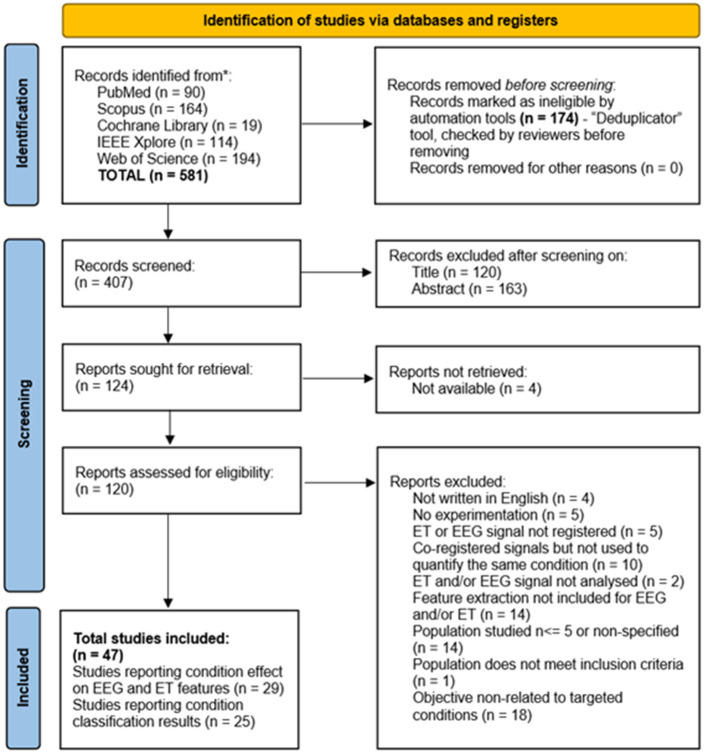 Figure 1
 Figure 2
Peer Reviews
No public reviews on file for this paper yet. If you reviewed it on a platform where reviews are public (OpenReview, ICLR, NeurIPS, ICML), you can paste yours below so the community can read it here.
Videos
No videos yet. Explain this paper in a talk, walkthrough, or lecture? Add one.
Taxonomy
TopicsHuman-Automation Interaction and Safety · Sleep and Work-Related Fatigue · Gaze Tracking and Assistive Technology